



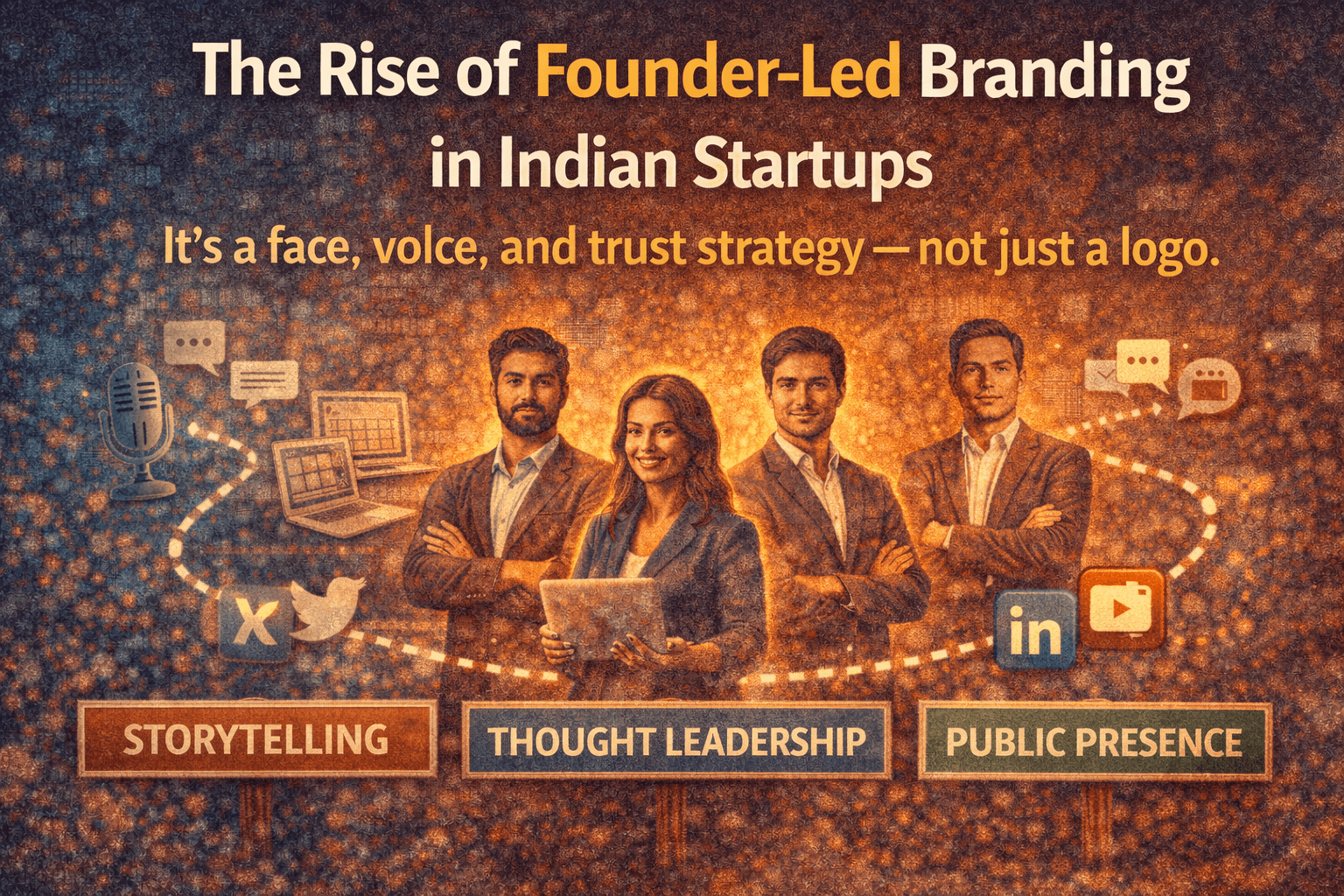
The Rise of Founder-Led Branding in Indian Startups

What is founder-led branding and why is it rising among Indian startups?
Founder-led branding is when a company’s public perception is shaped primarily through the founder’s own voice, thinking, and communication — not just logos and ad campaigns. In India, it’s grown from occasional interviews into a structured strategy: CRED’s Kunal Shah built a following of over a million on X and LinkedIn sharing behavioral-economics insights, and both Shah and Zerodha’s Nikhil Kamath now run podcasts with over a million subscribers each, turning long-form conversation into a core brand channel rather than a side project.
What Founder-Led Branding Actually Is (and Isn’t)
It’s not daily selfies, forced “thought leadership,” or turning a personal profile into a diary. It’s when a founder’s perspective and values shape how the market perceives the company before the product itself becomes widely known — people buying into who’s building something, not just what’s being built.
Why This Is Accelerating in India Right Now
Three forces are driving it. First, Indian startup categories have gotten crowded — most products in a given space now do roughly similar things, so believability, not features, becomes the differentiator. Second, marketing budgets are tighter across the board, and founder-led content costs attention and consistency rather than ad spend. Third, distribution platforms structurally favor individual voices: LinkedIn, X, and YouTube algorithms tend to push personal accounts further than brand accounts, which changes the return on a founder’s time versus a marketing team’s ad budget.
The Podcast Wave: India’s Clearest Founder-Branding Signal
The clearest, most measurable version of this trend in India right now is founder-hosted podcasts. Nikhil Kamath’s WTF is with Nikhil Kamath has built a subscriber base north of a million across YouTube, Spotify, and Apple Podcasts, featuring long-form conversations spanning business, tech, and philosophy — content that builds Kamath’s (and by extension Zerodha’s) brand as intellectually credible rather than promotional. Kunal Shah’s CRED Curious follows a similar model, pairing Shah’s known style of unconventional, behavioral-economics-driven thinking with guest conversations that go well beyond product talk. Zomato’s Deepinder Goyal and OYO’s Ritesh Agarwal have entered the same space.
Worth being honest about the trend’s other side, too: as more founders launch podcasts, the format has started to feel saturated — not every founder podcast finds an audience, and a founder’s name alone doesn’t guarantee listeners show up. The format rewards founders who already have a distinct point of view, not founders adopting it as a generic growth tactic.
Trust Compounds Where Virality Doesn’t
The founders who do this well tend to write and speak about specific, sometimes uncomfortable things: decisions they regret, what a failed hire taught them, why a strategy changed mid-course. That kind of specificity reads as accountable in a way polished announcements don’t — and in markets where skepticism is high and switching costs are low, that accountability functions as a real growth lever, not just a personality trait.
Kunal Shah’s public reputation illustrates this well beyond CRED itself: he’s become known as India’s most active startup founder-investor, having backed over 260 startups including Razorpay and Spinny, according to Tracxn data — a track record that reinforces the credibility of his public commentary on startups and consumer behavior, since his opinions are backed by a visible, checkable investment record rather than just stated confidence.
Investors and Talent Both Notice
Founders who communicate clearly and consistently in public tend to be read by investors as clearer thinkers generally — not because of follower counts, but because the discipline of explaining a problem simply, in public, over time, is itself a signal. The same applies to hiring: when a founder is public about how they think about culture, mistakes, and team-building, it acts as a natural filter — people who resonate with that thinking self-select toward the company, and people who don’t self-select away, which saves real time in later-stage hiring decisions.
Where Founder-Led Branding Backfires
Not all of it works. Founders who overshare, chase trending topics, or mistake hot takes for insight tend to erode the same trust the format is supposed to build. The founders whose branding holds up long-term tend to publish less often but more deliberately — consistent, specific, and grounded in real experience rather than performed for engagement. Silence is a better choice than forced, generic content.
Frequently Asked Questions
1. Which Indian founders are most associated with founder-led branding?
Kunal Shah (CRED), Nikhil Kamath (Zerodha), Deepinder Goyal (Zomato), and Ritesh Agarwal (OYO) are among India’s most recognized founder brands. They regularly share business insights, interviews, and personal perspectives that strengthen both their personal credibility and their companies’ brands.
2. Does founder-led branding require a large existing following?
No. Founder-led branding succeeds through consistency, authenticity, and a clear point of view—not follower count. Publishing valuable insights regularly helps founders build trust with customers, investors, employees, and industry peers over time.
3. Is founder-led podcasting still an effective strategy in 2025–2026?
Yes, if the content offers genuine expertise and unique insights. Although founder podcasts have become more common, audiences continue to engage with creators who share original experiences, practical knowledge, and thoughtful perspectives rather than generic business advice.
4. What’s the biggest risk of founder-led branding done poorly?
The biggest risk is losing credibility through overexposure without substance. Posting frequently without meaningful insights or authentic experiences can weaken trust. Successful founder branding prioritizes quality, consistency, and expertise over content volume.
What to Watch Next
- Whether founder podcasting in India consolidates around a smaller number of genuinely distinctive voices, as the current wave of entrants tests audience appetite
- Whether founder-led branding measurably affects fundraising outcomes for earlier-stage founders adopting the strategy, beyond the already-prominent names practicing it
- How founder-led branding interacts with governance scrutiny — as seen with other high-profile 2025 leadership stories in the Indian startup ecosystem, a founder’s public voice cuts both ways when problems surface
The bottom line: founder-led branding in India isn’t a hack or a trend that will fade — it’s a structural response to crowded markets and tighter budgets, and the founders getting real value from it are the ones treating it as a discipline of consistent, specific communication rather than a personal-branding side project.
Examples cited above draw from Storyboard18’s reporting on Indian founder podcasting, Business Standard’s reporting on Kunal Shah’s investment record via Tracxn data, and public subscriber figures for WTF is with Nikhil Kamath and CRED Curious.
Summary
Article Name
The Rise of Founder-Led Branding in Indian Startups
DescriptionIndian startups are leaning into founder-led branding to build trust, stand out, and scale faster. Here’s why it’s working right now.
Author
Upstartzen Editorial Team
Publisher Name
Upstartzen


