




Why Founders Are Talking Less About Valuations and More About Survival
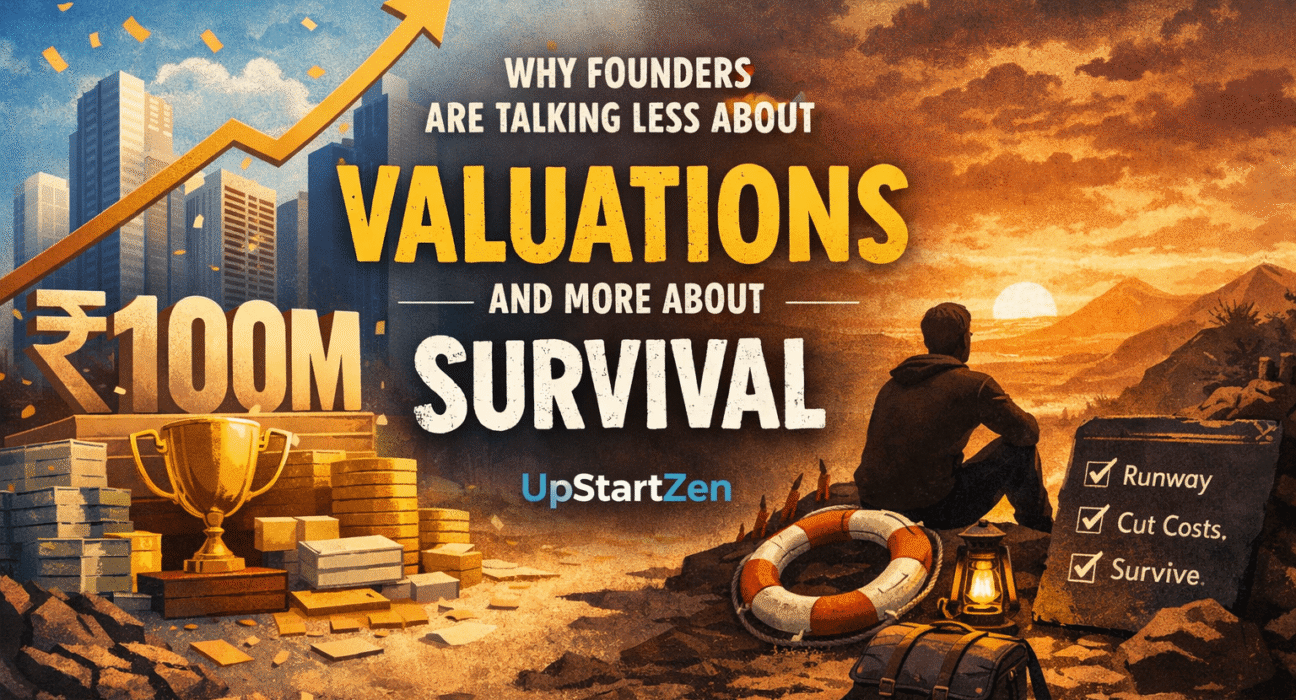
Why have Indian startup founders stopped talking about valuations and started talking about survival?
Partly it’s the funding data — Indian startups raised about $11 billion in 2025, down roughly 8% from 2024, with investor participation dropping sharply. But the shift isn’t only financial. Founder mental health surveys from 2025 show the human cost behind the numbers: one widely cited Startup Snapshot survey of founders found 72% reported mental health impacts including anxiety, burnout, or depression, and 45% rated their current mental health as “bad” or “very bad.” Survival talk has replaced valuation talk partly because founders are running leaner companies by necessity, and partly because many are running on less personal reserve than the pitch-deck version of startup life ever accounted for.
The Funding Reality Behind the Mindset Shift
The flex era of Indian startups — big rounds, bigger headlines, growth funded by cheap capital — cooled as funding tightened. Indian startups saw investor participation fall roughly 53% between 2024 and 2025, from around 6,800 investors to about 3,170, according to Tracxn data reported by TechCrunch. Mega-deals of $100 million or more fell 25% year-on-year, a 92% drop from 2021’s peak. When capital gets that selective, the questions founders face from investors change — from “how big can this get” to “how long can this survive without us.”
That shift in investor questioning has filtered directly into how founders think and talk. The internal conversation has moved from runway-as-footnote to runway-as-the-central operating question.
What the Data Says About Founder Wellbeing
This is the part that gets talked about less in startup media, and it’s worth being precise about since exaggerating it would do a disservice to founders genuinely struggling. Global surveys of startup founders — not India-specific, but broadly representative of the pressures founders across markets report — paint a consistent picture. A Sifted survey of 138 founders found 54% had experienced burnout in the past year, 46% rated their mental health as “bad” or “very bad,” and 75% reported anxiety in the same period; two-thirds said they had considered leaving their startup. A separate Startup Snapshot survey found 72% of founders reported some form of mental health impact from running their business.
These numbers should be read as indicative of a real, documented pattern among startup founders broadly, not as India-specific statistics — reliable India-specific founder mental health data is limited, and it’s worth being cautious about the strength of any single figure claiming to measure it precisely. What is clear is that the pressure driving founders toward survival-focused thinking isn’t purely strategic; it’s also personal, and increasingly, founders are willing to say so.
What Replaced the Valuation Conversation
The questions founders report focusing on now are less suited to a pitch deck and more suited to a hard look at the business: how many months of runway actually remain, what breaks first if revenue dips next quarter, whether the current team size is actually necessary, and whether the business can survive 18 months without fresh capital. These aren’t new questions in an absolute sense — but they’ve moved from background planning to the center of founder attention, replacing “what’s our next valuation mark” as the default conversation.
The Quiet Version of Success
The founders getting attention for the right reasons in this environment aren’t the loudest ones. They’re the ones who cut costs early, declined to raise on bad terms, slowed growth deliberately to fix fundamentals, or reached profitability without much fanfare. None of that produces a viral funding announcement. It does produce optionality — the ability to make decisions on the company’s own timeline rather than an investor’s.
This Isn’t the End of Ambition
It’s worth being clear that this shift doesn’t mean founders have scaled down what they want to build. It means the path there has changed — fewer, better-executed bets; smaller teams with clearer roles; revenue clarity prioritized over vanity growth metrics. Slower, in this framing, isn’t the opposite of ambitious. It’s a different theory of how to get there without the company — or the founder — running out of capacity first.
Frequently Asked Questions
1. Is there reliable data on Indian startup founder mental health specifically?
India-specific founder mental health data remains limited. However, industry reports clearly show increased financial pressure on founders as startup funding became more selective. This environment has intensified conversations around stress, resilience, and founder well-being across the Indian startup ecosystem.
2. What percentage of startup founders report burnout globally?
Global surveys consistently indicate that founder burnout is widespread. Recent studies report that more than half of startup founders have experienced burnout, while other surveys suggest that a significant majority have faced mental health challenges related to building and scaling a business.
3. Does focusing on survival over valuation mean founders are less ambitious?
No. Many founders are prioritizing sustainable growth instead of rapid expansion. The objective remains building a large, successful company, but with stronger fundamentals, healthier cash flow, and less dependence on external funding.
4. What’s driving the shift from valuation talk to survival talk among Indian founders?
Tighter funding conditions and greater investor focus on profitability are the primary drivers. As venture capital has become more selective, founders are emphasizing capital efficiency, unit economics, and long-term sustainability while managing increased operational pressure and smaller teams.
What to Watch Next
- Whether India-specific founder mental health research develops to match the more established Sifted and Startup Snapshot survey work done in other startup ecosystems
- Whether founder support infrastructure — peer networks, mental health resources through accelerators and investor networks — expands as the pressure driving burnout becomes more openly discussed
- Whether the “quiet success” pattern (profitable, undramatic growth) continues attracting investor attention at the same rate as 2025, or whether appetite for higher-growth narratives returns as capital conditions ease
The bottom line: founders talking less about valuations and more about survival reflects two real, connected shifts — a funding market that now rewards durability over headline growth, and a founder population increasingly willing to acknowledge that the old pace wasn’t sustainable, financially or personally.
Financial figures cited above are drawn from Inc42’s Annual Indian Startup Trends Report 2025 and TechCrunch’s reporting on Tracxn data. Founder mental health figures are drawn from Sifted’s 2025 founder survey and Startup Snapshot’s 2025 survey — both are global surveys, not India-specific.
Summary

Article Name
Why Founders Are Talking Less About Valuations and More About Survival
DescriptionFounders are moving away from valuation hype and focusing on survival, runway, and sustainability. Here’s why the startup mindset is quietly changing.
Author
Upstartzen Editorial Team
Publisher Name
Upstartzen