


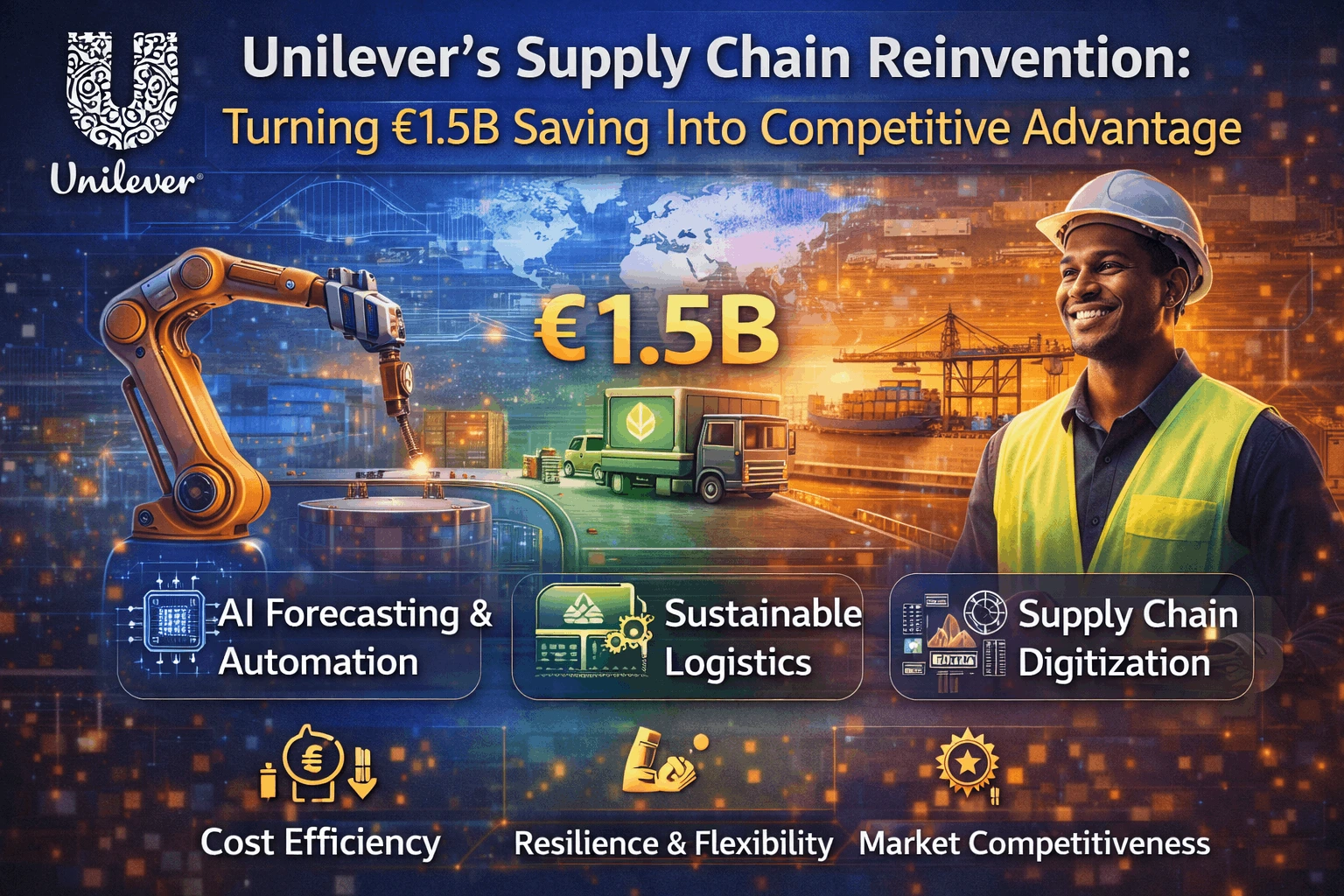
The Unilever Supply Chain Reinvention: Turning €1.5B in Savings Into Competitive Advantage

Synopsis
To be honest, most people don’t think about supply chains unless something breaks. A product goes missing from shelves. Delivery gets delayed. Prices suddenly spike. And suddenly, everyone starts talking about logistics like they’ve been supply chain experts forever. But behind the scenes, companies spend years — sometimes decades — rebuilding these invisible systems.
This report explores how Unilever, one of the world’s largest consumer goods companies, quietly reinvented its global supply chain and converted nearly €1.5 billion in cost savings into long-term competitive advantage. More importantly, this wasn’t just about cutting costs. It was about redesigning operations, adopting digital intelligence, improving sustainability, and strengthening global resilience in a post-pandemic economy.
And here’s the interesting part. While supply chain optimization might sound like a corporate buzzword, it’s actually becoming one of the biggest growth levers for global enterprises and startups alike. In fact, companies that modernize logistics are increasingly outperforming competitors in speed, pricing flexibility, and customer satisfaction.
This startup-focused corporate turnaround study analyzes Unilever’s operational overhaul, digital transformation strategy, leadership decision-making, and market impact. It also explores how startups, D2C brands, and scaling businesses can apply similar supply chain optimization strategies to build future-ready operations.
The Quiet Crisis That Forced Reinvention
Let’s rewind a bit. Before the transformation, Unilever had a massive — honestly, almost overwhelming — global supply network. Thousands of suppliers. Hundreds of factories. Multiple distribution hubs. Sounds impressive, right? Well… it also created complexity.
And complexity often means inefficiency.
Rising raw material costs, fluctuating consumer demand, global trade disruptions, and pandemic-driven logistics chaos exposed weaknesses across global manufacturing networks. Companies everywhere struggled. But Unilever faced a unique challenge: maintaining affordability across developing markets while preserving premium brand positioning globally.
You might be wondering… why not just cut costs and move on?
Because supply chains don’t work like that. Cutting corners can break customer trust faster than a bad product launch.
Instead, Unilever chose something harder. They rebuilt the system.
The €1.5 Billion Efficiency Breakthrough
The company’s transformation wasn’t a single project. It was a multi-year operational reset involving structural redesign, digital integration, and data-driven logistics forecasting.
Here’s where most organizations go wrong. They treat supply chain modernization as software implementation. Unilever treated it as a cultural transformation.
Key Strategic Moves Behind the Savings
1. Digital Supply Chain Intelligence
Unilever invested heavily in AI-powered demand forecasting and predictive logistics analytics. Instead of reacting to demand fluctuations, they started anticipating them.
Think of it like weather forecasting for product demand. Not perfect. But dramatically better than guesswork.
AI models helped optimize inventory levels, reduce overproduction, and minimize stockouts across retail and e-commerce channels.
And yes — this directly reduced warehousing costs while improving product availability.
2. Network Simplification
Large global companies often operate with overlapping supplier ecosystems. It happens gradually. One acquisition leads to another supplier contract, which leads to redundancy.
Unilever streamlined supplier networks and manufacturing hubs. They reduced unnecessary distribution layers and consolidated logistics infrastructure.
This helped reduce transportation expenses and improved fulfillment speed. And in today’s same-day delivery culture, speed equals revenue.
3. Agile Manufacturing
Traditional manufacturing follows rigid production cycles. But modern consumer demand? Totally unpredictable.
Unilever introduced flexible manufacturing capabilities that allow production shifts based on regional demand signals. Smaller batch manufacturing, faster reconfiguration, and modular factory designs improved operational agility.
In simpler words — they stopped producing products based on historical assumptions and started producing based on real-time consumer behavior.
4. Sustainability-Driven Cost Reduction
Here’s where things get interesting. Sustainability is often seen as a compliance requirement or branding initiative. But Unilever turned sustainability into a cost-saving engine.
Energy-efficient manufacturing, optimized packaging design, and reduced transportation emissions lowered operational expenses significantly. Sustainable sourcing partnerships also improved long-term supplier stability.
And honestly, sustainability today isn’t optional. It’s becoming a financial strategy.
The Digital Backbone: Automation + Data Visibility
Unilever integrated end-to-end supply chain visibility through cloud platforms, IoT sensors, and AI analytics dashboards. Real-time tracking across supplier inputs, factory production, and last-mile delivery created unprecedented operational transparency.
Before transformation, data was siloed across regions. After transformation, leadership could monitor global logistics performance instantly.
Imagine running a multinational supply chain like managing a single dashboard.
Sounds simple. But execution required deep technology integration, workforce retraining, and cross-functional alignment.
Leadership Decisions That Made the Turnaround Possible
Let’s be honest. Supply chain transformation isn’t just technology. It’s leadership risk-taking.
Unilever leadership made three critical strategic calls:
• Investing During Market Uncertainty
Many companies reduce operational investments during economic slowdowns. Unilever accelerated transformation during global disruption, gaining first-mover advantage.
• Breaking Organizational Silos
Supply chain, marketing, finance, and sustainability teams were integrated into shared performance metrics. This prevented internal misalignment.
• Shifting From Cost Control to Value Creation
Instead of measuring success purely through expense reduction, Unilever focused on customer experience improvements, demand responsiveness, and brand resilience.
That shift… changed everything.
Competitive Advantage Beyond Cost Savings
So yes, €1.5 billion in savings is impressive. But the bigger win was competitive positioning.
Faster Market Entry
Optimized supply chains enabled quicker product launches across regional markets.
Stronger Retail Partnerships
Improved logistics reliability strengthened retailer confidence and shelf positioning.
Enhanced Pricing Flexibility
Lower operational costs allowed better margin management during inflationary periods.
Brand Trust Reinforcement
Reliable product availability improved customer satisfaction and loyalty.
And trust, as we know, is becoming the ultimate currency in modern consumer markets.
Industry-Wide Impact: Why Supply Chain Reinvention Is Becoming a Growth Weapon
Post-pandemic global commerce has fundamentally shifted. Supply chain resilience is now considered as important as product innovation.
Startups, especially D2C brands and manufacturing-tech ventures, are learning that operational scalability determines valuation potential.
Investors are increasingly evaluating supply chain maturity before funding growth-stage companies.
And honestly… it makes sense. Growth without logistics efficiency creates operational collapse.
What Startups and Scaleups Can Learn From This Transformation
✔ Build Data Visibility Early
Waiting until scale stage to integrate supply analytics can create expensive restructuring later.
✔ Design Flexible Manufacturing
Modular production models support demand unpredictability.
✔ Integrate Sustainability With Operations
Environmental optimization often reduces long-term operational costs.
✔ Invest in Supplier Relationship Strategy
Reliable sourcing partnerships improve resilience during global disruptions.
✔ Treat Logistics as Customer Experience
Delivery reliability influences brand perception as much as product quality.
Risks and Challenges of Large-Scale Supply Chain Digitization
Not everything about transformation is smooth. In fact, it rarely is.
Technology Integration Complexity
Legacy systems often conflict with modern AI infrastructure.
Workforce Upskilling Requirements
Automation requires retraining employees rather than replacing them.
Capital Investment Pressure
Digital transformation demands long-term funding commitment.
Cybersecurity Risks
Data-connected supply chains create new digital vulnerabilities.
But companies that manage these risks successfully often gain multi-year competitive advantage.
What Is Supply Chain Reinvention and Why Did It Help Unilever Save €1.5 Billion?
Supply chain reinvention involves redesigning logistics operations using digital technology, AI forecasting, supplier optimization, and sustainable manufacturing practices. Unilever achieved €1.5 billion in savings by simplifying supplier networks, adopting real-time demand analytics, improving manufacturing agility, and integrating sustainability-driven cost efficiencies. The transformation improved operational resilience, reduced production costs, and strengthened market competitiveness.
The Future of Supply Chain Strategy
Looking ahead, supply chain innovation is moving toward autonomous logistics systems, AI-driven supplier negotiations, blockchain-based product traceability, and hyper-local manufacturing ecosystems.
Companies that adopt predictive logistics will outperform those relying on traditional supply planning. And organizations that combine sustainability with automation will likely lead the next decade of manufacturing innovation.
And maybe this is the real takeaway. Supply chains are no longer backend operations. They’re strategic growth engines.
Final Thoughts
To be honest, supply chain transformation isn’t flashy. It doesn’t grab headlines like product launches or funding announcements. But it quietly determines which companies survive economic shocks and which ones fade out.
Unilever’s reinvention story proves something important. Operational excellence isn’t just about efficiency — it’s about adaptability.
And in a business environment where consumer behavior changes overnight, adaptability might just be the ultimate competitive advantage.
For startups, scaleups, and global enterprises alike, the message is pretty clear. If you’re not reinventing your supply chain, you’re probably falling behind… even if everything looks stable today.
Summary
Article Name
Unilever Supply Chain Transformation: €1.5B Savings & Corporate Turnaround Strategy
DescriptionExplore how Unilever reinvented its global supply chain to save €1.5B, improve operational efficiency, and build long-term competitive advantage through AI, automation, and sustainability-driven logistics.
Author
Upstartzen Editorial Team
Publisher Name
Upstartzen


