


How Solo Founders Are Using AI for Customer Acquisition in 2026
Synopsis
Customer acquisition used to be expensive. Complicated. Team-heavy.
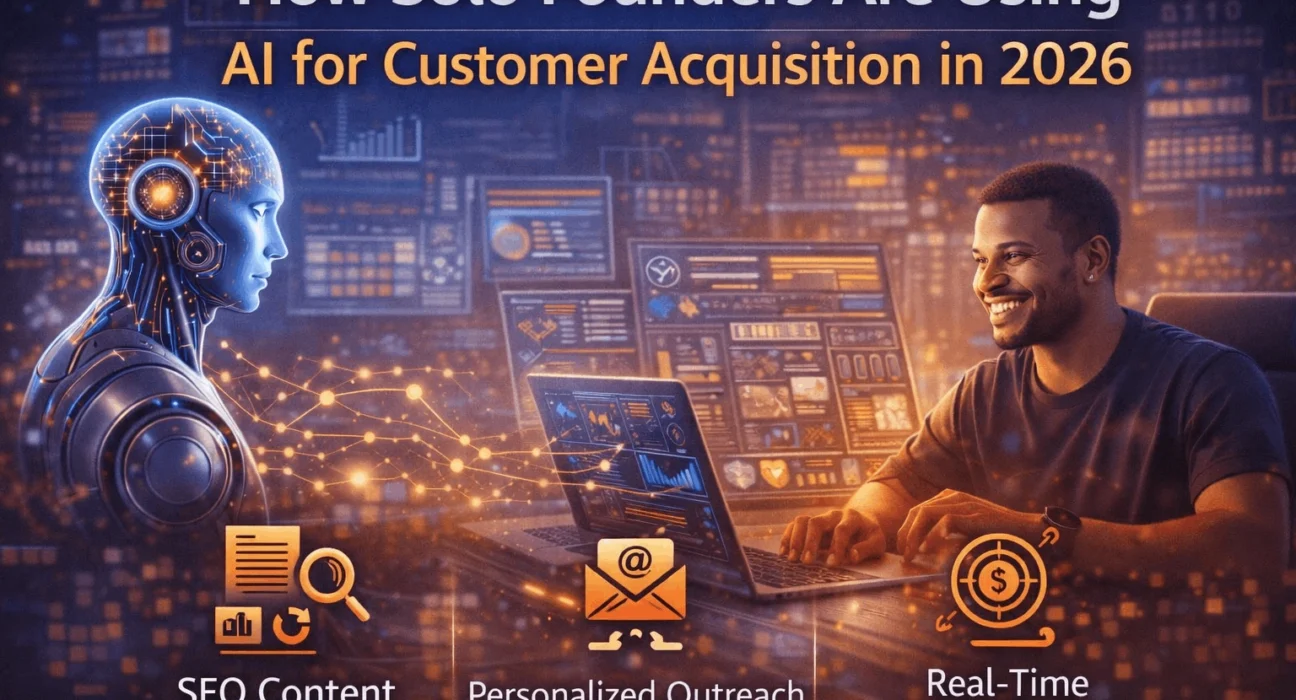
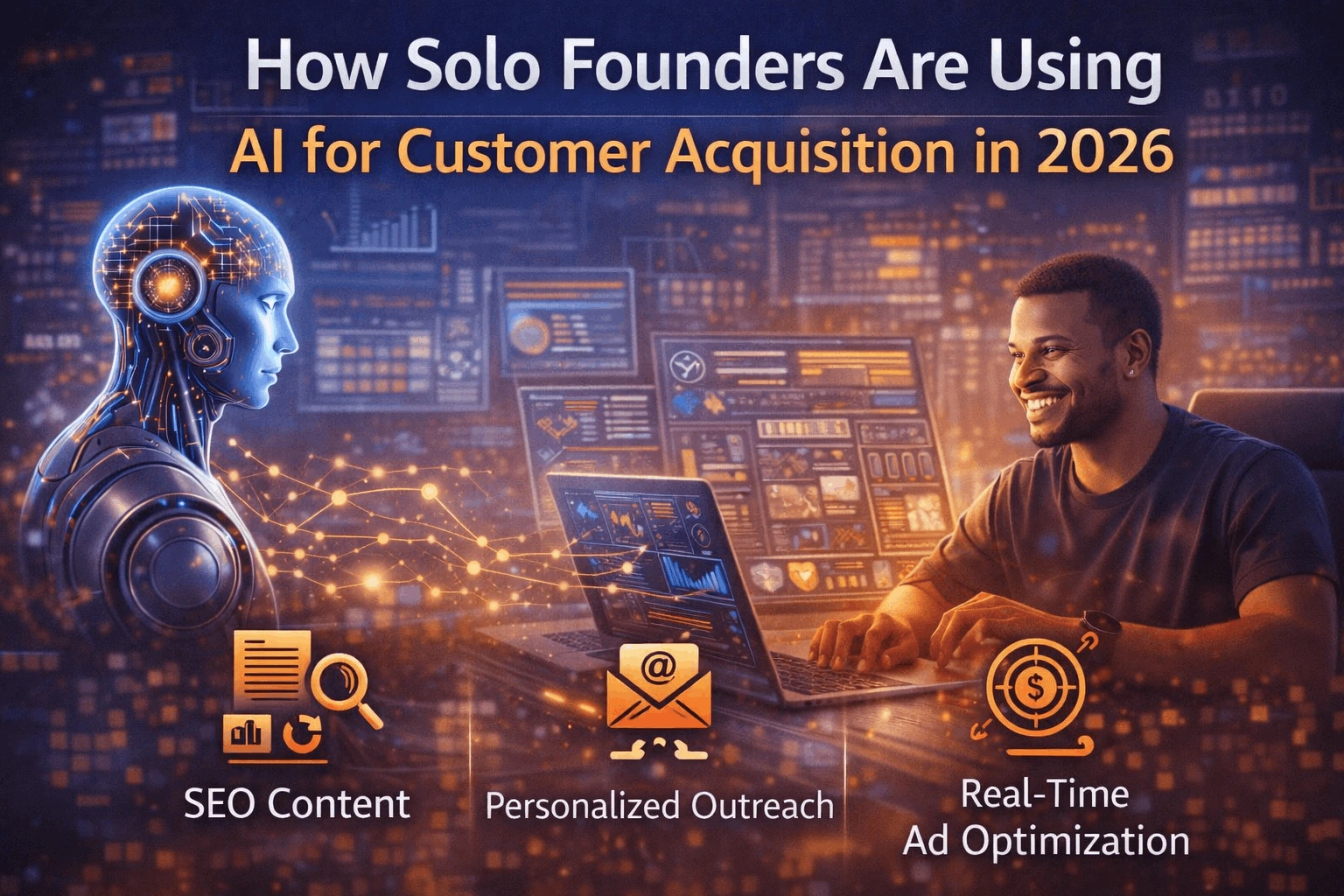
In 2026, that script has flipped — especially for solo founders building AI-first startups. Today’s one-person companies are leveraging artificial intelligence not just to build products, but to attract, nurture, and convert customers at scale. From AI-powered content marketing and automated sales funnels to hyper-personalized outreach and predictive analytics, founders are replacing entire growth teams with lean AI stacks.
This shift isn’t about cutting corners. It’s about precision. AI tools now allow solo entrepreneurs to test messaging faster, identify high-intent prospects, optimize ad spend in real time, and even automate follow-ups — all without hiring a traditional marketing department.
In this Growth Strategy deep dive, we explore how solo founders are using AI for customer acquisition in 2026, what tools are driving this change, which strategies are actually working, and where the risks lie. Because while AI lowers barriers, it also raises the competition bar.
If you’re building solo — or thinking about it — this is the new growth playbook.
How are solo founders using AI for customer acquisition in 2026?
Solo founders in 2026 are using AI tools to automate content creation, personalize outreach, optimize paid advertising, analyze customer behavior, and manage sales funnels. These AI-driven systems reduce acquisition costs, increase targeting precision, and allow one-person startups to scale without hiring large marketing teams.
The Old Way Was Expensive. The New Way Is… Smarter.
Let’s be honest.
Customer acquisition used to feel like lighting money on fire and hoping it turned into users.
You’d run ads. Hire freelancers. Maybe bring in a marketing manager. Burn through runway. Then cross your fingers that CAC doesn’t crush you.
But solo founders in 2026 don’t have the luxury of large burn rates. And frankly, they don’t need it.
AI has quietly become the most efficient growth hire a founder can make.
Not in a flashy “robot runs your company” way. More like… a behind-the-scenes strategist that never sleeps.
AI-Powered Content as a Growth Engine
One of the biggest shifts? Content marketing has become algorithmically enhanced.
Founders are using AI to:
- Identify long-tail search intent
- Analyze trending startup keywords
- Generate structured blog drafts
- Optimize headlines for click-through rate
- Repurpose content into LinkedIn threads, X posts, newsletters
Tools like SEMrush and Ahrefs are now integrated with AI suggestion layers that predict ranking probability before you even hit publish.
That’s huge.
Because organic growth in 2026 isn’t about publishing more. It’s about publishing smarter.
A solo founder I interviewed recently said:
“I don’t write blindly anymore. My AI stack tells me what’s ranking, what’s underserved, and how hard it’ll be to compete.”
That’s not guesswork. That’s calculated acquisition.
Hyper-Personalized Outreach at Scale
Cold outreach used to be generic. Painfully generic.
Now? AI analyzes:
- Prospect industry
- Recent funding news
- Hiring patterns
- Social posts
- Website copy tone
And crafts emails that actually feel human.
Platforms like Apollo.io and HubSpot have embedded AI workflows that score lead intent and automate follow-ups based on behavior triggers.
And here’s the kicker — solo founders are using this themselves.
Not outsourcing it.
Imagine sending 200 personalized emails that genuinely reference a company’s latest announcement… without manually researching each one.
That’s the leverage.
Paid Ads With Real-Time AI Optimization
You might be wondering — are ads still working in 2026?
Yes. But not blindly.
AI-driven ad optimization tools now:
- Predict which creatives will perform
- Adjust bids in real time
- Segment audiences automatically
- Suggest budget reallocation daily
Google and Meta’s AI systems have become far more autonomous, but founders are layering additional analytics tools on top to track actual LTV vs CAC performance.
The result?
Lower acquisition cost. Faster iteration cycles.
And fewer emotional decisions.
Predictive Analytics: Knowing Before Spending
This is where things get interesting.
AI tools now predict churn probability and purchase likelihood before you invest heavily in scaling campaigns.
That means founders can:
- Spot weak segments early
- Double down on high-intent users
- Improve onboarding messaging before churn spikes
It’s like having a growth analyst — without hiring one.
But. And this is important.
The founder still needs to interpret the data correctly. AI gives signals. Strategy still requires judgment.
GEO Strategy: Global Reach, Local Precision
Customer acquisition in 2026 is borderless.
Solo founders in India are selling to the US. European founders are targeting Southeast Asia. Geography matters less — but localization matters more.
AI tools now:
- Translate landing pages contextually (not just literally)
- Adjust messaging tone by region
- Analyze regional search behavior
- Optimize ads for country-specific keywords
So instead of building separate teams in every region, founders are running geo-optimized campaigns from a single dashboard.
And that changes everything.
The Solo Growth Stack (Realistic Version)
Let’s break this down practically.
A typical solo founder AI growth stack in 2026 might include:
- SEO intelligence platform
- AI content assistant
- Automated CRM with behavioral triggers
- AI-powered analytics dashboard
- Programmatic ad optimization
- Customer support chatbot
That’s essentially a five-person growth team… compressed into software subscriptions.
Cost? A fraction of payroll.
But Here’s the Truth No One Talks About
AI doesn’t guarantee growth.
It amplifies strategy.
If your positioning is weak, automation scales weakness.
If your product-market fit is unclear, AI accelerates failure faster.
And yes, some founders get overwhelmed. Too many dashboards. Too much data.
Growth in 2026 isn’t about stacking tools. It’s about clarity.
What’s your ICP? What problem are you solving? Where does demand already exist?
AI works best when pointed at a defined target.
Customer Acquisition Cost in 2026: What’s Changing?
Compared to 2021–2023, founders report:
- Lower content production cost
- More efficient ad testing
- Higher personalization response rates
- Faster iteration cycles
But increased competition in AI-driven verticals.
In other words — efficiency improved. Noise increased.
So differentiation matters more than ever.
The Psychological Shift
Here’s something subtle.
Solo founders aren’t thinking “How do I hire a marketing team?”
They’re thinking “How do I design a system?”
That mindset shift is huge.
Because systems scale. People require coordination.
And AI thrives inside structured workflows.
What This Means for Early-Stage Startups
If you’re early stage, here’s the takeaway:
You don’t need a massive marketing budget.
You need:
- Clear positioning
- Data-backed keyword strategy
- Automated lead nurturing
- Smart budget allocation
- Continuous optimization
And discipline.
Because AI reduces friction. But it doesn’t remove effort.
Final Thoughts
Customer acquisition in 2026 feels less chaotic.
More calculated.
Solo founders aren’t guessing anymore. They’re testing, automating, analyzing, refining.
It’s not magic. It’s leverage.
And honestly? It levels the playing field.
A one-person startup can now compete with funded companies — if the strategy is sharp and execution is consistent.
AI isn’t replacing founders.
It’s amplifying the focused ones.
FAQ’s
How are solo founders using AI for customer acquisition?
Solo founders use AI to automate content marketing, personalize outreach, optimize paid ads, analyze user behavior, and manage CRM workflows without hiring large marketing teams.
Does AI reduce customer acquisition cost in 2026?
Yes. AI reduces customer acquisition cost (CAC) by improving targeting accuracy, automating repetitive tasks, and optimizing ad spending in real time.
Can one person run marketing using AI tools?
In many cases, yes. With the right AI stack, a solo founder can manage SEO, outreach, paid advertising, and analytics efficiently.
What are the risks of relying on AI for growth?
Over-automation, weak differentiation, and poor data interpretation can limit growth. Strategy, positioning, and human judgment still play a critical role.
Summary
Article Name
How Solo Founders Are Using AI for Customer Acquisition in 2026
DescriptionDiscover how solo founders use AI for customer acquisition in 2026—automating content, ads, outreach, and analytics to scale faster with lower CAC.
Author
Upstartzen Editorial Team
Publisher Name
Upstartzen
Publisher Logo