
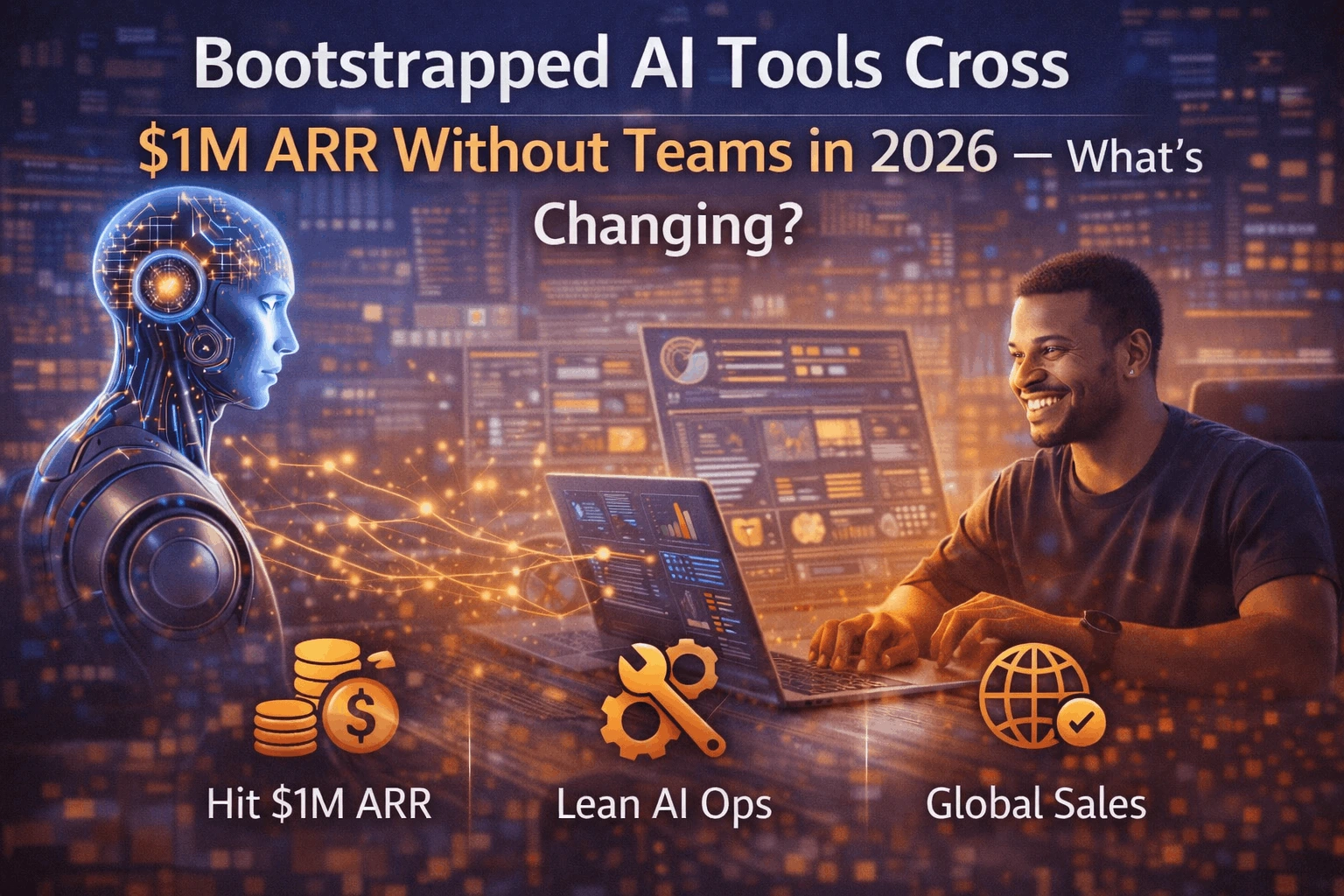
Bootstrapped AI Tools Cross $1M ARR Without Teams: What’s Changing?
Synopsis
For years, the startup narrative was predictable: raise venture capital, hire aggressively, chase growth, expand headcount, repeat. Revenue would (hopefully) follow.
But in 2026, something quieter — and arguably more disruptive — is happening.
Bootstrapped AI tools are crossing $1 million in annual recurring revenue (ARR) without teams. No massive seed round. No 15-person Slack workspace. Sometimes not even an office. Just one or two founders, an AI-augmented workflow, and a product that solves a real problem.
This shift signals more than just efficiency. It reflects a structural transformation in how startups are built, operated, and scaled. Artificial intelligence is no longer just a product feature — it has become operational infrastructure. From coding and customer support to marketing and analytics, AI now performs functions that once required entire departments.
In this Startup News deep dive, we explore why lean AI startups are reaching $1M ARR faster, how bootstrapped founders are competing with venture-backed companies, what investors are noticing, and whether this trend is sustainable — or simply the calm before another evolution.
How are bootstrapped AI startups reaching $1M ARR without teams in 2026?
Bootstrapped AI startups are reaching $1M ARR without teams by using artificial intelligence to automate product development, customer support, marketing, and analytics. This reduces operational costs, minimizes hiring needs, and enables founders to scale revenue with lean infrastructure.
The $1M ARR Milestone Used to Mean Something Different
Let’s rewind a bit.
Hitting $1M ARR used to feel like a major company milestone. It usually came with a growing team, investor backing, and structured departments. You had product managers, marketers, support staff — maybe even a small HR function.
Today? It might just be two founders and a stack of AI tools.
To be honest, that changes the psychology of scaling.
Reaching $1M ARR in 2026 doesn’t automatically mean “venture-ready.” Sometimes it just means the system works.
And that’s new.
AI as an Operational Backbone, Not Just a Feature
You might be wondering: what exactly changed?
The biggest shift isn’t the availability of AI tools. It’s their integration depth.
Bootstrapped AI tools today use automation for:
- Code generation and iteration
- Customer onboarding flows
- Support chat and ticket triaging
- Content marketing and SEO research
- Usage analytics and churn prediction
Platforms like OpenAI and infrastructure ecosystems around them have enabled startups to build features faster than traditional engineering cycles allowed just a few years ago.
And when product velocity increases, revenue follows more quickly — assuming product-market fit exists.
That assumption still matters. AI doesn’t magically create demand.
Smaller Teams, Bigger Output
There’s a phrase circulating in founder communities lately: “Revenue per employee is the new flex.”
And honestly? It makes sense.
According to ecosystem reports from platforms like Crunchbase and PitchBook, early-stage AI startups are operating with dramatically lower headcounts compared to SaaS companies from the 2018–2021 cycle.
Some bootstrapped founders are running:
- Product updates
- Marketing campaigns
- Sales funnels
- Customer support
All from a single dashboard.
It sounds exaggerated. But it’s not.
AI tools have effectively become digital teammates.
Bootstrapping Isn’t About Scarcity Anymore
Historically, bootstrapping implied constraint.
Limited budget. Slow growth. Conservative expansion.
But in 2026, bootstrapping an AI startup doesn’t necessarily mean slower growth. In fact, in some cases, it accelerates discipline.
When you don’t have external capital:
- You prioritize monetization early.
- You validate demand before scaling.
- You build lean systems.
Ironically, this often produces healthier businesses.
Because $1M ARR reached without external funding tends to be revenue-driven, not vanity-driven.
The Economics Are Simply Different
Here’s where the math gets interesting.
Let’s say a founder builds an AI productivity tool:
- Development cost: Minimal (AI-assisted coding)
- Customer support: Automated AI chat
- Marketing: SEO + automated outreach
- Analytics: AI dashboards
Monthly expenses remain relatively low.
So when revenue hits $80K–$100K per month, margins are strong.
Compare that to a traditional SaaS startup with:
- 8–12 employees
- Office expenses
- Sales salaries
- Layered management
The cost structures are worlds apart.
It’s not just about making $1M ARR. It’s about keeping most of it.
Global Distribution Is Easier Than Ever
Another structural shift?
Distribution.
Bootstrapped AI startups in India, Eastern Europe, and Southeast Asia are reaching global customers without relocating.
Thanks to:
- Cloud infrastructure
- International payment gateways
- AI-powered localization
- Global search visibility
Programs from Y Combinator and other accelerators have highlighted an increase in solo or micro-team founders building globally competitive AI tools.
Geography still matters. But it’s less limiting.
Investors Are Watching (Quietly)
Here’s something subtle.
Even though these startups are bootstrapped, investors are paying attention.
Why?
Because a company that hits $1M ARR without capital signals:
- Product-market fit
- Capital efficiency
- Operational discipline
- Strong retention
And if external funding is eventually raised, it’s often on better terms.
But not all founders want to raise.
That’s new, too.
Risks Nobody Talks About
Let’s not romanticize this.
Bootstrapped AI tools face real risks:
- Overdependence on third-party AI APIs
- Rapid commoditization
- Pricing pressure
- Limited defensibility
When multiple founders use similar AI infrastructure, differentiation becomes critical.
If your product is just a thin layer on top of a large model provider, long-term advantage can shrink quickly.
And scaling beyond $1M ARR often requires deeper product investment.
AI lowers entry barriers. It doesn’t eliminate competition.
What This Means for the Startup Ecosystem
This trend could reshape early-stage funding dynamics.
If more founders reach meaningful revenue milestones without capital, seed-stage investing may:
- Become more selective
- Focus on breakout scalability
- Prioritize unique IP or defensible moats
At the same time, the narrative around success is shifting.
Headcount growth isn’t the headline anymore.
Efficiency is.
Profitability is.
Sustainability is.
And maybe — just maybe — that’s healthier.
The Bigger Question: Is This Sustainable?
You might be thinking, is this just a 2026 trend?
Possibly.
Technology cycles evolve quickly.
But the structural change — AI as workforce multiplier — seems durable.
Founders now design businesses assuming automation as default.
That mindset won’t disappear.
And once founders experience scaling without massive overhead, it’s hard to go back.
Final Thoughts
Bootstrapped AI tools crossing $1M ARR without teams isn’t a fluke.
It’s a reflection of:
- AI-powered operational leverage
- Lean startup discipline
- Global digital distribution
- Smarter cost structures
The startup playbook is changing.
Not loudly. Not dramatically. But steadily.
And in 2026, hitting $1M ARR might mean something different than it used to.
Not “we raised big.”
But “we built smart.”
Frequently Asked Questions
How are bootstrapped AI startups reaching $1M ARR without teams in 2026?
Bootstrapped AI startups are reaching $1M ARR by using artificial intelligence to automate product development, customer support, marketing, and analytics. This reduces operational costs and allows founders to scale revenue without hiring large teams.
Why are AI startups able to operate with smaller teams?
AI startups use automation tools for coding, customer onboarding, sales outreach, and data analysis. These tools replace tasks that traditionally required multiple employees, enabling lean operations.
Is $1M ARR achievable without venture capital in 2026?
Yes. With AI-driven operational leverage and global digital distribution, founders can build profitable products and reach $1M ARR without raising venture capital, provided they achieve product-market fit.
Are bootstrapped AI startups more profitable than funded startups?
Bootstrapped AI startups often maintain higher margins because they operate with lower overhead and controlled burn rates. However, profitability depends on product differentiation, pricing strategy, and retention.
What risks do bootstrapped AI startups face?
Risks include overdependence on third-party AI infrastructure, rapid market commoditization, pricing pressure, and limited defensibility if the product lacks unique value or proprietary technology.
Summary
Article Name
Bootstrapped AI Tools Cross $1M ARR Without Teams in 2026 — What’s Changing?
DescriptionBootstrapped AI tools are crossing $1M ARR without teams in 2026. Discover how automation, lean operations, and AI leverage are reshaping startups.
Author
Upstartzen Editorial Team
Publisher Name
Upstartzen
Publisher Logo