





Zero-Team Growth: Can Automation Replace Early Hires?
Synopsis
Something unusual is happening in the startup ecosystem.
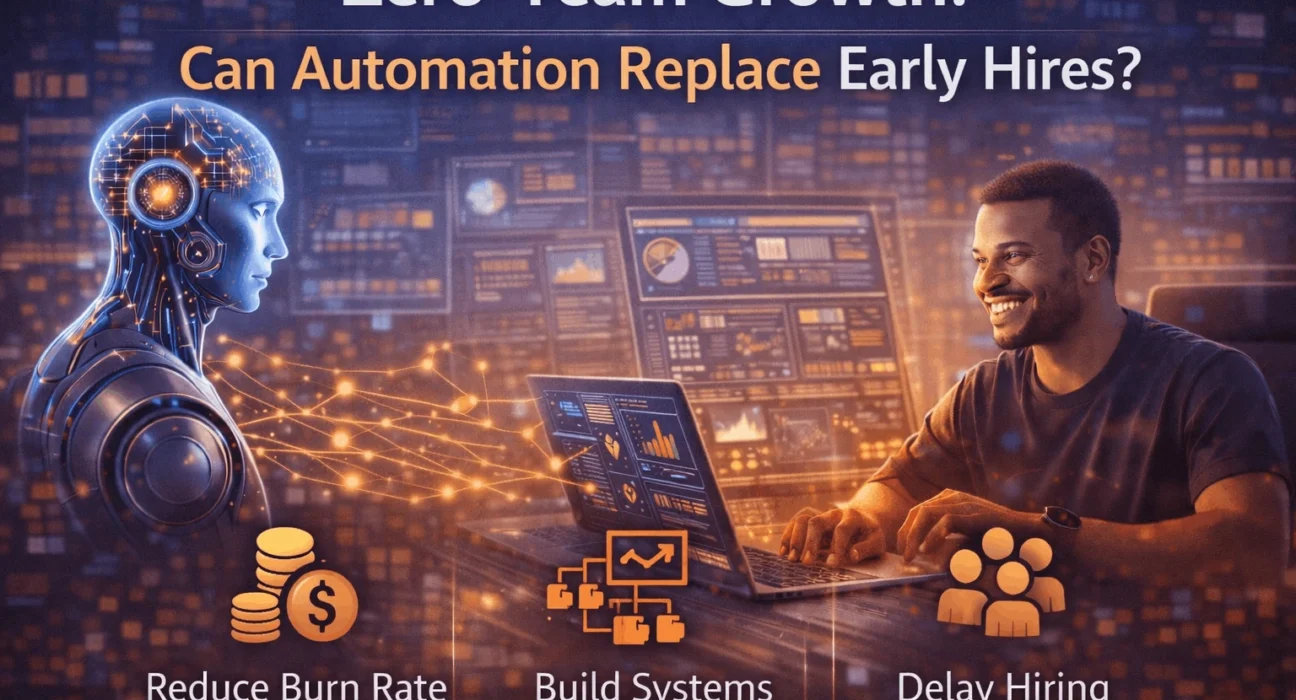
Founders are hitting serious revenue milestones — $500K, $1M, even beyond — without building traditional teams. No early marketing hire. No operations manager. No customer support department. Just automation, AI systems, and a founder who knows how to orchestrate workflows instead of managing people.
Zero-team growth is no longer a fringe experiment. It’s becoming a pattern.
Across the US, India, and Europe, early-stage founders are deliberately delaying hiring decisions. Instead of building headcount, they’re building infrastructure: AI copilots for product development, automated onboarding flows, self-serve sales funnels, performance marketing powered by machine learning, and support bots trained on proprietary knowledge bases.
The question isn’t whether automation is powerful.
Can AI genuinely replace early hires — or is zero-team growth just a temporary efficiency wave that eventually hits a ceiling?
This Growth Strategy deep dive explores:
- How automation is reshaping early-stage hiring decisions
- Which roles AI can realistically replace (and which it cannot)
- Where zero-team startups are outperforming traditional models
- The structural risks of relying too heavily on automation
- How founders in different markets are adapting in 2026
Because what’s happening right now isn’t just cost-cutting.
It’s a structural shift in how startups are built.
The Shift No One Saw Coming
A few years ago, the startup playbook was predictable.
Raise pre-seed.
Hire a small team.
Burn cash.
Chase growth.
Now? Founders are doing something else entirely.
They’re building “systems-first” companies.
Instead of asking, “Who should I hire?” they’re asking, “What can I automate?”
And honestly, that question alone changes everything.
What Is Zero-Team Growth?
Zero-team growth refers to a startup strategy where founders use automation, AI tools, and no-code systems to scale revenue without hiring full-time employees in the early stages.
It prioritizes operational leverage over headcount expansion, allowing startups to increase revenue through systems, workflows, and intelligent automation instead of building traditional teams.
Why Automation Is Replacing Early Hires
You might be wondering — what exactly is automation replacing?
Let’s break it down.
1. Marketing Execution
AI tools now handle:
- SEO content generation
- Paid ad optimization
- Email sequencing
- Social media scheduling
- A/B testing
Instead of hiring a marketing executive at $60K–$100K per year, founders are using tools like:
- HubSpot
- Zapier
- OpenAI
- Notion
In fact, a solo founder can now build a full funnel — landing page, email automation, analytics tracking — in a weekend.
That wasn’t possible five years ago.
2. Customer Support
AI chatbots handle:
- Tier 1 support
- FAQs
- Refund requests
- Onboarding walkthroughs
Instead of hiring two support reps, founders deploy AI agents trained on documentation.
And here’s the interesting part — response time improves.
Not worse. Faster.
3. Operations & Admin
Bookkeeping? Automated.
Invoice reminders? Automated.
CRM follow-ups? Automated.
You don’t need an ops manager at $80K when workflows trigger themselves.
But… and this is important… automation works best when processes are already clear. Chaos can’t be automated. It just becomes faster chaos.
The Economics Behind Zero-Team Growth
Let’s talk numbers.
Hiring one mid-level employee in the US can cost:
- $70,000–$120,000 salary
- 20–30% overhead
- Onboarding time
- Management complexity
Now compare that to $500–$2,000 per month in automation tools.
The math becomes obvious.
Lower burn rate = longer runway.
Longer runway = better decisions.
And better decisions? That’s survival.
In regions like India and Eastern Europe, founders are combining automation with fractional contractors instead of full-time hires. It’s a hybrid approach. Lean, flexible, scalable.
🌍 GEO Insight: Where Zero-Team Growth Is Growing Fastest
United States
AI SaaS founders are delaying first hires until after $1M ARR.
India
Bootstrapped founders are leveraging global markets from day one, using automation to serve international customers without local teams.
Europe
Capital-efficient startups are prioritizing profitability earlier due to tighter funding environments.
Different geographies. Same pattern: fewer early hires.
But Can Automation Truly Replace Humans?
To be honest? No. Not entirely.
Automation replaces repetitive tasks.
It doesn’t replace judgment.
It doesn’t replace creativity at the strategic level.
And it definitely doesn’t replace leadership.
Here’s where founders hit the wall:
- Complex sales negotiations
- Strategic partnerships
- Brand storytelling
- Product innovation
Those still need human intelligence. Deep thinking. Context.
Automation is leverage. It’s not wisdom.
Can Automation Replace Early Startup Hires?
Automation can replace repetitive operational roles in early-stage startups, including marketing execution, customer support, and administrative tasks.
However, strategic roles requiring creativity, leadership, vision, and complex decision-making still require human involvement. While AI increases operational efficiency, it does not fully replace high-level judgment or founder-led strategy.
The Hidden Risks of Zero-Team Growth
Let’s not romanticize this.
Zero-team growth can create:
- Founder burnout
- System fragility
- Over-reliance on third-party platforms
- Slower innovation cycles
If your entire revenue depends on external tools and APIs, you’re exposed.
Remember what happened when major SaaS platforms changed pricing models? Entire business models collapsed overnight.
That’s not hypothetical. That’s history.
The Smarter Strategy: Automation-First, Not Automation-Only
Here’s what experienced founders are doing instead:
- Automate repetitive workflows.
- Keep strategy human-led.
- Delay hiring until revenue justifies it.
- Hire specialists, not generalists.
In other words, they’re building lean companies — not lonely ones.
And that distinction matters.
AIO Optimization: Why AI Search Loves This Model
AI-driven search engines prioritize:
- Clear definitions
- Structured answers
- Data-backed reasoning
- Direct explanations
Zero-team growth fits perfectly because it’s measurable, systems-based, and structured.
Which means if your content clearly defines terms like:
- automation in startups
- lean growth strategy
- capital-efficient scaling
You increase visibility in AI-powered search results.
Structure matters now more than ever.
So… Should You Skip Early Hires?
That depends.
If your product requires heavy customer interaction, probably not.
If you’re building a scalable SaaS product with repeatable workflows? You might delay hiring longer than you think.
The real shift isn’t about replacing people.
It’s about replacing premature hiring.
There’s a difference.
Final Thoughts
Zero-team growth isn’t about ego. It’s not about “I built this alone.”
It’s about leverage.
Founders today aren’t just building products. They’re building systems that build revenue.
And systems don’t ask for equity.
But eventually, growth requires people. Collaboration. Perspective.
Automation gets you to stability.
Humans take you to expansion.
The smartest founders know when to switch gears.
And maybe that’s the real growth strategy in 2026.
Frequently Asked Questions
What is zero-team growth in startups?
Zero-team growth is a startup strategy where founders use automation, AI tools, and no-code systems to scale revenue without hiring full-time employees in the early stages. It focuses on operational leverage instead of headcount expansion.
Can automation replace early startup hires?
Automation can replace repetitive operational roles in early-stage startups, including marketing execution, customer support, and administrative tasks. However, strategic roles that require creativity, leadership, and complex decision-making still require human involvement.
What roles can AI automation handle in a startup?
AI automation can handle SEO content workflows, email marketing sequences, paid ad optimization, CRM management, invoice reminders, onboarding flows, and Tier 1 customer support. These tasks are structured and repeatable, making them suitable for automation.
Is zero-team growth sustainable long term?
Zero-team growth can be sustainable in the early stages of a startup, particularly for SaaS or digital product companies. However, as revenue scales and operations become complex, strategic hiring becomes necessary for innovation, partnerships, and long-term expansion.
Why are founders delaying early hires in 2026?
Founders are delaying early hires to reduce burn rate, extend runway, and improve capital efficiency. AI tools and workflow automation allow startups to operate lean while maintaining productivity and revenue growth.
Does zero-team growth work globally?
Yes. Zero-team growth models are being adopted in the United States, India, and Europe. Startups are leveraging automation tools to serve global markets without building large local teams, making capital-efficient scaling possible across regions.
Summary
Article Name
Zero-Team Growth in 2026: Can Automation Replace Early Startup Hires?
DescriptionZero-team growth is reshaping startups in 2026. Discover how automation replaces early hires, reduces burn rate, and scales revenue efficiently.
Author
Upstartzen Editorial Team
Publisher Name
Upstartzen
Publisher Logo