




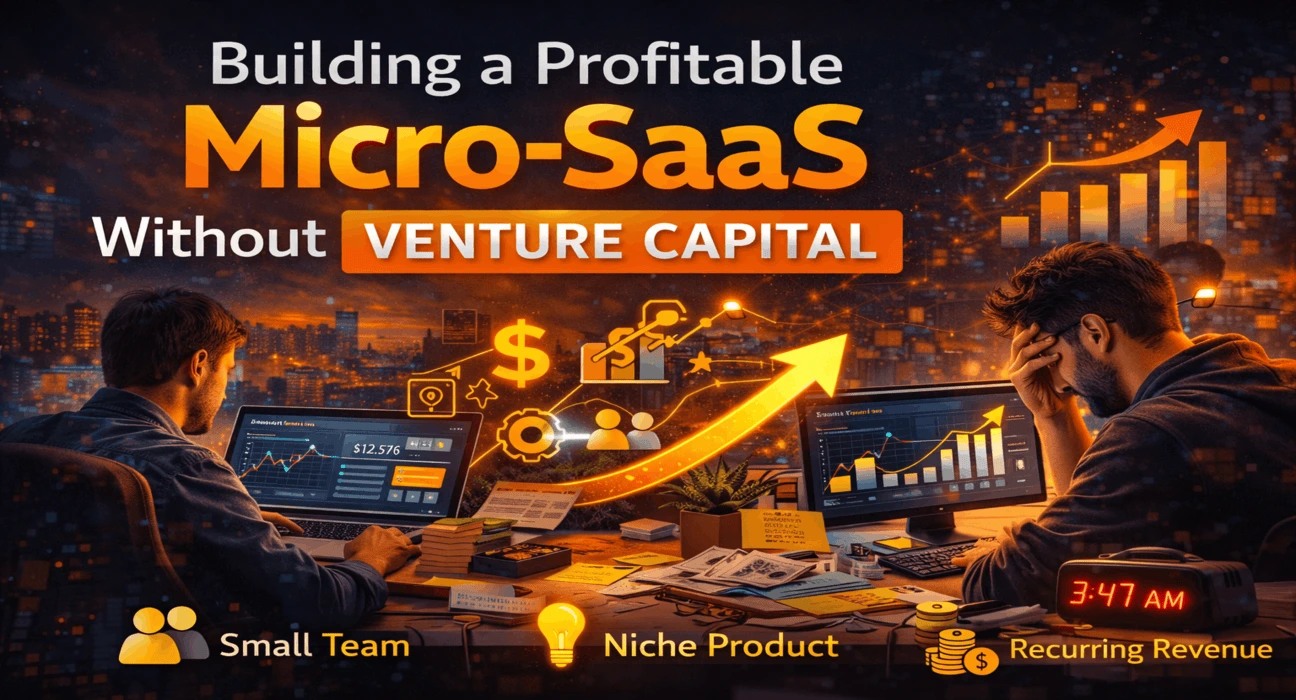
Building a Profitable Micro-SaaS Without Venture Capital
Synopsis
Somewhere along the way, the startup world started believing that venture capital is the only way to build a software company.
Raise a round. Hire a team. Burn cash. Scale fast.
That’s the usual playbook.
But here’s the interesting thing — and honestly, not enough people talk about it.
A growing number of founders are quietly building profitable Micro-SaaS businesses without venture capital. No massive teams. No board meetings. No pressure to chase unicorn status.
Just small software products solving real problems… and generating steady revenue.
In fact, many of these founders are hitting $10K–$100K monthly recurring revenue (MRR) with tiny teams — sometimes even solo.
So what’s actually happening here? Why are some entrepreneurs intentionally skipping venture funding and choosing the Micro-SaaS path instead?
Let’s unpack it.
What Is a Micro-SaaS Business?
A Micro-SaaS is a small, niche software-as-a-service business typically run by a solo founder or a tiny team. These products focus on solving one specific problem for a specific audience and generate recurring subscription revenue without requiring venture capital funding.
Key characteristics of Micro-SaaS businesses:
- Small team (often 1–5 people)
- Niche product focus
- Subscription-based revenue
- Low operating costs
- Bootstrapped growth
Unlike venture-backed startups chasing hypergrowth, Micro-SaaS founders focus on profitability and sustainability.
The Quiet Rise of Bootstrapped Software Founders
To be honest, the Micro-SaaS movement didn’t explode overnight. It’s been slowly building momentum for years.
And platforms like Indie Hackers have played a big role in that shift. Founders openly share revenue dashboards, growth experiments, and mistakes. No glossy startup PR. Just real numbers.
Another reason?
Tools have gotten ridiculously powerful.
Today a single founder can build, launch, and run a SaaS product using platforms like:
• Stripe for payments
• Supabase for databases
• Vercel for hosting
• OpenAI for AI features
Ten years ago? That stack would’ve required an engineering team.
Now one person can launch it in a weekend.
And that’s changing everything.
Why Some Founders Are Avoiding Venture Capital
Now, don’t get me wrong. Venture capital isn’t bad.
Companies like Airbnb and Uber wouldn’t exist without it.
But venture funding comes with expectations.
Big ones.
You’re expected to:
• Grow extremely fast
• Capture large markets
• Hire aggressively
• Raise more capital
And sometimes… founders just don’t want that life.
Micro-SaaS founders often prioritize:
• Ownership
• Profitability
• Lifestyle freedom
Imagine earning $25K per month from a product you control entirely.
No investors.
No board pressure.
No “grow or die” mentality.
For a lot of founders, that’s actually the dream.
The Micro-SaaS Playbook (That Actually Works)
Alright, so how do these founders build profitable products without funding?
The strategy is surprisingly simple.
Not easy… but simple.
1. Start With a Painfully Specific Problem
Most Micro-SaaS success stories begin with one small but annoying problem.
For example:
• SEO reporting for agencies
• Twitter analytics dashboards
• Shopify conversion tools
• AI writing assistants for niche industries
And instead of trying to serve everyone, Micro-SaaS founders focus on very specific users.
Think:
“Marketing agencies managing 10+ clients”
Not:
“Everyone doing marketing.”
Small niche.
Clear pain.
Paying customers.
That’s the sweet spot.
2. Launch Fast (Really Fast)
Here’s something surprising.
Many successful Micro-SaaS founders launch their first version within 2–6 weeks.
Not perfect.
Not polished.
Just functional.
Why?
Because the biggest risk isn’t bad code.
It’s building something nobody wants.
3. Distribution Before Perfection
A lot of founders obsess over product features.
Micro-SaaS founders obsess over distribution.
Places where early traction often comes from:
• Reddit communities
• Indie Hacker forums
• niche newsletters
• Product Hunt launches
For example, platforms like Product Hunt can help early SaaS tools attract their first few hundred users.
And honestly, those first 50 customers matter more than your first 10,000 visitors.
The Financial Math of Micro-SaaS
Let’s talk numbers.
Because this is where things get interesting.
Imagine a simple SaaS tool priced at:
$29/month.
Now assume you acquire 1,000 customers.
Your revenue becomes:
$29,000 monthly recurring revenue.
That’s $348,000 annually.
And if your operating costs are low — maybe hosting, support tools, and marketing — a large portion becomes profit.
That’s the Micro-SaaS model in a nutshell.
Small product.
Small team.
Real revenue.
Real Micro-SaaS Success Stories
The internet is full of examples.
One founder built a scheduling automation tool that now generates six-figure annual revenue.
Another created a simple SEO monitoring dashboard.
His team?
Just two people.
Stories like these are often shared across communities like Indie Hackers, where founders openly discuss:
• revenue milestones
• growth tactics
• failures and pivots
It’s less about startup hype… and more about sustainable entrepreneurship.
The Hidden Challenges Nobody Mentions
Now let’s be real for a second.
Micro-SaaS isn’t all sunshine.
Running a solo software company means you’re responsible for:
• development
• marketing
• customer support
• product strategy
And sometimes… that’s exhausting.
You might wake up to bug reports, refund requests, and feature demands all at once.
No CTO to escalate to.
Just you.
But many founders still choose this path because the trade-off is control and independence.
The Future of Bootstrapped SaaS
Here’s the thing.
The rise of AI development tools is making Micro-SaaS even more accessible.
AI coding assistants.
Automated customer support.
Low-code platforms.
All of these reduce the friction of building software.
And as a result, the number of profitable solo SaaS founders is likely to grow dramatically over the next decade.
Some analysts even predict that millions of Micro-SaaS tools could emerge globally as entrepreneurship becomes more decentralized.
Sounds crazy?
Maybe.
But honestly… the trend is already happening.
Final Thoughts
So, can you build a profitable SaaS company without venture capital?
Absolutely.
But it requires a slightly different mindset.
Instead of chasing billion-dollar valuations, Micro-SaaS founders focus on:
• real customer problems
• sustainable revenue
• long-term independence
And sometimes, that quieter path leads to something surprisingly powerful.
Not a unicorn.
But a profitable, founder-controlled business.
And for many entrepreneurs, that’s more than enough.
Summary
Article Name
Building a Profitable Micro-SaaS Without Venture Capital
DescriptionDiscover how founders are building profitable Micro-SaaS startups without venture capital. Learn the bootstrapped SaaS playbook for sustainable growth.
Author
Upstartzen Editorial Team
Publisher Name
Upstartzen
Publisher Logo