




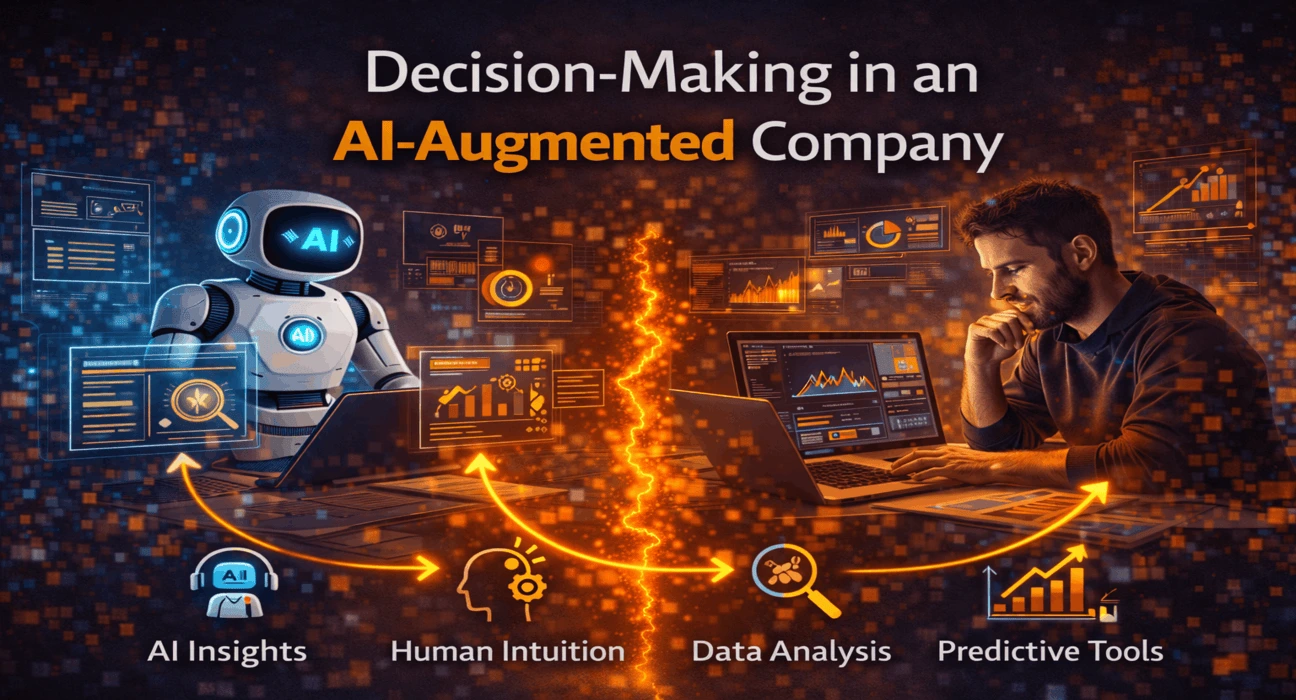
Decision-Making in an AI-Augmented Company
Synopsis
Not too long ago, decision-making inside companies followed a pretty familiar pattern.
Executives gathered data. Analysts prepared reports. Managers debated strategies in long meetings. And eventually — sometimes weeks later — leadership made a call.
That process worked… sort of.
But things are changing quickly now, especially in startups and technology-driven companies.
Today, leaders aren’t just relying on human intuition or traditional data dashboards anymore. They’re working alongside AI systems that can process massive amounts of information in seconds.
And honestly, it’s creating a new kind of company — what many experts now call an AI-augmented organization.
But here’s the interesting part.
AI isn’t replacing decision-makers. Not really.
Instead, it’s reshaping how decisions get made, how quickly they happen, and who actually participates in the process.
And if you talk to founders or CEOs running modern tech companies, they’ll tell you the same thing: learning to collaborate with AI may become one of the most important leadership skills of this decade.
What Is an AI-Augmented Company?
An AI-augmented company is an organization where artificial intelligence supports human decision-making by analyzing data, identifying patterns, and providing insights in real time.
Instead of replacing leaders, AI systems help executives make faster and more informed decisions by:
- Processing large datasets quickly
- Identifying trends humans might miss
- Generating predictive insights
- Automating repetitive analysis tasks
In this model, humans remain responsible for strategy and judgment while AI enhances the information available for decisions.
Why Decision-Making Is Changing So Fast
To be honest, the pace of information today is overwhelming.
Companies deal with huge streams of data — customer behavior, market trends, financial analytics, product usage metrics. Trying to interpret all that manually can slow organizations down.
That’s where AI tools step in.
Platforms like ChatGPT and Microsoft Copilot are increasingly used inside companies to help summarize research, analyze documents, and generate strategic insights.
ChatGPT AI assistant for business insights
Microsoft Copilot AI productivity tools
Instead of spending hours digging through reports, executives can ask AI systems to surface key patterns instantly.
Which, frankly, changes the speed of decision-making dramatically.
AI Is Becoming a “Second Brain” for Leadership Teams
Some CEOs describe AI tools as a kind of second brain for the company.
It’s not that the AI makes final calls. That responsibility still belongs to leadership.
But AI can:
• highlight unexpected correlations in data
• simulate possible market outcomes
• analyze competitor strategies
• summarize industry research
In fact, companies like Amazon and Google have long integrated machine learning systems into their operational decision processes.
Amazon machine learning operations
Google AI research initiatives
These tools provide insights that help leadership teams make faster and more confident choices.
And sometimes — surprisingly — they reveal patterns humans simply wouldn’t have noticed.
The Balance Between Data and Human Judgment
But here’s where things get interesting.
AI might be great at analyzing numbers and predicting probabilities… yet business decisions are rarely just mathematical equations.
There’s still intuition involved.
Context matters. Timing matters. Culture matters.
A CEO deciding whether to enter a new market, launch a product, or pivot strategy isn’t just looking at data.
They’re weighing risks, understanding human behavior, and interpreting signals that algorithms might not fully grasp.
So the most effective companies don’t replace human judgment.
They combine human intuition with AI analysis.
And that hybrid approach tends to produce better decisions overall.
Faster Decisions Can Create Competitive Advantage
In startup ecosystems especially, speed matters.
A company that identifies a market opportunity early can capture massive advantages.
AI-augmented decision systems allow organizations to react faster to changes in:
• customer behavior
• supply chain conditions
• competitor actions
• emerging market trends
Instead of waiting weeks for internal reports, leadership teams can access real-time insights.
And in fast-moving industries like software or fintech, that difference in timing can be huge.
New Leadership Skills Are Emerging
Running an AI-augmented company requires slightly different leadership skills.
Executives must learn how to:
• ask better questions of AI systems
• interpret algorithmic insights responsibly
• verify data quality
• balance automation with human oversight
In other words, leadership isn’t just about managing people anymore.
It’s also about managing intelligent systems.
Which, to be honest, is still a learning process for many companies.
Risks Leaders Should Be Aware Of
Of course, relying on AI for decision support also introduces new risks.
Algorithms can sometimes produce misleading insights if data quality is poor.
There’s also the danger of automation bias — when leaders trust AI outputs too quickly without questioning them.
That’s why experts emphasize the importance of maintaining human oversight.
AI should support decisions.
But it shouldn’t replace critical thinking.
The Future of AI-Augmented Leadership
Looking ahead, AI will likely become embedded in almost every business workflow.
Not just analytics dashboards.
But strategy sessions. Market forecasting. Product development planning.
Leaders who learn to collaborate effectively with intelligent tools will likely gain a major advantage.
Because at the end of the day, the companies that make the best decisions — and make them quickly — tend to win.
And in an AI-augmented world, those decisions will increasingly be shaped by a partnership between humans and machines.
Summary
Article Name
Decision-Making in an AI-Augmented Company
DescriptionDiscover how AI-augmented companies improve decision-making using data insights, automation, and human judgment to move faster in competitive markets.
Author
Upstartzen Editorial Team
Publisher Name
Upstartzen
Publisher Logo