




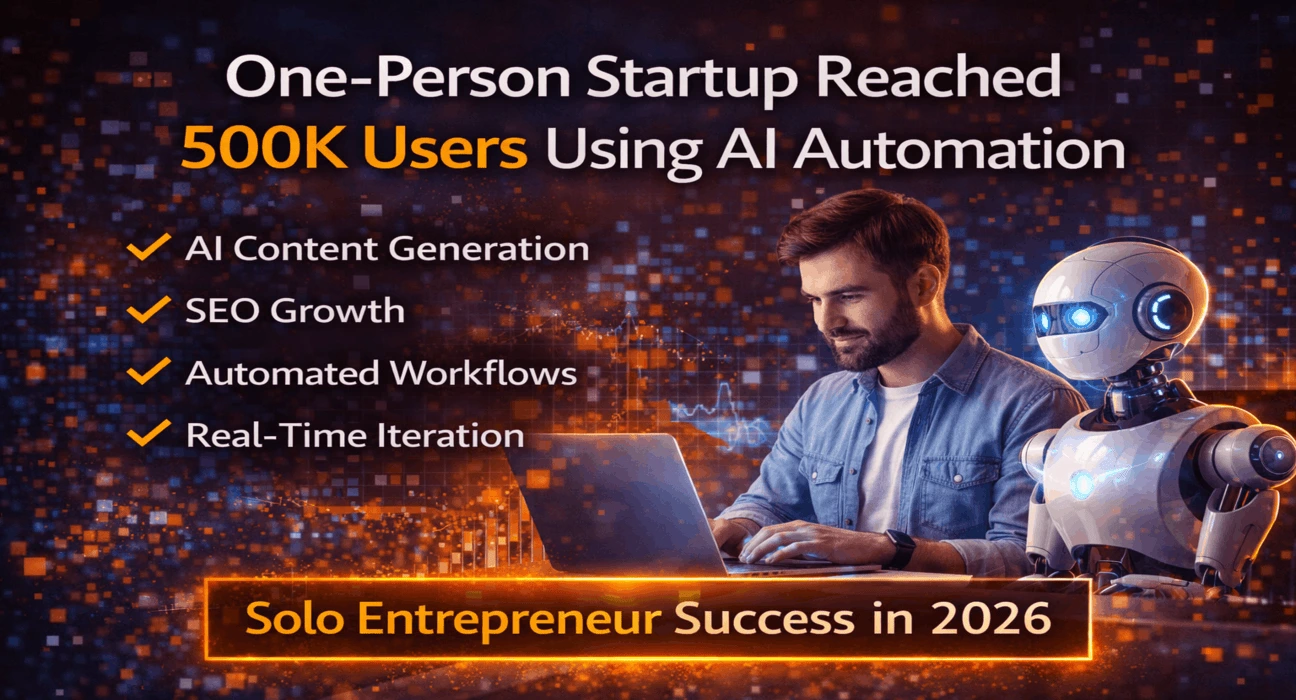
How a One-Person Startup Reached 500K Users Using AI Automation
Synopsis
It almost sounds unrealistic at first.
One person. No big team. No massive funding. And yet… 500,000 users.
If you were building startups even five years ago, this would’ve been nearly impossible. You’d need developers, marketers, support staff — maybe even a sales team.
But things are different now. Dramatically different.
AI automation has quietly changed the rules of the game.
And to be honest, we’re now seeing a new kind of founder emerge — someone who doesn’t build a startup with a team, but almost instead of one.
This story isn’t about luck or virality alone.
It’s about systems. Smart tools. And knowing how to use AI like leverage.
So let’s break it down.
What Does It Mean to Build a Startup Using AI Automation?
A one-person startup using AI automation is a business where a solo founder leverages artificial intelligence tools to handle key functions like product development, marketing, customer support, and analytics — enabling growth without hiring a large team.
These founders use AI to:
- Automate repetitive workflows
- Generate content and marketing campaigns
- Analyze user behavior
- Provide instant customer support
- Build and iterate products faster
The result is rapid user growth with minimal operational overhead.
The Beginning: Solving One Real Problem
You might be wondering… how does a solo founder even start something like this?
Well, in most cases, it begins pretty simply.
One problem. One niche. One solution.
Instead of building a massive product, this founder focused on a very specific use case — something people were actively searching for.
And here’s the thing — they didn’t spend months building it.
They validated the idea quickly using AI research tools and built a minimum viable product (MVP) in weeks.
AI Became the Entire Team
Now this is where things get interesting.
Instead of hiring different specialists, the founder relied heavily on AI tools like ChatGPT for content creation, product ideation, and user communication.
ChatGPT AI tool for startups
They also used automation platforms like Zapier to connect apps and streamline workflows.
Zapier automation platform
Need landing page copy? AI handled it.
Customer queries? Automated responses.
Email campaigns? Generated and scheduled.
And sure, it wasn’t perfect every time. But it was fast. Really fast.
Growth Didn’t Come From Ads (At First)
Here’s something that might surprise you.
The startup didn’t rely heavily on paid ads in the beginning.
Instead, growth came from:
• SEO-optimized content
• AI-generated blogs and landing pages
• organic search traffic
• early user referrals
The founder used tools like Ahrefs to identify search opportunities.
And then used AI to create content around those topics — quickly, consistently, and at scale.
It wasn’t about writing perfect content.
It was about publishing useful content faster than competitors.
Product Iteration Happened in Real Time
Traditional startups often take weeks — sometimes months — to roll out updates.
This one-person startup?
They were shipping improvements almost daily.
User feedback was collected automatically. AI summarized insights. And updates were implemented quickly.
It’s almost like the founder had a continuous feedback loop running in the background.
And honestly, that’s what kept users engaged.
Customer Support Without a Team
Now, customer support is usually where solo founders struggle.
But not here.
AI chat systems handled most of the queries — onboarding users, answering FAQs, even troubleshooting basic issues.
More complex problems? The founder stepped in personally.
This hybrid model kept support efficient without overwhelming the founder.
The 500K User Milestone
So how did they actually reach 500,000 users?
It wasn’t one big moment.
It was a combination of small, consistent wins:
• steady organic traffic growth
• continuous product improvements
• strong user retention
• word-of-mouth referrals
And maybe most importantly — speed.
While traditional teams were planning and debating, this founder was executing.
The Real Advantage: Leverage
If there’s one word to describe this entire journey, it’s leverage.
AI didn’t just make tasks easier.
It multiplied output.
One person could now:
• create content like a full marketing team
• build features like a small dev team
• support users like a customer success department
That’s a massive shift in how startups operate.
But It’s Not Completely Effortless
Let’s be real for a second.
This model isn’t “easy.”
It still requires:
• decision-making skills
• understanding of tools
• strategic thinking
• consistency
AI can assist, but it can’t replace direction.
The founder still had to guide the vision, prioritize features, and make critical calls.
What This Means for Future Startups
We’re entering an era where solo founders can build at scale.
Not every startup will reach 500K users, of course.
But the barrier to entry has dropped significantly.
And more importantly, the speed of execution has increased.
Which means competition is getting tougher too.
Final Thoughts
A one-person startup hitting 500K users used to sound like a rare exception.
Now, it’s becoming a pattern.
AI automation is giving founders a new kind of power — the ability to move faster, build smarter, and scale without traditional limitations.
And if you’re thinking about starting something…
Well, maybe the question isn’t “Do I need a team?”
Maybe it’s:
“How can I use AI to become one?”
Summary
Article Name
One-Person Startup Hits 500K Users With AI Automation
DescriptionDiscover how a one-person startup scaled to 500K users using AI automation, SEO, and smart tools—without hiring a large team or raising funding.
Author
Upstartzen Editorial Team
Publisher Name
Upstartzen
Publisher Logo