




Why Most Founders Burn Out (And How to Avoid It)
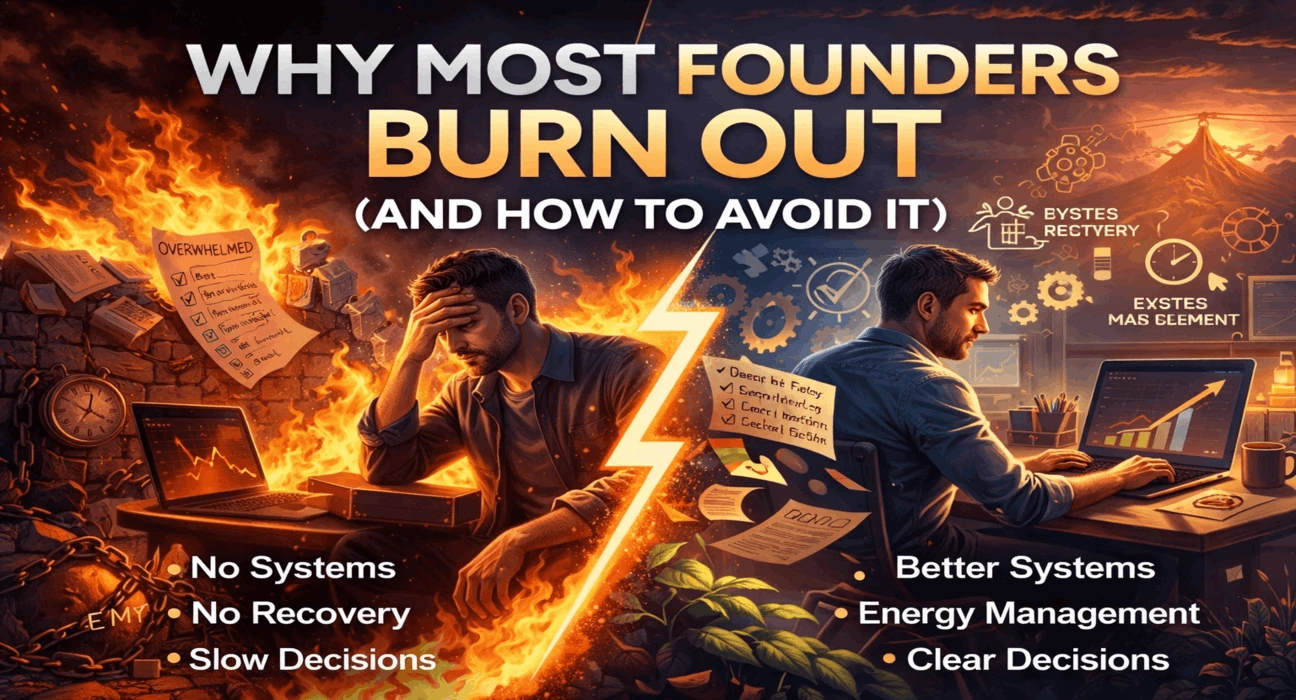
The Silent Startup Killer
Here’s the thing…
Most founders don’t fail because their idea is bad.
They fail because they run out of energy before they run out of opportunity.
Burnout doesn’t show up overnight.
It creeps in—through long hours, constant pressure, and the feeling that “if I stop, everything breaks.”
And by the time you notice it…
You’re already operating at 40% of your actual potential.
This isn’t just a productivity problem.
It’s a performance psychology problem.
Why Founder Burnout Is More Common Than Ever
The startup ecosystem glorifies hustle.
“Sleep is for the weak.”
“Work 18 hours a day.”
“Outwork everyone.”
But let’s be honest…
That mindset is outdated—and dangerously misleading.
📊 Reality Check:
- A study by Startup Genome found that 90% of startups fail, and burnout is a major contributing factor.
- Founders are 2x more likely to experience depression and 3x more likely to experience stress-related issues compared to the general population.
Burnout isn’t just emotional exhaustion.
It’s a system failure in how you manage energy, identity, and pressure.
What Is Founder Burnout?
Founder burnout is a state of chronic physical, emotional, and mental exhaustion caused by prolonged stress, overwork, and high responsibility in building and scaling a business.
Key Symptoms
- Constant fatigue (even after rest)
- Loss of motivation and focus
- Decision fatigue
- Irritability and emotional detachment
- Decline in productivity despite working more
In simple terms:
👉 Working more but achieving less due to exhaustion.
Core Breakdown: Why Founders Actually Burn Out
1. The “Everything Depends on Me” Trap
Early-stage founders wear multiple hats.
CEO. Marketer. Salesperson. Recruiter. Support.
At first, it feels empowering.
But over time, it becomes a psychological burden.
What’s really happening:
You’re operating in a high-responsibility, low-recovery loop.
Your brain never switches off.
👉 Result: Chronic stress + cognitive overload
2. Misaligned Effort vs. Outcome
Here’s a non-obvious truth:
Burnout isn’t caused by working hard.
It’s caused by working hard on things that don’t move the needle.
When effort ≠ results:
- Motivation drops
- Frustration rises
- Self-doubt kicks in
This is where most founders spiral.
3. The Identity Collapse Problem
Many founders tie their identity to their startup.
“If the startup fails, I fail.”
This creates:
- Fear-based decision making
- Emotional volatility
- Over-attachment to outcomes
Contrarian Insight:
The more emotionally attached you are to your startup, the faster you burn out.
High performers separate:
👉 Identity ≠ Outcome
4. Decision Fatigue (The Hidden Drain)
Founders make hundreds of decisions daily.
From strategy to hiring to messaging.
📊 Cognitive Insight:
The brain has limited decision bandwidth.
When it’s exhausted:
- You make poor decisions
- You avoid important tasks
- You default to comfort
This is why burnout often looks like procrastination, not exhaustion.
5. Lack of Psychological Recovery
Most founders think rest = sleep.
But recovery is deeper than that.
Real Recovery Includes:
- Mental detachment
- Emotional reset
- Creative stimulation
Without this, you’re always in “execution mode.”
👉 And that’s unsustainable.
Data & Real-World Examples
Case 1: The “Always-On” Founder
A SaaS founder scaled from ₹0 to ₹50L ARR in 12 months.
But:
- Worked 14–16 hours daily
- No structured breaks
- No delegation
At month 14:
👉 Burnout hit → Growth stalled → Team morale dropped
Lesson:
Speed without sustainability leads to collapse.
Case 2: The Strategic Founder
Another founder:
- Worked 6–8 focused hours/day
- Used systems and automation
- Prioritized high-leverage tasks
Result:
👉 Slower start, but consistent growth to ₹1Cr+ ARR
Lesson:
Energy management > time management
The 5-Step Anti-Burnout Framework for Founders
Founders can prevent burnout by managing energy, prioritizing high-impact work, building systems, creating recovery rituals, and separating identity from outcomes.
-
Shift from Time Management → Energy Management
- Track where your energy goes, not just hours worked
- Focus on high-energy, high-impact tasks
Tools: RescueTime, Toggl
-
Apply the 80/20 Rule Ruthlessly
- Identify the 20% of actions driving 80% of results
- Eliminate low-impact tasks and busywork
-
Build Decision Systems
- Create SOPs, templates, and pre-defined rules
- Reduce decision fatigue and increase execution speed
Examples: Fixed content calendar, pre-decided pricing
-
Create Recovery Rituals (Non-Negotiable)
- 7–8 hours of sleep
- 30–45 minutes of physical activity
- 1–2 hours weekly “no-work thinking time”
Tools: Headspace, Notion
-
Detach Identity from Outcome
- Separate self-worth from startup results
- Reduce emotional stress and fear-based decisions
In simple terms:
👉 Manage Energy → Focus → Systemize → Recover → Detach.
Non-Obvious Insight: Burnout Is a Growth Signal
Most people treat burnout as a problem.
But wait…
Burnout is actually feedback.
It’s your system telling you:
👉 “Your current way of operating doesn’t scale.”
Instead of asking:
“Why am I tired?”
Ask:
👉 “What system needs to change?”
Conclusion: Sustainable Founders Win Long-Term
Let’s be honest…
Anyone can hustle for 3 months.
Few can sustain performance for 3–5 years.
And that’s where real success happens.
Burnout isn’t a badge of honor.
It’s a signal that something is broken.
The founders who win are not the ones who work the hardest.
They’re the ones who:
- Manage energy intelligently
- Think clearly under pressure
- Build systems that reduce stress
👉 Build a business that doesn’t destroy you in the process.
FAQs: Founder Burnout
1. Why do most founders burn out?
Most founders burn out due to prolonged stress, lack of recovery, decision fatigue, and misalignment between effort and results.
2. How can founders prevent burnout?
Founders can prevent burnout by managing energy instead of time, prioritizing high-impact work, building systems, and maintaining consistent recovery routines.
3. Is burnout common among entrepreneurs?
Yes, burnout is common among entrepreneurs, as founders are more likely to experience stress, anxiety, and mental exhaustion due to high responsibility and uncertainty.
4. What are early signs of founder burnout?
Early signs include constant fatigue, loss of motivation, poor decision-making, irritability, and declining productivity.
5. Can burnout affect business growth?
Yes, burnout negatively impacts business growth by reducing decision quality, slowing execution, and limiting creativity and strategic thinking.
Summary
Article Name
Why Most Founders Burn Out (And How to Avoid It Without Slowing Growth)
DescriptionLearn why founders burn out and how to avoid it with proven strategies, performance psychology insights, and actionable frameworks for sustainable growth.
Author
Upstartzen Editorial Team
Publisher Name
Upstartzen
Publisher Logo