




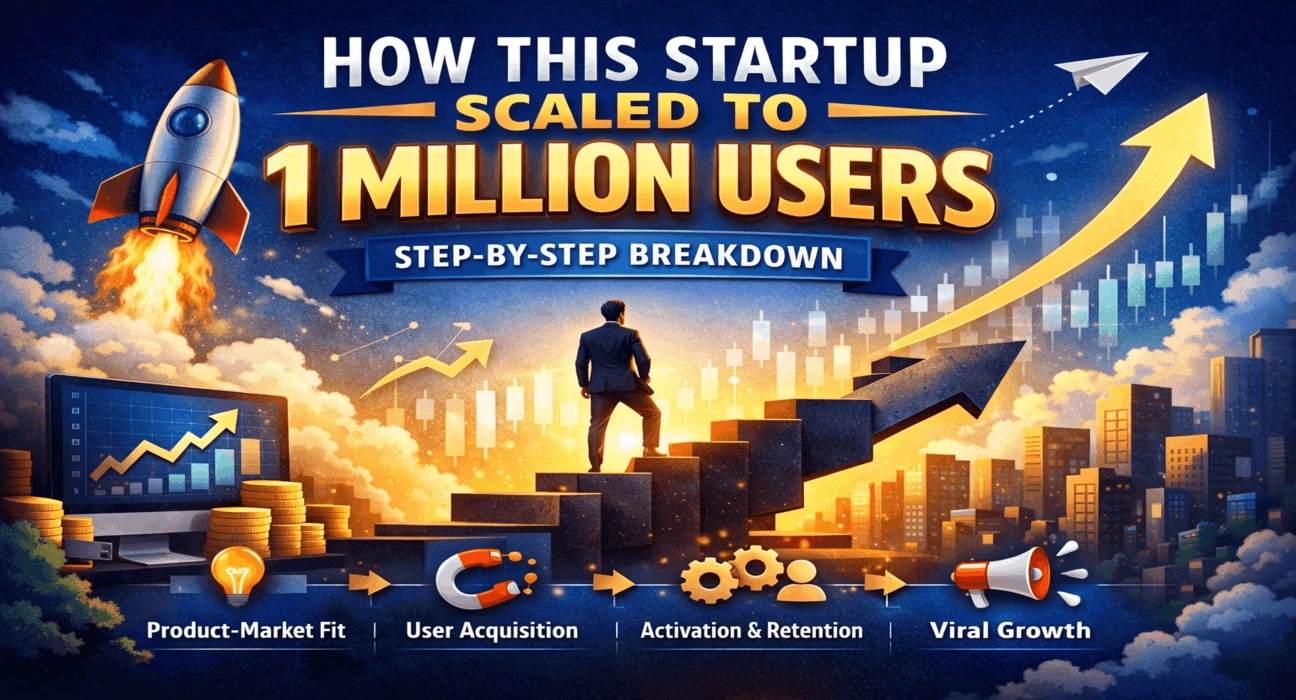
How This Startup Scaled to 1 Million Users (Step-by-Step Breakdown)
The Truth Behind “Overnight” Success
Everyone loves the story of a startup hitting 1 million users.
It sounds fast. Almost magical.
But here’s the thing…
There’s no such thing as overnight growth.
Behind every “viral success” is a system—a repeatable engine built on experiments, failures, and smart distribution.
And if you understand that system…
You can replicate it.
This isn’t just a case study.
It’s a playbook you can actually use.
Why Understanding Growth Systems Matters
Most founders chase tactics.
- “Should I run ads?”
- “Should I go viral?”
- “Should I do SEO?”
But high-growth startups don’t chase tactics.
They build growth systems.
📊 Reality:
Startups that scale fast typically:
- Test 20–30 growth experiments/month
- Double down on 1–2 channels that work
- Build compounding loops, not one-time spikes
👉 The difference isn’t effort.
It’s strategy + iteration speed.
What Does It Take to Reach 1 Million Users?
To reach 1 million users, a startup must build a scalable growth engine that combines product-market fit, high-leverage acquisition channels, activation optimization, retention systems, and viral or compounding loops.
Core Components
- Product-Market Fit – Solve a real problem with clear demand
- Acquisition Engine – Consistently bring in new users through scalable channels
- Activation Optimization – Ensure users experience value quickly
- Retention System – Keep users engaged and returning
- Referral / Viral Loop – Turn users into growth drivers
In simple terms:
👉 Get users → Deliver value fast → Keep them → Let them bring more users.
Core Breakdown: The 5-Stage Growth System
Stage 1: Nail Product-Market Fit (PMF)
Let’s be honest…
Most startups try to scale before they’re ready.
That’s the fastest way to burn money.
PMF Signals:
- Users come back without reminders
- Word-of-mouth starts naturally
- Retention improves week-over-week
Simple Framework:
👉 Problem → Solution → Obsession
If users aren’t slightly obsessed, you’re not there yet.
Stage 2: Build a Repeatable Acquisition Channel
You don’t need 10 channels.
You need one channel that works consistently.
Common Winning Channels:
- SEO (long-term compounding)
- Paid ads (fast testing)
- Social media (distribution leverage)
- Partnerships (borrowed audiences)
Example:
A SaaS tool scaled to 100K users primarily through SEO by:
- Publishing 100+ high-intent articles
- Targeting problem-based keywords
- Ranking within 6–8 months
👉 Result: Passive, compounding traffic.
Stage 3: Optimize Activation (The Hidden Lever)
Most founders ignore this.
Big mistake.
Activation = First meaningful user experience
If users don’t “get value” quickly…
They leave.
Optimization Tactics:
- Reduce onboarding steps
- Show quick wins within 5 minutes
- Use guided flows
Tool Recommendation:
- Mixpanel (track user behavior)
- Hotjar (visualize drop-offs)
Stage 4: Build Retention Systems
Here’s a non-obvious truth:
👉 Retention drives growth more than acquisition.
If users don’t stay, scaling is pointless.
Retention Drivers:
- Habit formation
- Continuous value delivery
- Personalization
Example:
A productivity app increased retention by:
- Sending personalized reminders
- Adding streak-based gamification
👉 Result: 35% increase in 30-day retention
Stage 5: Create a Viral or Referral Loop
What Is a Viral Loop?
A viral loop is a growth mechanism where existing users bring in new users, creating a self-sustaining cycle of acquisition.
Simple Viral Loop
- User signs up
- User gets value
- User invites others
- New users repeat the cycle
Examples of Viral Loops
- Referral rewards – Incentivized sharing (Dropbox-style)
- Social sharing – Content-driven growth (social platforms)
- Collaboration invites – Product-led invites (Slack-style)
Key Insight:
👉 Incentivize sharing only after delivering value.
Data & Case References
Case 1: Dropbox (Classic Example)
- Offered extra storage for referrals
- Simple, clear incentive
- Built into product experience
👉 Result:
60% of signups came from referrals
Case 2: Notion (Community-Led Growth)
- Focused on power users
- Enabled templates & sharing
- Built strong community ecosystem
👉 Result:
Millions of users without heavy paid ads
Case 3: Hypothetical Breakdown (Realistic Model)
Let’s model a path to 1M users:
- Month 1–3: 1,000 users (PMF validation)
- Month 4–6: 10,000 users (SEO + early traction)
- Month 7–12: 100,000 users (scaling acquisition)
- Month 12–18: 1M users (viral/referral loop kicks in)
👉 Growth isn’t linear. It’s compounding.
Step-by-Step Growth Playbook
To scale a startup effectively, follow a structured growth playbook: validate demand, focus on one channel, optimize activation, improve retention, and build a growth loop.
-
Validate Demand First
- Talk to users to understand real needs
- Identify clear pain points
- Build a minimum viable solution (MVP)
-
Focus on One Growth Channel
- Test multiple acquisition channels
- Double down on the best-performing one
-
Improve Activation Rate
- Shorten onboarding process
- Deliver value as quickly as possible
-
Increase Retention
- Build user habits
- Add engagement triggers (notifications, content, updates)
-
Add a Growth Loop
- Implement referral systems
- Enable easy sharing
- Leverage network effects
In simple terms:
👉 Validate → Acquire → Activate → Retain → Scale.
Bonus Insight:
👉 Don’t scale what’s broken.
Fix retention before increasing traffic.
Monetization & Tools
To execute this growth system:
Recommended Tools:
- Ahrefs / SEMrush → SEO growth
- Google Analytics → Traffic insights
- Mixpanel → User behavior tracking
- Notion → Growth experiment tracking
These tools help you:
- Identify opportunities
- Track performance
- Optimize continuously
Contrarian Insight: Growth Is Not About Hacks
Let’s be honest…
There’s no secret hack.
The startups that scale don’t rely on tricks.
They:
- Run more experiments
- Learn faster
- Build better systems
👉 Growth is a process, not an event.
Conclusion: Build a Growth Engine, Not Just Growth
Reaching 1 million users isn’t luck.
It’s the result of:
- Clear strategy
- Relentless iteration
- Strong fundamentals
Most founders fail because they chase shortcuts.
The ones who win?
They build systems that scale.
👉 Focus on repeatability.
That’s where real growth lives.
FAQs: Reaching 1 Million Users
1. How do startups reach 1 million users?
Startups reach 1 million users by combining product-market fit, scalable acquisition channels, strong retention systems, and viral growth loops.
2. What is the fastest way to scale a startup?
The fastest way to scale is to identify a high-performing acquisition channel and optimize retention before scaling aggressively.
3. Why is retention important for growth?
Retention ensures users stay engaged, making acquisition more effective and enabling compounding, long-term growth.
4. What is a growth loop in startups?
A growth loop is a system where existing users bring in new users, creating a continuous and scalable cycle of growth.
5. Can every startup reach 1 million users?
No, but startups with strong product-market fit, efficient systems, and scalable strategies significantly increase their chances.
Summary
Article Name
How This Startup Scaled to 1 Million Users (Step-by-Step Growth Blueprint)
DescriptionLearn how a startup scaled to 1 million users with proven growth strategies, acquisition channels, and actionable frameworks you can apply today.
Author
Upstartzen Editorial Team
Publisher Name
Upstartzen
Publisher Logo