



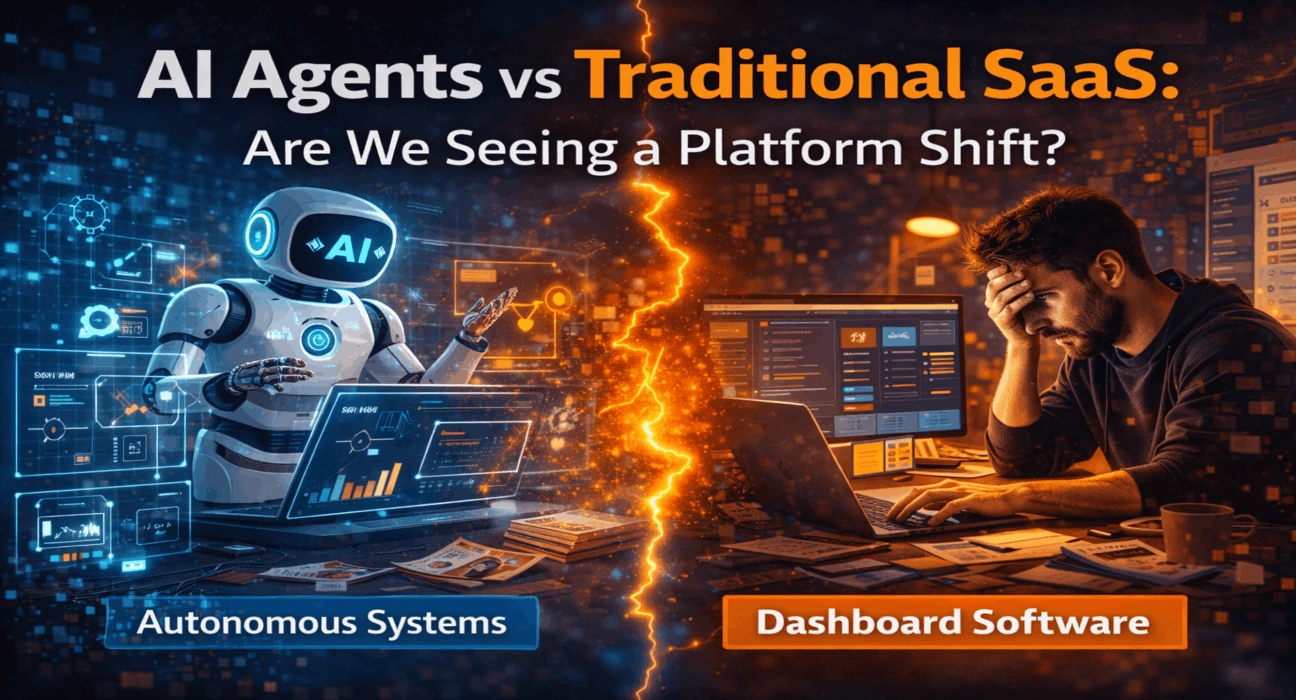
AI Agents vs Traditional SaaS: Are We Seeing a Platform Shift?
Synopsis
For the past two decades, Software as a Service (SaaS) dominated the tech world.
If a company needed tools for marketing, analytics, CRM, or customer support… they subscribed to software. Simple.
Log in. Click buttons. Run workflows.
But something interesting is starting to happen.
And honestly, it’s catching a lot of founders off guard.
Instead of people operating software, software is beginning to operate itself.
That’s where AI agents enter the picture.
These systems don’t just assist users — they complete tasks independently. They analyze data, make decisions, run workflows, and sometimes even communicate with other tools automatically.
So the big question floating around tech circles right now is this:
Are AI agents simply another feature inside SaaS platforms… or are they the beginning of a completely new platform shift?
Let’s unpack it.
What Are AI Agents?
AI agents are autonomous software systems that can perform tasks, make decisions, and interact with other tools or platforms with minimal human intervention.
Unlike traditional SaaS tools that require users to manually operate dashboards and workflows, AI agents can:
- Analyze data automatically
- Execute multi-step tasks
- Communicate with APIs and external tools
- Learn from outcomes and improve decisions
Because of this autonomy, AI agents may represent a new computing interface — where users delegate work to intelligent systems instead of manually operating software.
The Traditional SaaS Model (How Software Worked for Years)
To understand the shift, it helps to revisit how SaaS actually works.
Traditional SaaS tools follow a pretty predictable structure.
You log into a dashboard.
You configure settings.
You run reports or actions.
Think about tools like:
• Salesforce for customer management
• HubSpot for marketing workflows
• Slack for team communication
They’re incredibly powerful platforms.
But they all rely on the same assumption:
Humans operate the software.
Users click buttons.
Users run workflows.
Users analyze results.
AI agents flip that assumption entirely.
AI Agents Change the Interface of Software
Here’s where things start getting interesting.
With AI agents, the interface isn’t necessarily dashboards anymore.
Instead, you might simply say:
“Find leads in the fintech industry and send outreach emails.”
And the agent handles everything.
Research.
Filtering.
Personalized messaging.
Campaign execution.
Platforms like OpenAI and Anthropic are pushing this direction forward by developing large language models capable of reasoning through complex tasks.
And tools built on top of these models are evolving quickly.
Which raises a serious question.
If software can act autonomously… do we still need traditional dashboards?
Why Founders Are Paying Close Attention
Startup founders tend to notice platform shifts early.
Because those shifts create entirely new markets.
We saw it happen before:
Desktop software → Web applications
Web applications → Mobile apps
Mobile apps → Cloud SaaS
Now some technologists believe the next step could be:
Software → Autonomous AI agents
Even companies like Microsoft and Google are integrating agent-style AI into their ecosystems.
From productivity tools to development platforms, automation is becoming more proactive and intelligent.
And startups? They’re experimenting aggressively.
Why AI Agents Could Disrupt SaaS
There are a few reasons analysts believe AI agents could challenge traditional SaaS models.
Let’s break them down.
1. Reduced Software Complexity
Traditional SaaS platforms often require onboarding, training, and configuration.
AI agents simplify that.
Instead of learning software, users simply describe outcomes.
That drastically reduces friction.
2. Cross-Tool Automation
One SaaS platform typically solves one category of problem.
AI agents, on the other hand, can operate across multiple tools simultaneously.
For example:
An AI agent could connect your CRM, marketing platform, analytics dashboard, and billing system… and coordinate workflows between them.
Humans rarely do that efficiently.
3. Continuous Execution
SaaS tools usually operate when humans trigger them.
AI agents can run continuously.
Monitoring markets.
Tracking customer behavior.
Optimizing campaigns.
All without waiting for someone to log in.
But SaaS Isn’t Disappearing Anytime Soon
Now — and this is important — AI agents probably won’t replace SaaS entirely.
At least not soon.
In fact, many AI agents will likely run on top of SaaS platforms.
Think of SaaS as infrastructure.
And agents as operators.
A good analogy might be this:
SaaS platforms are like factories.
AI agents are the workers inside them.
You still need the factory.
But the workers are becoming autonomous.
The Real Shift Might Be the User Interface
Some experts argue the real platform shift isn’t SaaS vs agents.
It’s interfaces.
For years, software relied on graphical user interfaces — dashboards, menus, and forms.
But AI introduces something new:
Conversational interfaces.
Instead of clicking menus, users describe what they want.
And the system executes it.
That’s a big change.
What This Means for Startup Founders
For founders building software today, this shift raises several strategic questions.
Should your product remain a dashboard tool?
Or should it evolve into an autonomous system?
Some startups are already moving in this direction by building AI copilots inside their platforms.
Others are building fully autonomous tools from the ground up.
Honestly, the market is still experimenting.
Which makes this moment particularly exciting.
Final Thoughts
So are AI agents replacing traditional SaaS?
Not exactly.
But they are changing how people interact with software.
And historically, when interfaces change, entire industries shift along with them.
Command lines became graphical interfaces.
Web apps replaced desktop software.
Mobile apps changed digital behavior entirely.
AI agents could represent the next step in that evolution.
Or maybe — and this is possible too — they simply become another layer on top of SaaS.
Either way, one thing seems clear.
Software is slowly moving from something we operate… to something that operates for us.
And honestly, that’s a pretty fascinating shift to watch.
Summary
Article Name
AI Agents vs SaaS: Are We Entering a New Software Era?
DescriptionAI agents are transforming how software works. Explore whether autonomous AI systems could disrupt traditional SaaS platforms and reshape the future of software.
Author
Upstartzen Editorial Team
Publisher Name
Upstartzen
Publisher Logo