



AI Tool Stack for Solo Founders in 2026 (Realistic & Affordable)
Synopsis
A few years ago, starting a company alone sounded… honestly, a little unrealistic.
You needed developers. Designers. Marketing teams. Customer support. Maybe even a sales team before your first serious revenue.
But in 2026, things look very different.
Thanks to the explosion of AI-powered tools, solo founders are now building and running profitable startups with surprisingly small budgets — sometimes under $200 per month.
And to be honest, the most interesting part isn’t just the technology.
It’s the new operating model.
One founder can now manage product development, content marketing, customer onboarding, analytics, and automation — all using a carefully designed AI tool stack.
But here’s the catch.
The internet is full of “100 AI tools you must use” lists. Most of them are unrealistic, expensive, or simply unnecessary.
So instead of that, let’s talk about something more practical.
A realistic, affordable AI tool stack that solo founders are actually using in 2026.
What Is an AI Tool Stack for Solo Founders?
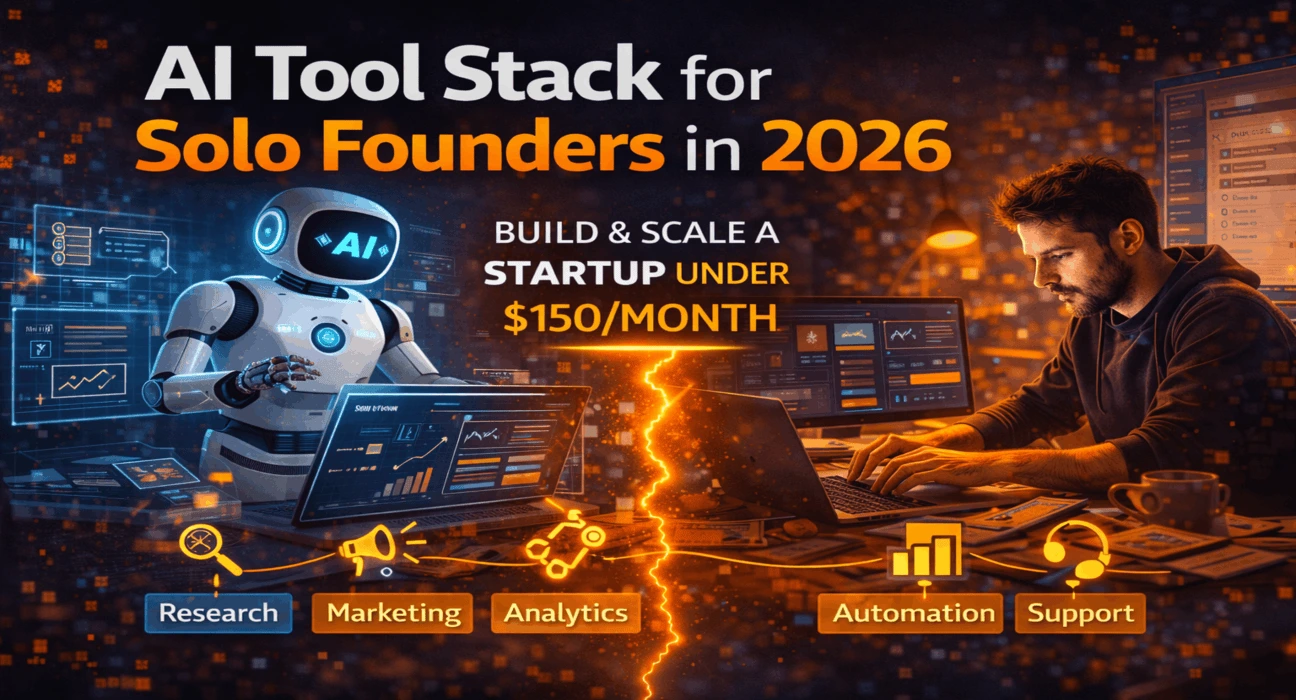
An AI tool stack for solo founders is a curated set of affordable AI-powered tools used to automate essential business tasks such as product development, content creation, marketing, analytics, and customer support — enabling a single founder to operate like a small team.
Typical AI tool stacks include solutions for:
- AI writing and research
- No-code product development
- Marketing automation
- Analytics and growth tracking
- Customer support automation
When combined effectively, these tools allow solo entrepreneurs to build and scale startups without hiring large teams.
The New Reality of Solo Startups
If you’ve spent any time around startup communities lately, you might have noticed a pattern.
Small teams are getting smaller.
And sometimes… they’re disappearing entirely.
A growing number of founders are running profitable micro-SaaS businesses alone, powered heavily by AI.
Tools from companies like OpenAI, Anthropic, and Notion have dramatically lowered the barrier to starting digital products.
But having access to AI tools isn’t the same as using them effectively.
That’s where a well-designed stack matters.
The Core AI Tool Stack for Solo Founders
Let’s walk through the essential categories every solo founder usually needs.
Not the flashy stuff — the practical tools that actually get work done.
1. AI Research and Writing Tools
Content creation is still one of the most powerful growth strategies for early startups.
Blog posts. Landing pages. newsletters. SEO articles.
And yes, doing all that alone can be exhausting.
That’s where AI writing assistants come in.
One of the most commonly used tools is ChatGPT.
ChatGPT AI writing assistant
Founders use it for:
• blog outlines
• SEO content drafts
• marketing copy
• customer support responses
Another helpful research tool is Perplexity AI.
It’s great for gathering verified sources quickly — something especially useful when writing industry articles.
2. No-Code Product Development Tools
You might be wondering:
Do solo founders still need developers?
Sometimes, yes.
But no-code platforms have come a long way.
One standout tool is Bubble.
With Bubble, founders can build:
• SaaS platforms
• marketplaces
• internal tools
• MVP products
Another popular tool is Webflow.
Webflow website builder
Many startups now launch their first website entirely on Webflow before writing a single line of code.
3. Automation and Workflow Tools
Running a startup involves dozens of repetitive tasks.
Emails. Notifications. Data syncing.
Automation tools handle these behind the scenes.
One of the most widely used platforms is Zapier.
Zapier automation platform
Zapier connects thousands of apps and automates workflows such as:
• lead capture
• email follow-ups
• CRM updates
• data syncing
And honestly, once you start automating tasks, it becomes hard to go back.
4. Analytics and Growth Tracking
You can’t grow what you don’t measure.
Even solo founders need clear insights into user behavior.
Two popular analytics tools include:
Google Analytics
Google Analytics website tracking
and
Plausible Analytics
Plausible analytics dashboard
The difference?
Google Analytics offers powerful insights, while Plausible provides simpler dashboards and better privacy compliance.
5. Customer Support Automation
Customer support used to require dedicated teams.
Now AI chat systems handle many early-stage support interactions.
Platforms like Intercom provide AI-driven support chatbots.
These systems can answer questions, guide onboarding, and escalate complex issues when needed.
The Real Cost of a Solo Founder AI Stack
Here’s the good news.
A practical AI stack doesn’t need to be expensive.
Many founders operate with something like:
AI writing tools: $20–$40
Automation tools: $20–$50
Analytics tools: free or $9
No-code development tools: $30–$50
Total monthly cost?
Often under $150 per month.
That’s less than the cost of hiring a single freelancer for one project.
But Tools Alone Don’t Build Companies
This part is important.
AI tools amplify productivity — but they don’t replace strategy.
The best solo founders still focus on fundamentals:
• understanding their customers
• solving real problems
• building sustainable revenue models
Tools make execution faster.
But the thinking still has to come from the founder.
Final Thoughts
The rise of AI tools has quietly created a new startup archetype:
The solo founder operator.
Someone who designs products, writes content, automates workflows, and manages growth — often without hiring large teams.
And honestly, that trend will probably continue.
AI capabilities are improving rapidly.
Automation is becoming more powerful.
And software is becoming easier to build.
Which means the question for future founders isn’t just:
“Do I have a team?”
It’s increasingly:
“Do I have the right stack?”
Because with the right AI tools, a single founder can now do what once required an entire startup team.
And that… is a pretty remarkable shift.
Summary
Article Name
Best AI Tool Stack for Solo Founders in 2026
DescriptionDiscover the most practical and affordable AI tool stack for solo founders in 2026. Learn how one person can build, automate, and grow a startup using AI tools.
Author
Upstartzen Editorial Team
Publisher Name
Upstartzen
Publisher Logo