





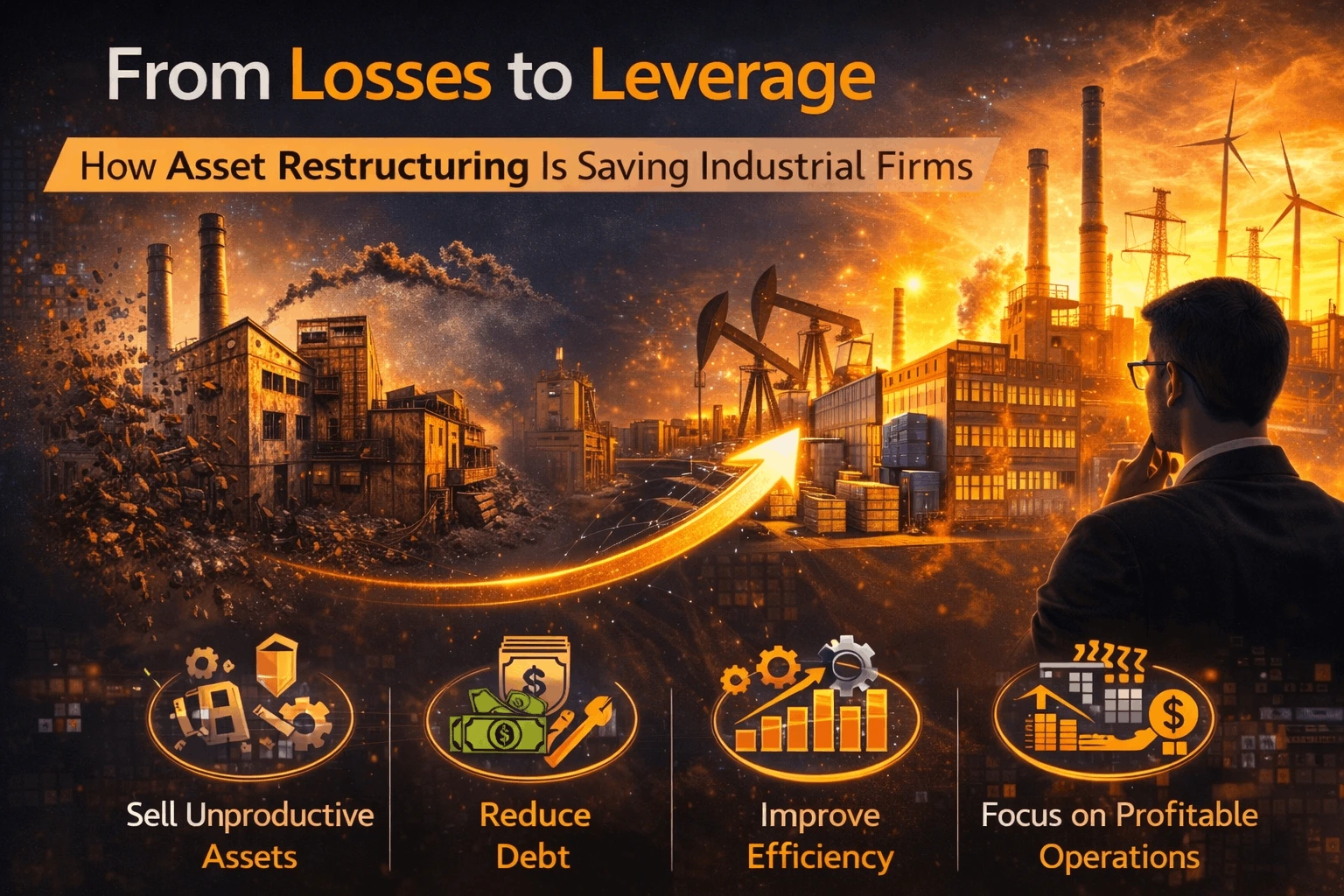
From Losses to Leverage: How Asset Restructuring Is Saving Industrial Firms

Synopsis
For a long time, the playbook for struggling industrial companies was pretty predictable. Cut costs. Lay off staff. Shut down underperforming units. Maybe sell a division or two if things got really rough.
But something interesting has been happening lately. And to be honest, it’s not getting nearly as much attention as flashy tech layoffs or startup funding rounds.
Industrial firms — especially mid-sized manufacturers and infrastructure operators — are quietly using asset restructuring as a survival strategy. Not just to stop losses… but to actually regain leverage in the market.
And when we talk about leverage, it’s not only financial leverage. It also includes operational flexibility, investor confidence, and the ability to compete again in a market that has changed dramatically over the last decade.
In fact, asset restructuring is becoming one of the most effective corporate turnaround strategies in sectors such as energy, manufacturing, logistics, and heavy industry.
So how does it work? And why are more companies choosing restructuring instead of traditional cost-cutting?
Let’s break it down.
What Is Asset Restructuring and Why Are Industrial Firms Using It?
Asset restructuring is a corporate turnaround strategy where companies reorganize, sell, repurpose, or optimize underperforming assets to improve financial stability, reduce debt, and increase operational efficiency.
Industrial firms use asset restructuring to shift capital toward profitable operations, strengthen balance sheets, and adapt to changing market conditions while maintaining long-term competitiveness.
The Industrial Sector Has Been Under Pressure
If you’ve been watching industrial markets over the past few years, you probably noticed something.
Margins have been tightening. Supply chains have become unpredictable. Energy prices swing more than they used to. And investors — well, they’re a lot less patient than they were a decade ago.
Companies like General Electric and Siemens have already demonstrated what large-scale restructuring can look like. Divesting divisions, spinning off business units, and narrowing focus.
But here’s the thing. It’s not just the giants doing this anymore.
Mid-sized industrial firms are adopting similar strategies — sometimes even faster.
And honestly, they have to.
Industrial markets today reward specialization and efficiency. The days of sprawling conglomerates holding dozens of unrelated assets are fading.
The Old Playbook: Cost Cutting
Traditionally, when an industrial firm faced losses, leadership went straight to cost reduction.
Which usually meant:
- workforce reductions
- facility closures
- delayed capital investment
- operational downsizing
Sure, those moves can stabilize finances temporarily. But they don’t always solve the core issue: misaligned assets.
Think about it like owning a fleet of trucks when the market suddenly demands rail logistics. Cutting driver salaries won’t fix that mismatch.
And that’s exactly where asset restructuring enters the conversation.
A Shift Toward Strategic Asset Management
Asset restructuring focuses less on cutting and more on reallocation.
Instead of shrinking the business, companies evaluate which assets truly create value.
That could include:
• selling underperforming plants
• merging redundant operations
• spinning off non-core business units
• converting facilities for new production lines
• investing in automation for higher efficiency
In other words, it’s less about survival — and more about repositioning.
Real-World Example: Industrial Portfolio Simplification
Take General Electric again.
The company spent years restructuring its massive portfolio, eventually separating into focused businesses like aviation, healthcare, and energy. The goal was simple: reduce complexity and improve capital allocation.
Details about GE’s restructuring strategy can be found here:
GE Corporate Transformation Overview
Now, not every industrial firm operates at GE’s scale. But the principle still applies.
Focus creates efficiency.
And efficiency attracts capital.
Why Investors Actually Like Asset Restructuring
You might assume investors get nervous when companies start selling assets. But interestingly, the opposite often happens.
Investors tend to reward restructuring when it signals discipline.
Why?
Because it shows leadership is willing to make tough decisions instead of protecting legacy operations.
In many cases, asset restructuring leads to:
- improved debt ratios
- higher return on assets (ROA)
- stronger free cash flow
- clearer corporate strategy
And let’s be honest… clarity matters. Investors hate confusion more than they hate risk.
How Does Asset Restructuring Improve Financial Performance?
Asset restructuring improves financial performance by eliminating underperforming operations, reducing operational costs, reallocating capital to profitable business segments, and strengthening a company’s balance sheet.
Technology Is Accelerating Restructuring Decisions
Here’s something that doesn’t get talked about enough.
Advanced analytics and industrial AI are making it easier for companies to identify which assets actually generate value.
Firms can now analyze:
- equipment utilization rates
- maintenance costs
- productivity per facility
- supply chain efficiency
Solutions from companies like IBM and Honeywell help industrial operators monitor asset performance in real time.
And when the data shows a facility consistently underperforming? Decisions become a lot clearer.
Global Trends Driving Restructuring
Asset restructuring is also being accelerated by broader economic forces.
1. Energy Transition
Industrial firms are moving away from carbon-intensive operations and investing in cleaner infrastructure.
This often requires selling or repurposing legacy facilities.
2. Supply Chain Realignment
Manufacturers are shifting production closer to key markets. That means older facilities in some regions are being closed or sold.
3. Capital Efficiency Pressure
Private equity firms and institutional investors now demand stronger balance sheets and clearer capital strategies.
The Startup Angle: Why Founders Should Pay Attention
Now you might be wondering… what does this have to do with startups?
Quite a lot, actually.
When industrial firms restructure assets, they often:
- outsource specialized operations
- invest in automation platforms
- partner with technology providers
- acquire innovative startups
So restructuring can actually create new opportunities for startups building solutions in areas like:
- industrial software
- predictive maintenance
- robotics and automation
- energy optimization
Corporate turnarounds sometimes become startup growth engines.
Funny how that works.
Risks of Asset Restructuring
Of course, restructuring isn’t magic.
Done poorly, it can create its own problems.
Companies sometimes face:
- operational disruption
- employee resistance
- short-term revenue decline
- integration challenges
And occasionally, leadership misjudges which assets truly drive value.
But when executed carefully, restructuring can fundamentally reset a company’s trajectory.
AEO, GEO & AIO Optimization Notes
AEO (Answer Engine Optimization)
Clear definitions, structured subheadings, and direct answers improve visibility in AI-powered search results.
GEO (Generative Engine Optimization)
Providing context, industry examples, and real-world company references helps AI models understand topic relevance.
AIO (AI Optimization)
Readable language, concise explanations, and structured sections improve discoverability in AI-driven search interfaces.
Final Thoughts
Industrial companies aren’t just cutting costs anymore.
They’re rethinking what they actually own — and why.
Asset restructuring allows firms to transform losses into leverage by redirecting resources toward the parts of the business that truly matter.
And in a global economy where efficiency, sustainability, and capital discipline matter more than ever, that kind of strategic clarity can make the difference between slow decline and a genuine corporate turnaround.
The lesson?
Sometimes saving a company isn’t about doing more.
It’s about owning less — but owning the right things.
Summary
Article Name
From Losses to Leverage: How Asset Restructuring Is Reviving Industrial Firms
DescriptionIndustrial companies are using asset restructuring to cut losses, improve capital efficiency, and drive corporate turnarounds. Here’s how the strategy is reshaping industry.
Author
Upstartzen Editorial Team
Publisher Name
Upstartzen
Publisher Logo