





How CEOs Are Reducing Headcount Without Reducing Output
Synopsis
A few years ago, if a company announced layoffs, the narrative was pretty predictable.
Revenue pressure. Market downturn. Cost-cutting mode.
But something different has been happening lately. And to be honest, it’s a little more complicated than the usual “economic slowdown” explanation.
Across the tech world and startup ecosystem, CEOs are quietly reducing team sizes — yet many of these companies are still maintaining, sometimes even increasing, productivity.
Sounds contradictory, right?
Fewer people. Same output.
You might be wondering how that’s even possible.
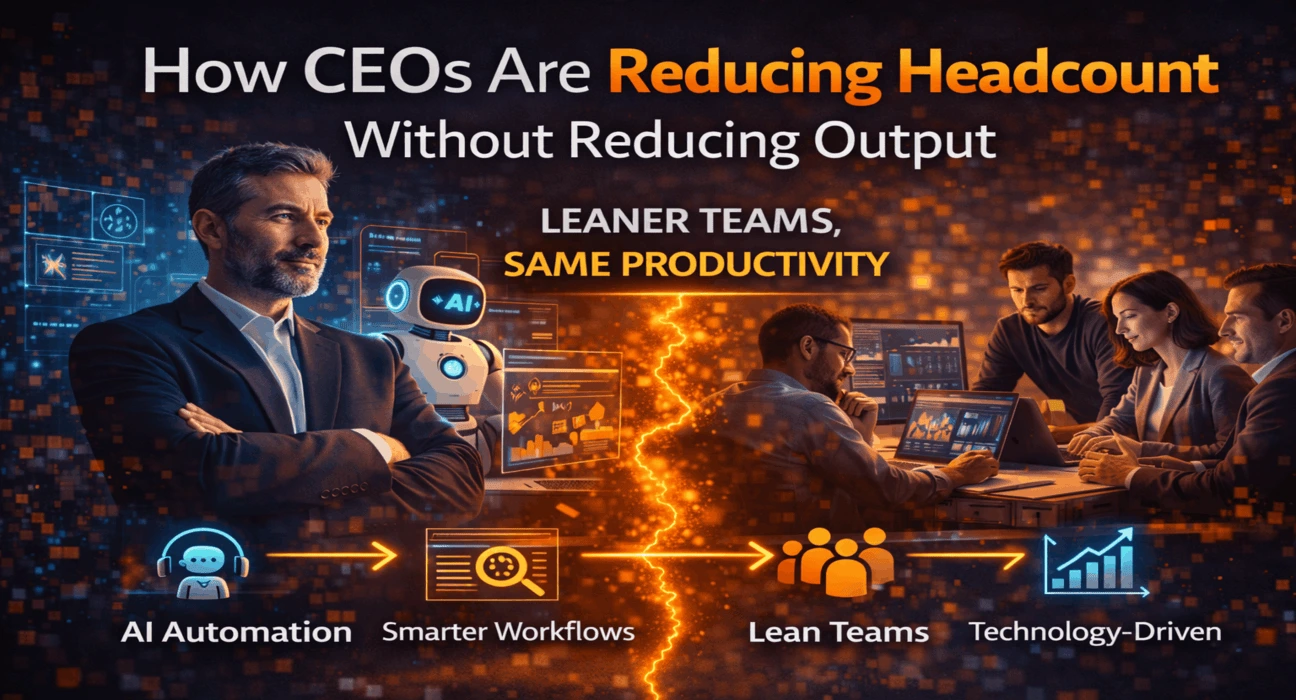
Well, the answer sits at the intersection of AI automation, operational restructuring, and smarter workflow design.
It’s not simply about cutting jobs. In many cases, it’s about redesigning how work gets done.
And for modern startups trying to survive competitive markets, this shift is becoming a strategic necessity.
Let’s unpack what’s really happening.
Why Companies Are Reducing Headcount in the First Place
Before discussing productivity, we should probably address the obvious question: why are companies shrinking teams at all?
Over the past few years, many tech companies expanded aggressively. Cheap capital, booming digital demand, and rapid hiring created massive organizations almost overnight.
But when economic conditions tightened, those structures suddenly looked… heavy.
Executives began realizing that growth alone doesn’t guarantee sustainability.
Companies like Meta Platforms and Google publicly announced workforce reductions while simultaneously investing heavily in AI and automation.
Meta workforce restructuring strategy
Google AI transformation strategy
The message from leadership was clear: future productivity would depend more on technology than sheer headcount.
What “Doing More With Less” Actually Means
Doing more with less refers to the strategy where companies reduce headcount while maintaining or even increasing productivity by leveraging automation, artificial intelligence, and improved operational efficiency.
Instead of relying on large teams, organizations increase output by:
- Automating repetitive tasks
- Using AI-powered tools for research and analysis
- Improving internal workflows
- Focusing teams on higher-value work
This approach allows companies to maintain performance levels while operating with leaner, more efficient teams.
AI Tools Are Replacing Repetitive Work
One of the biggest drivers behind leaner teams is automation.
Tasks that once required entire departments — content drafting, customer support responses, internal research — can now be assisted by AI systems.
Platforms like ChatGPT and Notion AI are increasingly integrated into daily workflows.
ChatGPT AI productivity tool
Notion AI workspace assistant
And honestly, the impact can be dramatic.
A marketing team that previously needed five writers might now operate effectively with two — supported by AI for research, outlines, and early drafts.
Developers, designers, analysts — many roles are experiencing similar productivity boosts.
It doesn’t mean humans are disappearing from the process.
But their roles are shifting toward strategy, decision-making, and creative direction rather than manual execution.
Operational Efficiency Is Becoming a CEO Priority
Another factor that’s often overlooked is workflow optimization.
Sometimes companies didn’t have too many employees… they simply had inefficient processes.
CEOs are now investing heavily in workflow management systems, collaboration tools, and automation pipelines.
Tools like Zapier allow teams to automate routine processes across software platforms.
Zapier automation workflows
Instead of manually moving data between tools, automated systems handle these tasks in the background.
It might sound small.
But multiply that efficiency across hundreds of daily tasks, and suddenly entire workloads shrink.
Smaller Teams Often Move Faster
Here’s something interesting.
Some CEOs are discovering that smaller teams actually operate more efficiently.
Large organizations tend to create layers of communication, approvals, and coordination overhead.
But lean teams?
They move fast.
Decision-making is quicker. Meetings are shorter. Accountability becomes clearer.
In fact, venture capitalist Marc Andreessen has frequently argued that technology-driven companies should prioritize small, highly productive teams rather than large bureaucratic structures.
Marc Andreessen productivity philosophy
And in many modern startups, that philosophy is becoming reality.
The Risk CEOs Must Manage Carefully
Of course, reducing headcount isn’t without risks.
If layoffs are handled poorly, they can damage morale, reputation, and long-term talent retention.
Employees who remain may experience burnout if workloads aren’t balanced properly.
That’s why many CEOs emphasize that efficiency improvements should come from smarter systems, not simply fewer people doing more work.
The goal isn’t squeezing employees harder.
It’s eliminating unnecessary friction in the way work happens.
What This Means for the Future of Work
If this trend continues — and most analysts believe it will — the structure of companies could change significantly.
Organizations may become smaller but more technologically empowered.
AI tools will handle routine processes.
Human employees will focus on creativity, strategy, and problem-solving.
And productivity metrics will increasingly depend on how effectively companies integrate technology, not just how many employees they hire.
Which, honestly, represents a pretty big shift in how businesses think about growth.
Final Thoughts
The idea that companies can reduce headcount while maintaining output might sound counterintuitive at first.
But when you look closer, it’s not really about cutting people.
It’s about redesigning the way work happens.
Automation replaces repetitive tasks.
AI accelerates research and execution.
Lean teams reduce bureaucracy.
Put all those factors together, and the result is a new operational model — one where productivity comes from systems and intelligence, not just scale.
And for CEOs navigating uncertain economic conditions, that model is quickly becoming the new standard.
Summary
Article Name
How CEOs Are Cutting Headcount Without Cutting Output
DescriptionDiscover how CEOs are reducing headcount without lowering productivity by using AI automation, smarter workflows, and leaner operational strategies.
Author
Upstartzen Editorial Team
Publisher Name
Upstartzen
Publisher Logo