



From Failure to Funding: Lessons from 5 Startup Founders Who Turned Setbacks into Success
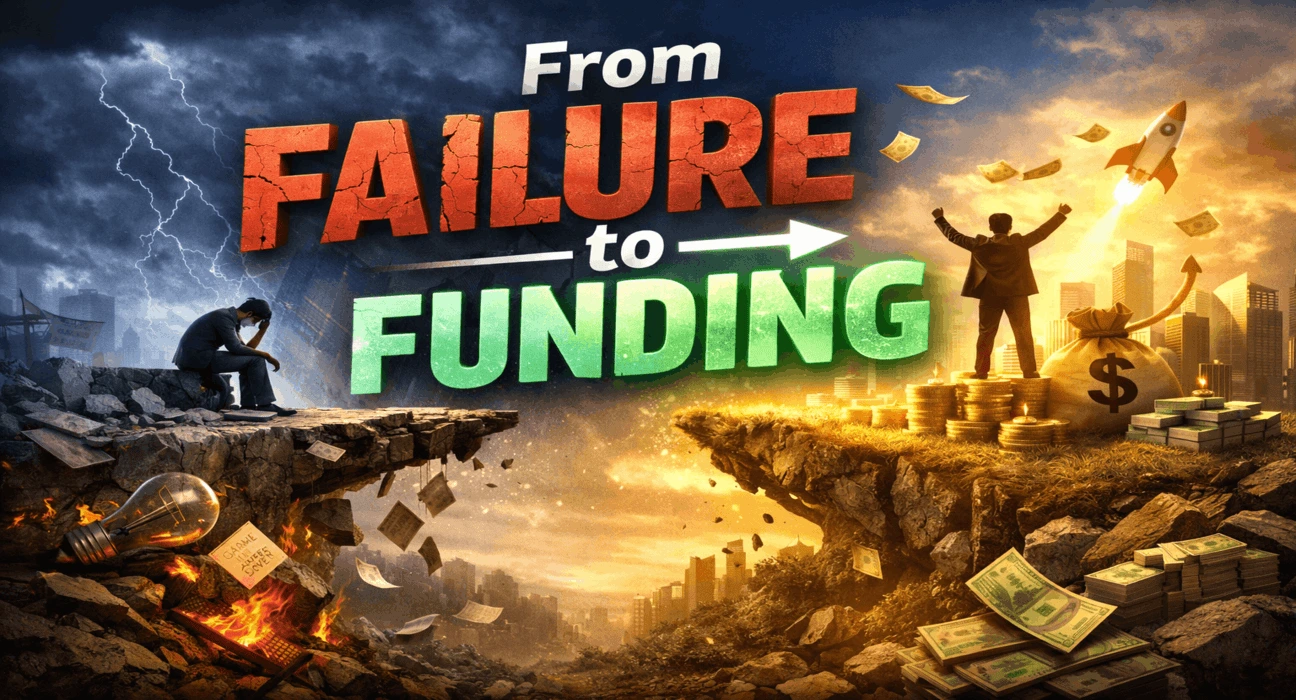
Failure isn’t rare in startups.
It’s the default.
What’s rare?
Founders who fail, learn, and come back stronger.
Because here’s the truth…
Investors don’t just fund ideas.
They fund clarity, resilience, and proof of learning.
Some of the most successful founders today didn’t get it right the first time.
They failed. Badly.
And that’s exactly what made them fundable later.
Let’s break down the real lessons—not the stories.
📊 Context: Why Failure is Becoming a Strategic Advantage
Startup culture often glorifies success.
But behind every funded startup, there’s usually:
- A failed product
- A wrong market
- A bad timing decision
Today, investors are smarter.
They look for:
- Pattern recognition
- Learning velocity
- Execution discipline
👉 Which means:
Failure is no longer a red flag. It’s a signal—if you learned from it.
What Does “Failure to Funding” Mean?
“Failure to funding” refers to the journey where startup founders learn from unsuccessful ventures or mistakes and use those insights to build stronger, fundable businesses.
Key Elements
- Learning from failure
- Improving strategy
- Demonstrating traction
- Building investor confidence
In simple terms:
👉 Fail → Learn → Improve → Get Funded.
Core Breakdown: 5 Founder Lessons That Actually Matter
1. Failure Clarifies the Real Problem (Not the Idea)
🧠 Lesson:
Most first-time founders solve the wrong problem.
📉 What Happens:
- Build product → No demand
- Launch → No traction
💡 What Successful Founders Do:
They pivot from:
❌ Idea-first thinking
➡️ Problem-first thinking
📊 Insight:
Second-time founders are more likely to succeed because:
👉 They understand customer pain deeply
2. Timing Matters More Than Talent
Let’s be honest…
You can build a great product at the wrong time and still fail.
📉 Common Mistake:
- Market not ready
- Technology not mature
- Customer awareness low
💡 Post-Failure Advantage:
Founders learn:
- When to enter
- When to wait
- When to pivot
📊 Example Pattern:
Many startups fail, then relaunch 1–2 years later and succeed.
👉 Same idea. Different timing.
3. Distribution Beats Product (Every Time)
This is the harsh truth…
Most failed startups didn’t fail because of bad products.
They failed because:
👉 No one knew they existed
💡 Lesson:
After failure, founders focus on:
- Marketing early
- Building audience
- Testing channels
📊 Insight:
Startups with strong distribution:
👉 Raise funding faster
Because traction = proof.
4. Investors Fund Traction, Not Potential
🧠 First-Time Mistake:
Pitch decks full of:
- Vision
- Market size
- Future projections
💡 After Failure:
Founders shift to:
- Real users
- Revenue data
- Retention metrics
📊 Logical Estimate:
A startup with:
👉 1,000 active users
is more fundable than:
👉 A “billion-dollar idea” with zero users
5. Resilience is the Real Signal Investors Look For
Here’s the thing…
Failure filters out weak founders.
💡 What Surviving Founders Show:
- Persistence
- Adaptability
- Emotional stability
📊 Investor Psychology:
They think:
👉 “If this founder survived failure, they can handle scale.”
📊 Real Founder Case Patterns (Lesson-Based)
🧩 Case Pattern 1: Failed Product → Niche Pivot
- Founder builds broad solution → fails
- Narrows down to niche audience
- Gains traction
👉 Lesson: Specific wins. General loses.
🧩 Case Pattern 2: No Users → Content Strategy
- First startup gets zero traction
- Founder builds audience via content
- Launches second startup with built-in users
👉 Lesson: Audience is leverage
🧩 Case Pattern 3: Burn Money → Build Lean
- First startup spends heavily → fails
- Second startup focuses on:
- Lean operations
- Revenue-first
👉 Lesson: Efficiency beats scale (early stage)
🧩 Case Pattern 4: Solo Founder → Strong Team
- First attempt: solo struggle
- Second attempt: builds complementary team
👉 Lesson: Execution is a team sport
🧩 Case Pattern 5: Idea Obsession → Customer Obsession
- First startup: idea-driven
- Second startup: customer-driven
👉 Lesson: Customers decide success
Contrarian Insight (Important)
Failure alone doesn’t make you better.
Let’s be honest…
Some founders fail multiple times and learn nothing.
👉 The difference is:
Reflection + iteration
Without that:
- Failure becomes repetition
- Not progress
Post-Failure to Funding Framework (Step-by-Step)
Founders can turn failure into funding by auditing mistakes, validating real problems, building lean, focusing on distribution, and proving traction.
-
Post-Failure Audit
- Analyze what went wrong
- Identify if the issue was product, market, or execution
-
Identify the Real Problem
- Talk directly to users
- Validate real demand
-
Build Smaller, Faster
- Launch a lean MVP quickly
- Test assumptions early
-
Focus on Distribution Early
- Build an audience from day one
- Experiment with acquisition channels
-
Show Traction Before Funding
- Active users
- Revenue growth
- User engagement metrics
In simple terms:
👉 Audit → Validate → Build → Distribute → Prove.
Quick Wins
- Talk to 10 users before building
- Validate willingness to pay
- Build audience on LinkedIn or Twitter
- Track retention, not just acquisition
Key Takeaways
- Failure clarifies direction
- Timing matters more than perfection
- Distribution drives success
- Traction attracts funding
- Resilience builds trust
Recommended Tools
- Notion – for planning & tracking
- Figma – for MVP design
- Stripe – for payments
- HubSpot – for CRM
- Google Analytics – for tracking
🔚 Conclusion
Failure isn’t the opposite of funding.
It’s often the path to it.
Because the founders who succeed aren’t the ones who avoid mistakes…
They’re the ones who:
- Learn faster
- Adapt quicker
- Execute smarter
And when they come back?
They don’t just build another startup.
👉 They build a fundable one.
Frequently Asked Questions (Failure to Funding)
1. Can failure help in getting startup funding?
Yes, founders who learn from failure and demonstrate improved strategy, traction, and execution often gain higher investor confidence.
2. Why do investors value experienced founders?
Experienced founders better understand markets, avoid common mistakes, and execute more effectively.
3. What is the biggest lesson from failed startups?
The biggest lesson is to focus on solving real customer problems instead of relying on assumptions.
4. How can founders recover from startup failure?
Founders can recover by analyzing past mistakes, validating new ideas, and building lean, customer-focused products.
5. What do investors look for in second-time founders?
Investors look for resilience, the ability to learn, proven traction, and strong execution capability.
Summary
Article Name
From Failure to Funding: 5 Startup Lessons Every Founder Must Know
DescriptionLearn how founders turn failure into funding with proven lessons, real insights, and actionable strategies to build a successful startup.
Author
Upstartzen Editorial Team
Publisher Name
Upstartzen
Publisher Logo