




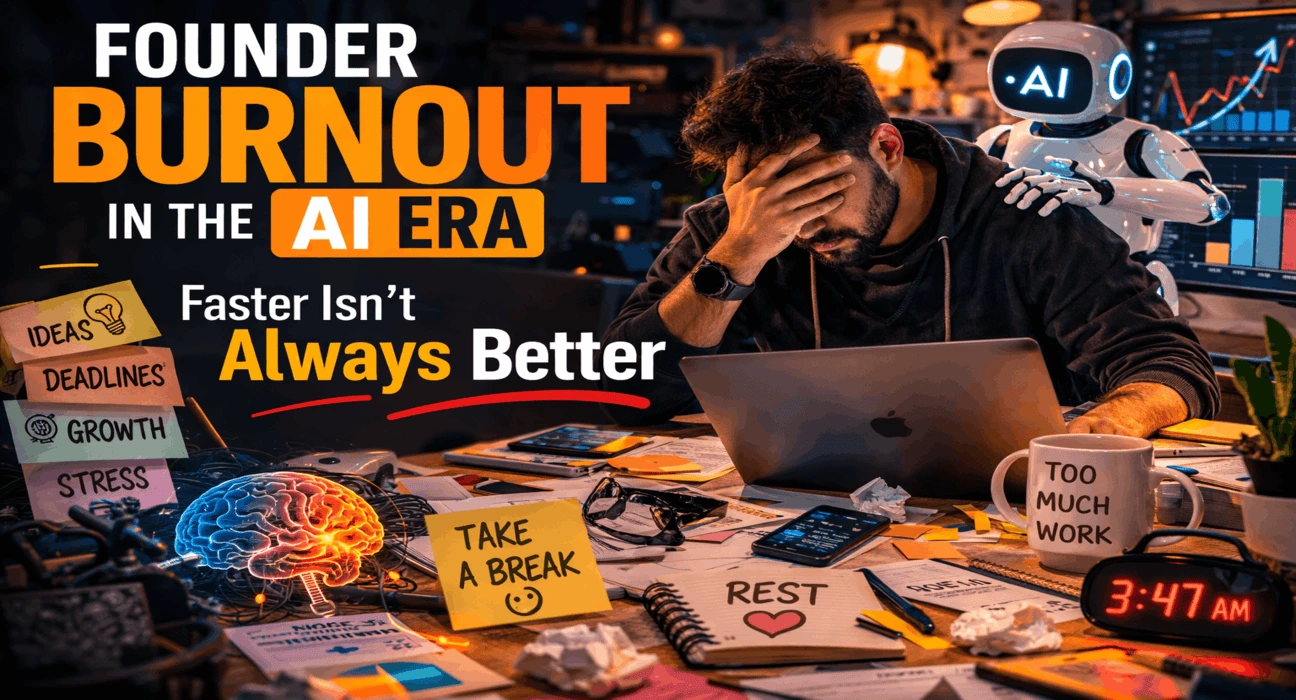
Founder Burnout in the AI Era: Faster Isn’t Always Better
Synopsis
For years, startup culture celebrated speed. Move fast. Ship fast. Scale fast. Break things if necessary.
But something strange is happening in the AI startup ecosystem lately. Founders are moving faster than ever… yet burning out sooner than expected.
To be honest, the AI boom has created a kind of hyper-acceleration culture. With tools that can build products in weeks instead of months, the pressure to move quickly has intensified. Investors expect rapid iteration. Markets shift overnight. And competitors appear almost instantly.
But here’s the catch.
Just because startups can move faster doesn’t mean founders should always move faster.
Across tech communities, early-stage founders are quietly talking about burnout — the mental exhaustion that comes from trying to keep up with a pace that feels almost unnatural. And interestingly, it’s happening even in bootstrapped startups with small teams or even solo founders.
So the real question is this:
Is the AI startup era accidentally creating a burnout epidemic?
Let’s unpack what’s actually happening.
The New Startup Timeline: Months Instead of Years
Not that long ago, launching a SaaS startup could take a year.
You’d hire engineers, design infrastructure, test features, build marketing channels. It was slow but steady.
Now? Entire AI products are launching in 30–60 days.
Developers can plug into AI APIs, generate UI components automatically, and automate backend workflows. Tools like OpenAI, Anthropic, and Google DeepMind have drastically lowered the barrier to building AI-powered software.
And honestly, that’s exciting.
But here’s the flip side.
Speed has quietly changed founder expectations.
Instead of thinking in 12-month product cycles, founders are now operating on weekly or even daily iterations. That might sound productive… until you’re the one trying to maintain that pace for months.
And that’s where burnout starts creeping in.
What Is Founder Burnout in the AI Era?
Founder burnout in the AI era refers to the mental and emotional exhaustion experienced by startup founders due to rapid product cycles, constant innovation pressure, and the expectation to build, launch, and scale AI products at unprecedented speed.
This burnout often stems from:
- Continuous product iteration cycles
- High competition in AI markets
- Solo founder responsibilities
- Pressure to stay ahead of AI technology trends
- Lack of work-life boundaries
Many founders feel they must operate 24/7 just to stay competitive. And that pressure adds up.
The “Infinite Competition” Problem
One thing that’s different about AI startups is the speed of competition.
In traditional startups, competitors might appear months later.
Now? Someone can copy your idea in a weekend.
That’s not an exaggeration.
Because AI tools are accessible globally, developers everywhere are launching similar products simultaneously.
You might be celebrating a product launch… and two days later see five similar tools on platforms like Product Hunt.
That creates a strange psychological loop:
Launch faster → competitors appear → build faster → launch again → repeat.
And honestly, that loop can be exhausting.
When “Move Fast” Turns Into “Never Stop”
Startup culture has always admired hustle.
But the AI startup ecosystem has amplified it.
Founders aren’t just building products anymore. They’re also:
- Managing communities
- Posting on social media
- Writing newsletters
- Handling support
- Running marketing campaigns
- Iterating product features daily
And sometimes they’re doing all of that alone.
The rise of the solo AI founder is inspiring… but also demanding.
Because behind every fast-moving AI product is usually someone who hasn’t taken a real break in months.
Why AI Startups Burn Out Faster
Let’s be real for a second.
The problem isn’t AI itself. It’s the pace around it.
Several factors are driving this burnout trend.
1. The “Build in Public” Pressure
Founders today often share their startup journey online.
Platforms like X (Twitter) and LinkedIn reward constant updates, growth milestones, and product announcements.
But that also creates comparison.
You see another founder shipping features every day… and suddenly you feel like you’re falling behind.
Even when you’re not.
2. AI Technology Evolves Weekly
AI tools evolve incredibly fast.
A feature that feels innovative today might become standard next month.
That forces founders to constantly update their products just to remain relevant.
And keeping up with every new model release or API update can feel like chasing a moving train.
3. Small Teams, Huge Expectations
Many AI startups operate with tiny teams.
Sometimes it’s just one or two people.
But customers still expect enterprise-level reliability, support, and innovation.
That mismatch between team size and user expectations can be overwhelming.
The Hidden Mental Cost of Rapid Innovation
Burnout doesn’t always look dramatic.
Sometimes it’s subtle.
A founder who once loved building products suddenly feels tired opening their laptop.
Ideas feel less exciting.
And small problems feel bigger than they actually are.
That’s usually the first sign something isn’t right.
Interestingly, some investors are starting to acknowledge this issue. Programs like Y Combinator have increasingly discussed founder mental health in startup communities.
Because, well… a burned-out founder can’t build a sustainable company.
A Healthier Approach to Building AI Startups
So does this mean founders should slow down completely?
Not really.
Speed still matters in startups.
But sustainable speed matters more.
Here are a few approaches many experienced founders recommend.
Focus on One Core Problem
Some founders try to build too many AI features at once.
Instead, successful startups usually focus on solving one problem extremely well.
It sounds simple… but it reduces cognitive overload dramatically.
Build Cycles Instead of Constant Speed
Instead of working at maximum speed all the time, founders can structure work into cycles:
Build → Launch → Rest → Iterate
That rhythm makes innovation sustainable.
Automate Internal Workflows
Ironically, AI itself can reduce founder burnout.
Automation tools can handle tasks like:
- Customer onboarding
- Support responses
- Data analysis
- Content generation
Platforms like Zapier and Notion are increasingly used by founders to automate daily operations.
The AI Startup Era Needs Sustainable Founders
Here’s something many people forget.
Startups aren’t just about products.
They’re about the people building them.
And if founders burn out quickly, innovation slows down anyway.
The AI era will likely produce thousands of new startups over the next decade. Some will grow into massive companies. Others will pivot or fade away.
But the founders who succeed long term probably won’t be the ones who simply move fastest.
They’ll be the ones who build consistently without burning themselves out.
Which, if you think about it, is a much harder skill.
Final Thoughts
The AI startup boom is exciting. No question about it.
But speed alone isn’t a strategy.
And sometimes… slowing down slightly is what actually helps founders build better companies.
Because at the end of the day, startups are marathons.
Not sprints.
Even in the age of AI.
Summary
Article Name
Founder Burnout in the AI Era: Why Moving Faster Isn’t Always Better
DescriptionThe AI startup boom is accelerating innovation — but it’s also increasing founder burnout. Here’s why moving faster isn’t always better for startups.
Author
Upstartzen Editorial Team
Publisher Name
Upstartzen
Publisher Logo