



How GE’s Breakup and Restructuring Helped Create $200B in Market Value

📊 Synopsis
General Electric (GE) was once considered one of the world’s most powerful conglomerates, operating across aviation, healthcare, energy, finance, and media. But after the 2008 financial crisis, the company began struggling with rising debt, operational complexity, and declining investor confidence. The traditional conglomerate model started losing relevance in a fast-moving, tech-driven global economy.
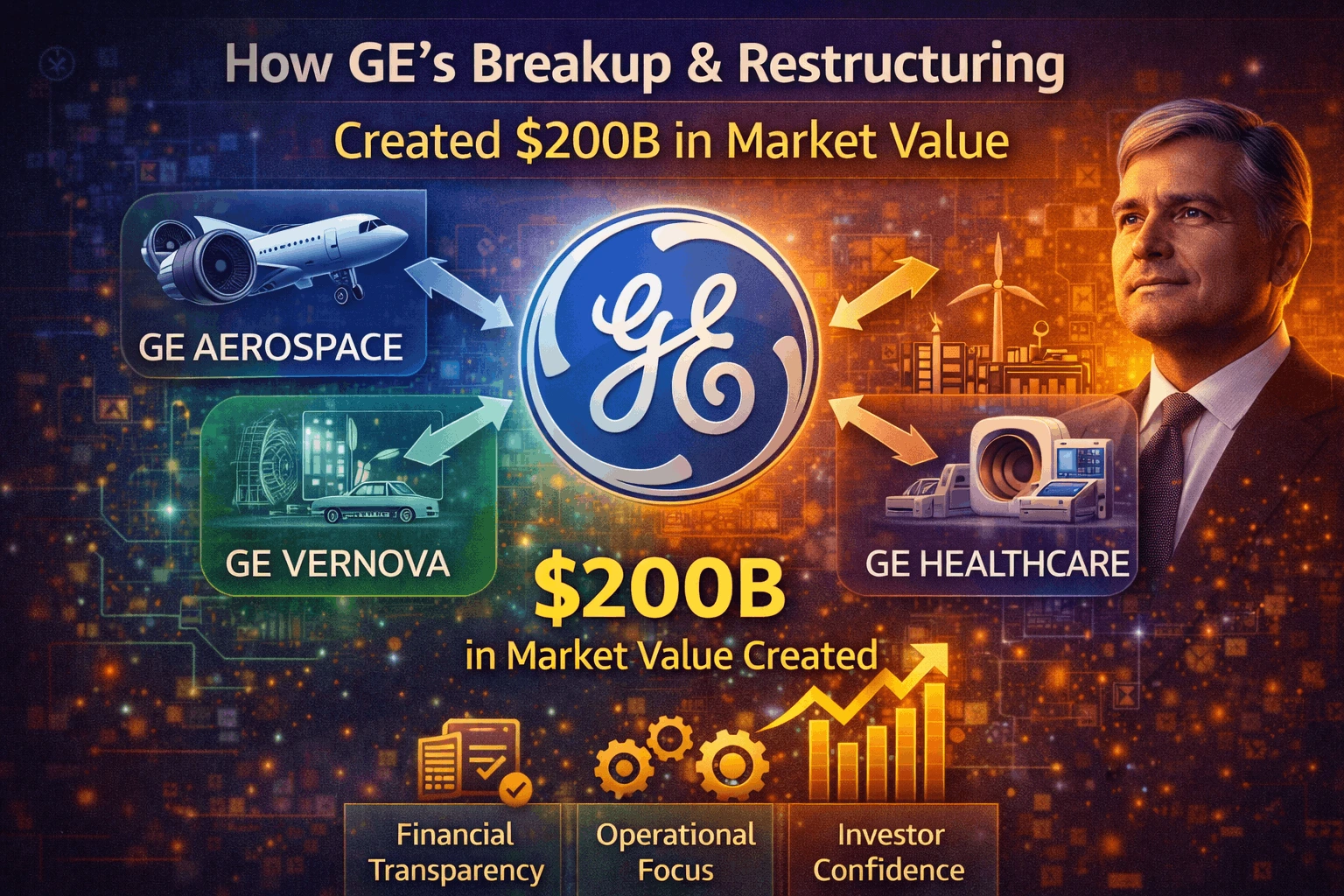
In a bold strategic move, GE decided to split into three independent companies — GE Aerospace, GE HealthCare, and GE Vernova. Instead of managing multiple unrelated industries under one structure, each entity gained operational focus, financial transparency, and independent growth strategies.
The restructuring unlocked nearly $200 billion in combined market value, transforming GE into a modern case study on corporate reinvention. The story highlights a powerful lesson for businesses and startups alike — sustainable growth often comes from strategic focus rather than scale alone.
Why Did GE Break Up Its Business?
General Electric split into separate companies to improve financial transparency, increase operational focus, reduce debt burden, and unlock shareholder value. By separating aviation, healthcare, and energy businesses into independent entities, GE allowed each division to pursue specialized growth strategies, leading to improved investor confidence and significant market value creation.
The Rise — And Overstretch — of a Corporate Titan
To understand GE’s turnaround, we need to rewind a bit. Because GE wasn’t just successful… it was legendary. Founded by Thomas Edison in 1892, GE basically shaped modern industrial America.
At its peak under Jack Welch in the 1980s and 1990s, GE became known for aggressive expansion and financial discipline. Welch built GE into one of the most valuable companies globally. And honestly, for years, the conglomerate strategy worked beautifully.
But — and this is where reality creeps in — markets don’t stay loyal to old models forever.
GE Capital, its financial services arm, became massively profitable during growth years. Yet during the 2008 financial crisis, that same division exposed GE to enormous risk. Investors started questioning whether an industrial company should be so heavily tied to financial markets.
And suddenly, GE looked… vulnerable.
The Conglomerate Discount Problem
You might be wondering what “conglomerate discount” means. Sounds technical, right? But it’s actually pretty simple.
When a company operates across unrelated industries, investors sometimes undervalue it because financial performance becomes harder to analyze. It’s like trying to judge three businesses inside one financial statement. Confusing. Messy. Risky.
According to investment research published by Harvard Business Review
Why Conglomerates Rise and Fall
Conglomerates often struggle with valuation because investors prefer focused, transparent businesses.
GE faced exactly this issue.
The Bold Decision: Strategic Breakup
Instead of protecting its legacy structure, GE leadership — especially under CEO Larry Culp — made a difficult call. And let’s be honest, it was risky.
GE announced plans to split into three companies:
1. GE Aerospace
Focused purely on aviation engines and defense technology. This division already had strong global demand and high margins.
2. GE HealthCare
Specialized in medical imaging, diagnostics, and hospital technology. A sector benefiting from global healthcare expansion.
3. GE Vernova
Dedicated to energy infrastructure, renewables, and power solutions — arguably one of the most future-facing divisions.
By separating these verticals, GE allowed each company to operate with independent leadership, customized capital allocation, and targeted innovation strategies.
Financial Transparency Changed Everything
Here’s something many casual readers miss. Breaking up GE wasn’t just about simplifying operations. It dramatically improved financial clarity.
Investors could finally evaluate each business individually. Aviation could be valued against aerospace competitors. Healthcare could be compared with medical device giants. Energy could be benchmarked against renewable infrastructure players.
According to Bloomberg’s corporate restructuring analysis
GE’s Historic Breakup Strategy Explained
Clearer financial reporting significantly increased investor trust and valuation multiples.
And honestly, investor psychology matters more than most companies admit.
Debt Reduction and Balance Sheet Reset
GE’s restructuring also helped tackle another silent problem — debt. Over years of expansion and acquisitions, GE accumulated massive liabilities.
By divesting non-core assets and redistributing liabilities across new entities, GE strengthened balance sheets. And stronger balance sheets mean better borrowing capacity, improved credit ratings, and higher institutional investment confidence.
It’s kind of like decluttering your financial house before inviting investors inside.
Leadership Autonomy Accelerated Growth
Each spun-off company now had focused leadership teams. That meant faster decision-making, industry-specific innovation, and more accountable management structures.
For example:
- GE Aerospace could prioritize next-gen jet engine efficiency.
- GE HealthCare could accelerate AI-driven diagnostic tools.
- GE Vernova could invest heavily in renewable energy infrastructure.
And when companies operate with laser focus, innovation often moves faster. Almost naturally.
Market Value Creation: The $200 Billion Story
Now comes the part that really grabbed global investor attention.
Post-restructuring, combined market valuations of GE Aerospace, GE HealthCare, and GE Vernova crossed roughly $200 billion across various market cycles and valuation estimates.
That value wasn’t magically created. It was unlocked.
Because investors could finally see each company’s individual potential.
What Startups and Modern Corporations Can Learn
And this is where GE’s story becomes incredibly relevant to startup ecosystems and growth-stage companies.
Lesson 1: Bigger Isn’t Always Better
Sometimes expansion hides inefficiencies.
Lesson 2: Focus Drives Valuation
Investors love clarity. Clear business models attract better funding and partnerships.
Lesson 3: Transparency Builds Trust
When stakeholders understand financial performance clearly, confidence rises.
Lesson 4: Strategic Divestitures Aren’t Failures
They can actually be growth strategies disguised as restructuring.
The Emotional Side of Corporate Reinvention
To be honest, corporate turnarounds aren’t just spreadsheets and boardroom decisions. They’re emotional. Cultural. Risky. Breaking up GE meant redefining more than 130 years of legacy identity.
And yet, that emotional courage might be the biggest takeaway here.
Because sometimes, survival isn’t about holding onto tradition. It’s about knowing when to evolve.
The Future of Post-Breakup GE Entities
Each GE entity now operates with clearer strategic vision:
- GE Aerospace is focusing on global aviation expansion.
- GE HealthCare is integrating AI and data analytics into medical technology.
- GE Vernova is positioning itself as a renewable energy infrastructure leader.
And markets? They’re watching closely.
Why GE’s Turnaround Matters Globally
This isn’t just a US corporate story. It’s a global business case study in value unlocking through restructuring.
Large family businesses, diversified conglomerates, and even multi-vertical startups across Asia and emerging markets are studying GE’s transformation.
Because, well… it proves something simple yet powerful.
Sometimes breaking apart is how you grow stronger.
Why Did GE Break Up Its Business?
General Electric split into separate companies to improve financial transparency, increase operational focus, reduce debt burden, and unlock shareholder value. By separating aviation, healthcare, and energy businesses into independent entities, GE allowed each division to pursue specialized growth strategies, leading to improved investor confidence and significant market value creation.
Final Thoughts
GE’s breakup wasn’t just a financial strategy. It was a mindset shift. A legacy corporation admitting that agility sometimes beats size.
And if you think about it, that’s a lesson every founder, investor, and corporate strategist can learn from. Growth isn’t always about adding more pieces. Sometimes it’s about rearranging — or even removing — the pieces that hold you back.
And GE? It didn’t just survive reinvention.
It monetized it.
Summary
Article Name
How GE’s Breakup Created $200B in Market Value | Corporate Turnaround Case Study
DescriptionDiscover how General Electric’s historic breakup into GE Aerospace, GE HealthCare, and GE Vernova unlocked $200B in market value and reshaped modern corporate turnaround strategy.
Author
Upstartzen Editorial Team
Publisher Name
Upstartzen


