




The Lean Infrastructure Model: Scaling Without Heavy Payroll
Synopsis
For a long time, the startup world believed something pretty simple.
Growth meant hiring.
More engineers, more marketers, more support staff — basically more people everywhere. Headcount was almost like a status symbol. If your startup suddenly had 200 employees, well… it meant you were doing something right.
But things have changed.
And honestly, they’ve changed fast.
Many modern startups are scaling revenue and product reach without dramatically expanding payroll. In fact, some companies are deliberately staying small — not because they can’t hire, but because they don’t need to.
You might be wondering how that works.
The answer lies in what many founders are calling the Lean Infrastructure Model — a way of building companies that rely more on technology, automation, and flexible resources rather than large internal teams.
It’s a different way of thinking about growth.
And for many startups navigating uncertain markets, it’s becoming the smarter approach.
What Is the Lean Infrastructure Model?
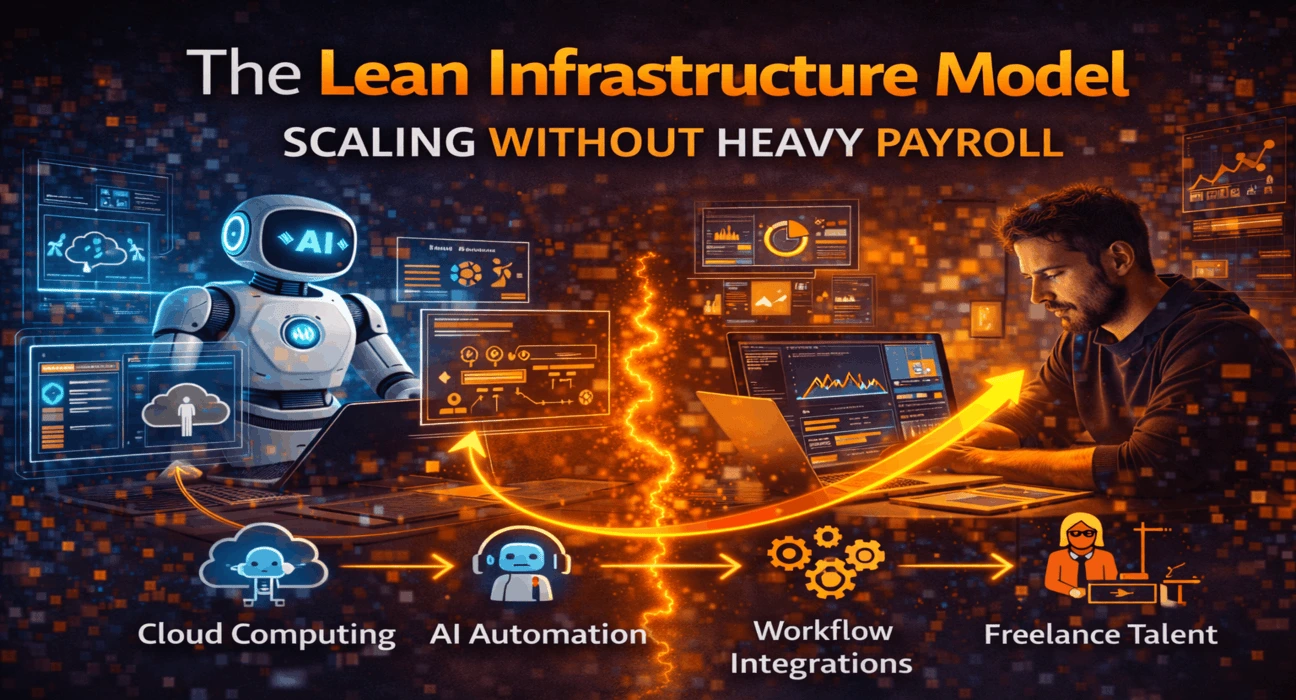
The Lean Infrastructure Model is a business strategy where companies scale operations using automation, cloud services, AI tools, and outsourced expertise instead of expanding full-time payroll.
Instead of building large internal departments, startups rely on:
- Cloud-based infrastructure
- AI-powered automation tools
- Contract specialists and freelancers
- Software integrations that reduce manual work
This approach allows companies to scale faster while keeping operational costs and payroll relatively low.
Why Traditional Scaling Models Are Changing
To understand the shift, it helps to look at how startups used to grow.
Historically, scaling meant building massive internal teams. Customer support departments expanded. Engineering teams doubled. Marketing divisions grew quickly.
But there was a downside.
Large teams often created complexity.
Communication layers increased. Decision-making slowed down. And operating costs grew significantly.
Today, founders are realizing something important: technology can now handle a surprising amount of operational work.
For example, cloud infrastructure platforms like Amazon Web Services allow startups to scale their backend systems without hiring large IT departments.
AWS cloud infrastructure services
Instead of maintaining physical servers or large technical teams, startups can deploy global infrastructure within minutes.
That’s a huge shift from the old model.
Automation Is Doing What Entire Departments Once Did
Automation tools are quietly transforming how businesses operate.
Tasks that once required dedicated employees — scheduling, data synchronization, email responses, internal reporting — can now be handled automatically.
Workflow automation platforms like Zapier connect multiple apps and automate repetitive tasks.
Zapier automation platform
For example, a single automated workflow might:
• capture a new lead
• send a welcome email
• update a CRM system
• notify the sales team
All without human intervention.
Multiply that across hundreds of daily processes, and suddenly the need for large operational teams drops dramatically.
AI Is Accelerating the Lean Model
Artificial intelligence is probably the biggest driver behind this new infrastructure strategy.
AI tools can now assist with tasks like research, content creation, customer support, and analytics.
Platforms such as ChatGPT are increasingly used by startups to speed up internal workflows.
ChatGPT AI productivity assistant
Instead of assigning early-stage research tasks to multiple team members, founders often rely on AI to gather insights quickly.
And this doesn’t eliminate human creativity — it simply removes the slower, repetitive parts of the process.
Which, to be honest, many teams don’t miss.
Outsourcing Is Becoming Strategic, Not Temporary
Another pillar of the lean infrastructure model is flexible talent.
Rather than hiring large full-time teams, companies often collaborate with specialists on demand.
Freelance marketplaces like Upwork allow startups to access skilled designers, developers, and marketers globally.
Upwork freelance hiring platform
This means companies can scale capabilities when needed — and scale down when projects end.
The result is a workforce that’s flexible instead of permanently fixed.
For startups managing limited capital, that flexibility can be incredibly valuable.
Lean Infrastructure Often Leads to Faster Decision-Making
Here’s something interesting founders often discover after adopting lean operations.
Smaller internal teams tend to move faster.
There are fewer meetings, fewer layers of approval, and fewer internal bottlenecks.
Decisions happen quickly because communication flows directly between key people.
In fact, many investors now encourage startups to focus on small, highly productive teams supported by strong technology stacks.
It’s not about shrinking ambition.
It’s about removing friction.
The Hidden Advantage: Financial Resilience
There’s another reason the lean infrastructure model is gaining attention.
Economic uncertainty.
Startups that rely heavily on large payrolls often struggle when funding conditions tighten.
But lean companies — those with flexible infrastructure and lower fixed costs — can adapt much more easily.
They can extend runway, experiment with new products, and survive market shifts.
And in the unpredictable world of startups, resilience is often more valuable than rapid expansion.
Final Thoughts
The Lean Infrastructure Model doesn’t mean companies stop hiring entirely.
People still matter. Expertise still matters. Creativity definitely matters.
But what’s changing is the balance between human effort and technological systems.
Cloud platforms handle infrastructure.
Automation tools streamline operations.
AI accelerates research and production.
Freelance talent fills specialized roles.
Put together, these elements allow startups to scale without building massive payroll structures.
And honestly, that may become the defining growth strategy for modern startups.
Not bigger teams.
But smarter infrastructure.
Summary
Article Name
The Lean Infrastructure Model: Scale Without Heavy Payroll
DescriptionDiscover how startups are scaling using the Lean Infrastructure Model—leveraging AI, automation, cloud services, and flexible talent instead of heavy payroll.
Author
Upstartzen Editorial Team
Publisher Name
Upstartzen
Publisher Logo