





Regional Economies Are Rebounding — But Not Where You Think
Synopsis
For a while there, the narrative around the global economy felt… pretty straightforward. Big cities drive growth. Tech hubs attract investment. Financial centers bounce back first after downturns.
That’s how the story usually goes.
But lately, if you look a little closer — and honestly, you have to look past the headlines — the recovery pattern looks different. Almost upside down.
Regional economies are rebounding in places many analysts didn’t expect. Smaller manufacturing regions, logistics corridors, secondary tech cities, and even mid-sized industrial clusters are quietly accelerating. Meanwhile, some traditional powerhouse metros are growing… but not nearly as fast as they used to.
And that shift matters. A lot.
Because where economic activity moves, startups, investors, infrastructure spending, and talent pipelines tend to follow.
So the real question isn’t whether regional economies are recovering — they clearly are. The more interesting question is where that growth is happening and why.
Let’s unpack it.
Why Are Regional Economies Rebounding in Unexpected Places?
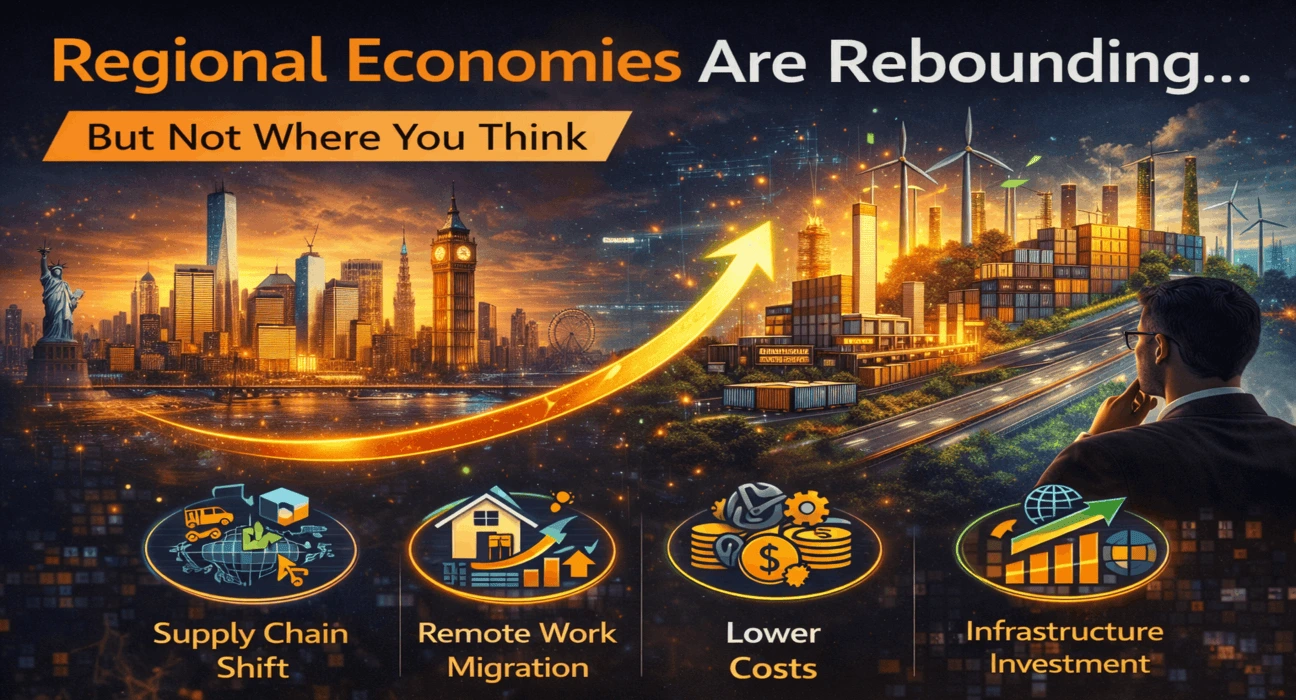
Regional economies are rebounding in unexpected locations due to shifts in supply chains, the rise of remote work, lower operational costs, increased infrastructure investments, and government incentives encouraging businesses to expand beyond traditional metropolitan hubs.
The Old Growth Map Is Changing
For decades, economic growth followed a pretty predictable pattern.
Major metropolitan areas — think places like New York City, London, and San Francisco — dominated investment flows.
That’s where capital lived. That’s where venture firms operated. That’s where most startups wanted to be.
And to be fair, those cities still matter. A lot.
But something subtle has been happening over the last five years. Growth is becoming more geographically distributed.
Instead of one dominant hub, we’re seeing multiple emerging economic zones.
And in some cases, those zones are outperforming traditional tech or finance centers.
Supply Chains Are Reshaping Local Economies
You might remember the supply chain disruptions during the pandemic. Ports clogged, shipping costs exploded, factories slowed down.
Companies learned a painful lesson: relying on distant suppliers creates risk.
So many businesses started reshaping their supply chains — moving production closer to key markets.
Economists call it regionalization.
Manufacturing clusters are re-emerging in regions that historically relied on industrial activity. Logistics hubs are expanding along transportation corridors. And companies are investing heavily in domestic infrastructure.
Organizations like World Economic Forum have highlighted this shift toward regional supply networks in recent economic outlook reports.
Global Supply Chain Resilience Insights
And here’s the interesting part: when supply chains move, local economies often follow.
The Remote Work Effect
This one’s impossible to ignore.
Remote work didn’t just change office culture. It changed where people live and build companies.
Suddenly, founders and employees didn’t need to cluster around expensive downtown districts.
They could operate from smaller cities with:
- lower real estate costs
- easier hiring environments
- better quality of life
Secondary markets began attracting talent that previously flowed only into major hubs.
Cities like Austin, Bengaluru, and Lisbon have benefited from this decentralization trend.
But interestingly, even smaller regional economies are seeing momentum now.
Infrastructure Spending Is Changing the Map
Infrastructure doesn’t always grab headlines. It’s not flashy.
But it quietly shapes economic development.
Governments across several regions are investing heavily in:
- transportation corridors
- energy infrastructure
- semiconductor manufacturing
- renewable power systems
For example, initiatives under the U.S. Infrastructure Investment and Jobs Act aim to revitalize industrial regions and modernize transportation networks.
Infrastructure Investment and Jobs Act Overview
Infrastructure investments often attract private capital shortly afterward.
Factories follow highways. Data centers follow power capacity. Logistics hubs follow rail and port access.
And suddenly, smaller regional economies become strategic growth nodes.
The Cost Equation
Let’s be honest — cost still drives a lot of business decisions.
Operating in major global cities can be expensive. Sometimes painfully so.
Commercial rent, wages, regulatory costs, and infrastructure limitations can push companies to reconsider location strategies.
Regional economies often offer:
- lower operating expenses
- available industrial land
- government incentives
- less competition for skilled labor
In other words, they provide room to grow.
And startups — especially capital-efficient ones — are paying attention.
The Startup Opportunity Nobody Talks About
Here’s where things get interesting for founders.
Economic decentralization creates opportunity.
Startups built around regional infrastructure needs are emerging across sectors like:
- logistics technology
- clean energy infrastructure
- industrial automation
- smart manufacturing
- agri-tech platforms
Many of these startups operate outside traditional venture hubs.
Which sometimes means less competition for funding and partnerships.
And honestly, some of the most exciting industrial innovations today are coming from regional clusters rather than global cities.
What Factors Are Driving Regional Economic Growth in 2026?
Key drivers of regional economic growth in 2026 include supply chain regionalization, remote work migration, major infrastructure investments, lower operational costs, and government incentives encouraging businesses to expand beyond major metropolitan areas.
Talent Is Becoming More Distributed
Talent used to flow almost entirely toward major metropolitan economies.
Graduates moved to big cities. Experienced professionals followed job opportunities there.
But now, talent mobility is increasing.
Digital work tools allow distributed teams to collaborate across regions.
Companies like Microsoft and Zoom have helped normalize remote collaboration platforms that make distributed operations practical.
So a startup in a mid-sized region can now recruit engineers, designers, and analysts from across the country — sometimes globally.
And that’s quietly leveling the playing field.
Not Every Region Is Rebounding
Of course, it’s not universal.
Some regions still face structural challenges such as declining industries, limited infrastructure, or weak investment pipelines.
Economic recovery tends to concentrate in areas that combine:
- strategic infrastructure
- skilled workforce availability
- supportive policy frameworks
- private capital investment
Without those ingredients, growth can stall.
So the rebound is real — but uneven.
Why Investors Are Watching Regional Economies
Venture investors and private equity firms are starting to notice the shift.
Regional clusters offer something attractive: undervalued opportunity.
Costs are lower. Competition is lighter. And local governments often support economic development initiatives.
Organizations like International Monetary Fund have highlighted regional economic divergence as a key trend shaping global growth patterns.
IMF Regional Economic Outlook
When macroeconomic trends point toward geographic diversification, capital tends to follow.
Final Thoughts
Economic recoveries rarely follow the exact path analysts predict.
And right now, regional economies are demonstrating that growth can emerge in places that once sat outside the spotlight.
Supply chain shifts, infrastructure investments, and changing work patterns are redistributing economic activity across a broader geographic landscape.
For founders, investors, and policymakers, the lesson is pretty simple.
Don’t only watch the big cities.
Sometimes the most interesting growth stories are happening just outside the traditional map.
Summary
Article Name
Regional Economies Are Rebounding — But Not Where You Think
DescriptionRegional economies are rebounding in unexpected places. Discover how supply chain shifts, remote work, and infrastructure investment are reshaping growth in 2026.
Author
Upstartzen Editorial Team
Publisher Name
Upstartzen
Publisher Logo