



Subscription Models That Still Work in 2026
Synopsis
Not that long ago, subscription businesses felt unstoppable.
Streaming services, SaaS tools, productivity apps — everything seemed to be turning into a monthly subscription. Companies loved the predictable revenue. Investors loved the recurring cash flow. And customers… well, at first they loved the convenience.
But somewhere along the way, things got a bit messy.
Subscription fatigue became a real thing. People suddenly realized they were paying for dozens of services every month.
Music apps, video platforms, AI tools, newsletters, productivity software — the list just kept growing.
And honestly, many consumers started asking a simple question: “Do I really need all these subscriptions?”
So here we are in 2026, and the landscape looks different.
Some subscription models are struggling. Others, surprisingly, are thriving.
The companies that are still winning have figured out something important: subscriptions only work when they continuously deliver obvious value.
Let’s take a closer look at which subscription models are still working — and why.
What Is a Successful Subscription Model in 2026?
A successful subscription model in 2026 is a business model where customers pay recurring fees for ongoing access to valuable services, content, or software that consistently delivers measurable value.
The most effective subscription models today focus on:
- Clear, ongoing customer benefits
- Flexible pricing tiers
- Continuous product updates
- Personalized user experiences
Companies that prioritize value and flexibility tend to retain subscribers longer and significantly reduce churn.
SaaS Subscriptions Still Lead the Market
Software-as-a-Service subscriptions remain one of the strongest business models in the digital economy.
Why?
Because companies rely on these tools every single day.
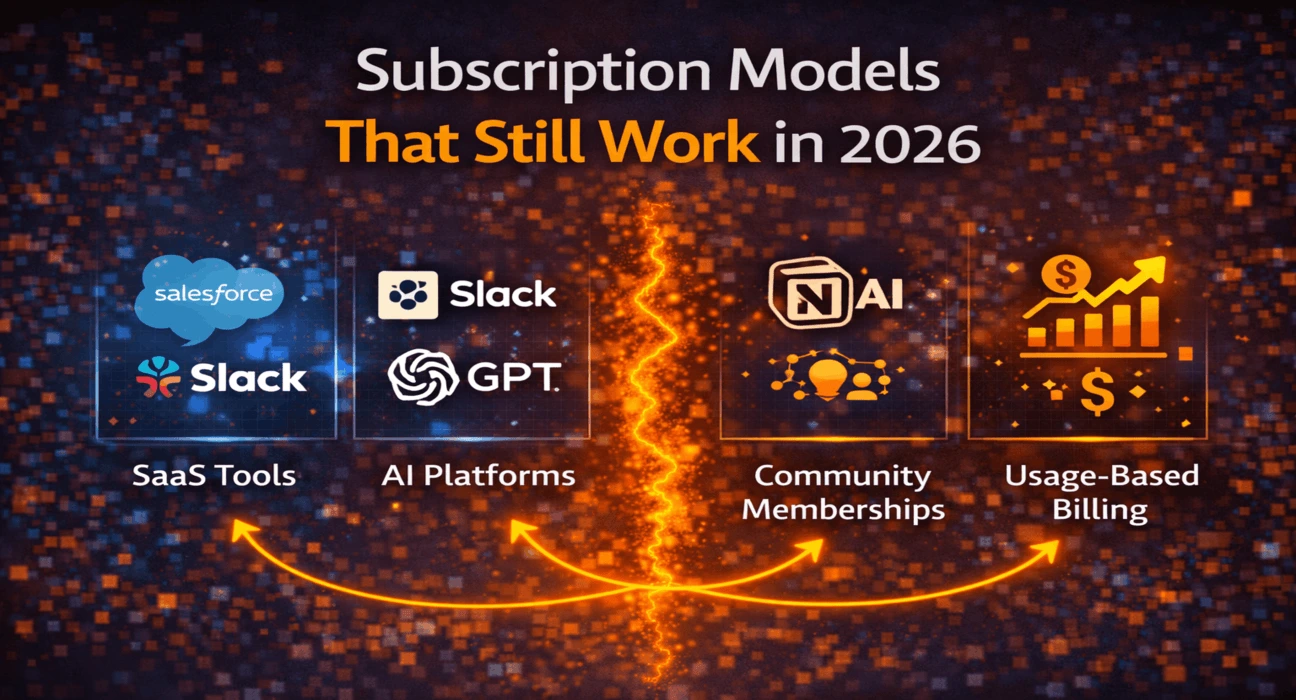
Platforms like Salesforce and Slack have built massive recurring revenue streams by becoming deeply integrated into business workflows.
Salesforce CRM platform
Slack collaboration software
And once a company adopts these tools, switching away becomes difficult.
That’s what makes SaaS subscriptions particularly durable.
To be honest, businesses don’t usually cancel tools that run their daily operations.
AI Tool Subscriptions Are Growing Fast
Another category exploding in 2026 is AI-powered tools.
Startups and professionals are increasingly subscribing to AI assistants that help with writing, research, coding, marketing, and automation.
Platforms such as ChatGPT and Notion AI are good examples of this shift.
ChatGPT AI productivity platform
Notion AI workspace tools
What makes AI subscriptions interesting is that they often replace multiple tools at once.
Instead of paying for separate services, users subscribe to one platform that handles many tasks.
That consolidation actually helps reduce subscription fatigue.
Community-Based Memberships Are Surprisingly Resilient
Here’s something many founders didn’t expect.
Community-driven subscriptions are performing extremely well.
Paid communities, expert networks, and niche membership platforms have built loyal audiences willing to pay for exclusive access.
Platforms like Circle enable creators and startups to run private communities with recurring memberships.
Circle community platform
Why do these subscriptions work?
Because they offer something algorithms can’t easily replicate — human connection and insider knowledge.
People subscribe not just for content, but for conversations, networking, and belonging.
Usage-Based Subscriptions Are Replacing Flat Pricing
Another trend becoming popular is usage-based subscription pricing.
Instead of paying a fixed monthly fee, customers pay based on how much they actually use the product.
Cloud computing companies pioneered this model.
For example, infrastructure providers like Amazon Web Services charge based on storage, computing power, and data usage.
AWS cloud infrastructure pricing
This model works because it feels fair.
Customers only pay for what they use — which builds trust and reduces cancellation rates.
Bundled Subscriptions Are Making a Comeback
Another interesting shift in 2026 is the return of bundled subscriptions.
Instead of selling one service at a time, companies package multiple offerings together.
Think about how Amazon created a powerful ecosystem with its Prime membership.
Amazon Prime membership benefits
Customers receive shipping perks, streaming content, discounts, and other services — all under one subscription.
Bundles make the price feel more justified.
And honestly, they make cancellation harder too.
Why Many Subscription Models Are Failing
Not every subscription business is thriving, though.
Some fail because they offer too little ongoing value.
If customers feel like they’re paying for something they rarely use, they cancel quickly.
Others fail because pricing is too rigid.
Modern consumers expect flexibility — monthly plans, annual discounts, usage-based pricing, and easy cancellation.
Companies that ignore these expectations often struggle with churn.
The Key Lesson for Startups
If there’s one takeaway for founders building subscription businesses in 2026, it’s this:
Subscriptions only work when value keeps showing up.
Customers need to feel like the service is worth paying for every month.
That might mean:
• regular product updates
• new features
• personalized experiences
• exclusive community access
In other words, subscriptions can’t be passive anymore.
They have to evolve constantly.
Final Thoughts
The subscription economy isn’t disappearing.
But it’s definitely maturing.
Companies that rely on recurring revenue now need to focus more on customer outcomes, product value, and pricing flexibility.
And the startups that get this balance right?
Well… they’ll likely build some of the most sustainable businesses of the next decade.
Summary
Article Name
Subscription Models That Still Work in 2026
DescriptionDiscover the subscription business models still thriving in 2026—from SaaS and AI tools to community memberships and usage-based pricing strategies.
Author
Upstartzen Editorial Team
Publisher Name
Upstartzen
Publisher Logo