

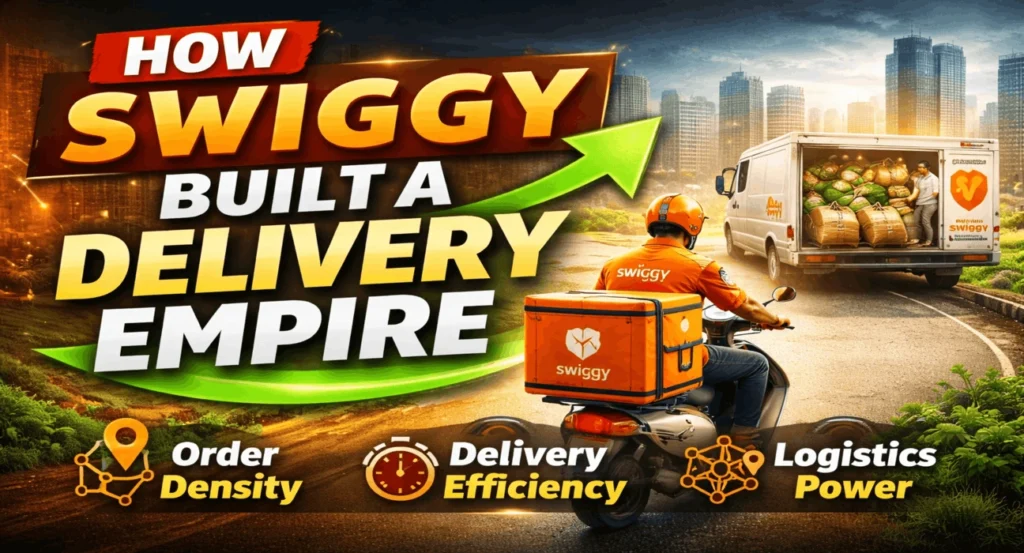

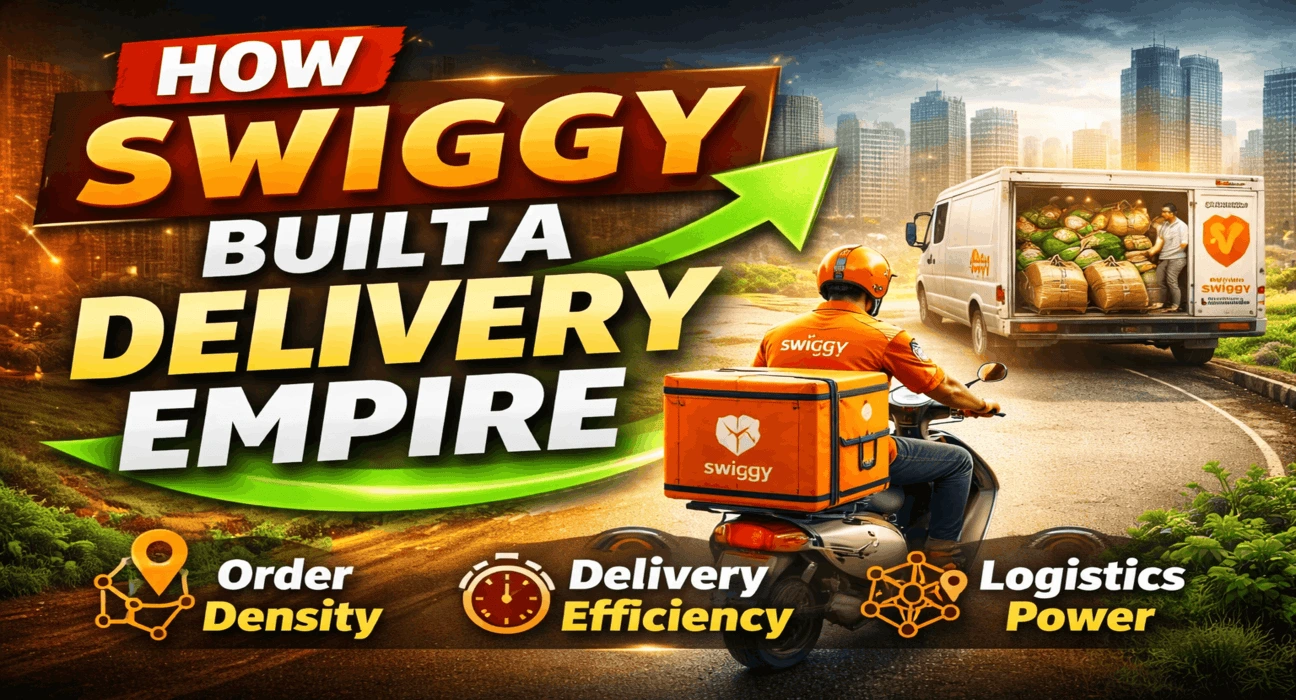
How Swiggy Built a Delivery Empire (A Data-Led Breakdown for Builders)
The One Insight That Explains Everything
Swiggy didn’t win because more people ordered food.
Swiggy won because every new order made its system more efficient.
That’s the entire game.
Not growth.
Not funding.
Efficiency compounding through density.
What is Swiggy’s core growth strategy?
Swiggy’s growth strategy is built on increasing order density to improve delivery efficiency, reduce cost per order, and create a self-reinforcing logistics network.
Key Components
- Increase Order Density – More orders per area lead to faster deliveries
- Improve Delivery Efficiency – Better route optimization and rider utilization
- Reduce Cost Per Order – Higher density lowers operational costs
- Build a Logistics Moat – Strong network becomes hard to replicate
Why it works:
👉 More orders → Better efficiency → Lower costs → More competitive pricing → More orders
In simple terms:
👉 Density drives efficiency, and efficiency drives growth.
If you look at Swiggy like a “startup,” you’ll miss the point.
Swiggy behaves like:
A logistics company that happens to deliver food.
That shift in thinking changes everything:
- You stop optimizing for downloads
- You start optimizing for orders per area
- You stop chasing users
- You start engineering density
The Metric That Quietly Built the Empire
Most dashboards track:
- MAUs
- CAC
- Retention
Swiggy’s real metric:
Orders per square kilometer per hour
Because that single metric controls:
- Delivery time
- Rider utilization
- Cost per order
- Customer experience
The System That Compounds (Explained Simply)
Here’s how Swiggy’s engine actually works:
- More orders in a locality
- Better route optimization
- Lower delivery time
- Higher customer satisfaction
- More repeat orders
Which leads back to:
👉 Even more orders in the same locality
This is not growth. This is a compounding system.
Strategic Decisions That Looked Wrong (But Weren’t)
1. Building Their Own Delivery Fleet
At a time when others outsourced logistics, Swiggy chose control.
Short-term impact:
- Higher costs
- Operational complexity
Long-term outcome:
- Control over delivery experience
- Ability to optimize cost per order
- Faster iteration cycles
Founder takeaway:
If logistics is core, outsourcing is not strategy—it’s dependency.
2. Depth Over Expansion
Instead of expanding everywhere, Swiggy went deep where it mattered.
Why?
Because without density:
- Riders sit idle
- Costs rise
- Delivery slows
So they built:
City dominance before national presence
How does Swiggy reduce delivery costs?
Swiggy reduces delivery costs by increasing order density, optimizing delivery routes, batching multiple orders, and minimizing rider idle time.
Key Methods
- Increase Order Density – More orders in the same area reduce travel time per delivery
- Route Optimization – Smart algorithms find the fastest and most efficient paths
- Order Batching – Multiple orders are delivered in a single trip
- Minimize Idle Time – Keeps riders consistently engaged with deliveries
In simple terms:
👉 More orders + smarter routing = lower cost per delivery.
The Hidden Lever: Idle Time
This is where most founders miss the plot.
The biggest cost in delivery isn’t fuel.
It’s:
Time when nothing is happening.
If a rider waits:
- Cost per order increases
- Earnings drop
- Supply weakens
Swiggy solved this through:
- Demand prediction
- Smart allocation
- Multi-order batching
Even a small improvement here changes margins dramatically.
Instamart Was Not a New Business
It was a capacity unlock.
Food delivery has time peaks:
- Lunch
- Dinner
Everything else?
Idle capacity.
Instamart filled those gaps.
Result:
- Higher order frequency
- Better fleet utilization
- Improved unit economics
Same network. More use cases. Better efficiency.
What This Means for Founders
Swiggy’s story isn’t about food delivery.
It’s about system design.
3 Lessons You Can Actually Apply:
1. Growth without density is expensive
Scaling users without improving efficiency is a trap.
2. Control your core layer
If something defines your experience—own it.
3. Optimize systems, not just metrics
Metrics improve when systems improve—not the other way around.
Swiggy Strategy Summary
Swiggy built its delivery empire by focusing on order density, logistics efficiency, and system-level optimization rather than just user growth.
Its strategy revolves around reducing delivery costs through better routing, higher order frequency, and improved rider utilization.
Core Strategic Focus
- Order Density – Increase orders per location to improve efficiency
- Logistics Optimization – Use technology for smarter routing and batching
- Rider Utilization – Maximize productivity and reduce idle time
- Cost Efficiency – Lower cost per order to improve margins
Strategic Insight:
👉 Efficiency-led growth creates sustainable competitive advantage.
In simple terms:
👉 Optimize the system → Reduce costs → Scale profitably.
The Real Competitive Advantage
People compare Swiggy with Zomato on:
- Users
- Revenue
- Profitability
But the real question is:
Whose system gets stronger with every order?
Because in this business:
- Apps can be copied
- Discounts can be matched
But:
A dense logistics network is almost impossible to replicate quickly.
Final Thought (Built for Shareability)
Swiggy didn’t scale a business.
They engineered a system where scale reduces cost.
And if you understand that,
You’re not just studying Swiggy.
You’re learning how modern businesses are actually built.
Summary
Article Name
How Swiggy Built a Delivery Empire: The Real Growth Strategy Explained
DescriptionA data-driven breakdown of Swiggy’s growth strategy—order density, delivery efficiency, and how it built a scalable logistics network.
Author
Upstartzen Editorial Team
Publisher Name
Upstartzen
Publisher Logo