


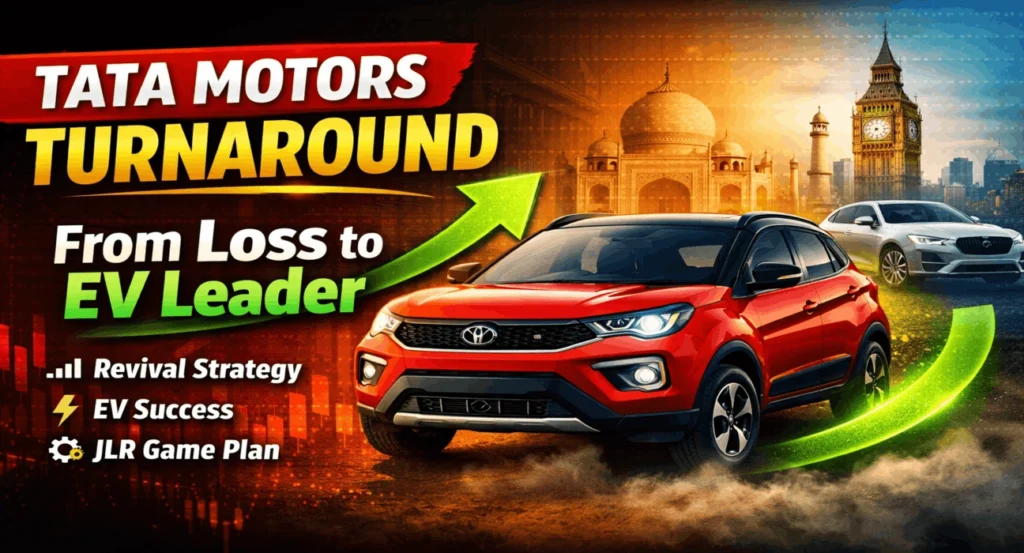

The Tata Motors Turnaround: How an Indian Auto Giant Rebuilt Itself from the Ground Up

🚀 Why Tata Motors’ Turnaround Matters Today
In an era where companies rise and fall faster than ever, the turnaround of Tata Motors is not just a business story—it’s a blueprint.
Because this wasn’t a startup pivot.
This was a legacy company, with decades of baggage, trying to stay relevant in a rapidly evolving market.
And the truth is:
Most legacy companies don’t fail because of competition. They fail because they can’t reinvent themselves fast enough.
Tata Motors almost did.
Tata Motors’ journey to success
📉 What Went Wrong: The Decline Phase
1. Weak Passenger Vehicle Strategy
By 2014–2016:
- Market share was declining
- Brand perception was weak
- Products lacked emotional appeal
Cars were seen as:
👉 Functional, but not aspirational
2. Overdependence on Commercial Vehicles
Tata Motors’ strength became its weakness.
- Heavy reliance on CV segment
- Highly cyclical demand
- Economic slowdown = direct revenue hit
3. The Pressure of Jaguar Land Rover (JLR)
The acquisition of Jaguar Land Rover was initially questioned.
- High costs
- Global market volatility
- Brexit & China slowdown impact
At one point, JLR became more of a risk than an asset.
acquisition of Jaguar Land Rover was initially questioned.
- High costs
- Global market volatility
- Brexit & China slowdown impact
At one point, JLR became more of a risk than an asset.
The Turning Point: Strategy Reset
Leadership Shift That Changed Direction
When Guenter Butschek stepped in, the strategy wasn’t “grow fast.”
It was:
Fix what’s broken first. Then scale.
🏗️ The Turnaround Framework (What Actually Worked)
🔹 1. Product First Strategy (Not Marketing Gimmicks)
Instead of pushing ads, Tata Motors fixed:
- Design
- Safety
- Performance
Launches like:
- Tata Nexon
- Harrier
- Tiago
…changed perception.
📌 Example:
Nexon became one of India’s safest cars (5-star Global NCAP)
👉 That single factor repositioned the brand.
🔹 2. Cost Optimization Without Killing Innovation
Most companies:
👉 Cut costs → Kill growth
Tata Motors:
👉 Cut inefficiencies → Invest in future
- Reduced operational waste
- Improved supply chain
- Continued investing in EV & R&D
🔹 3. Leveraging JLR Instead of Isolating It
Instead of treating JLR separately:
- Shared technology
- Shared learning
- Improved engineering capabilities
👉 Turned a “burden” into a capability engine
⚡ The EV Bet: Timing the Future Right
Tata Motors didn’t just recover.
It positioned itself ahead of the curve.
Key launches:
- Tata Nexon EV
- Tigor EV
Why this worked:
- Early mover advantage
- Government EV push
- Lack of strong competitors initially
👉 Result:
Tata Motors became India’s EV market leader
What Caused Tata Motors’ Turnaround?
Tata Motors’ turnaround was driven by a product-focused strategy, cost optimization with continued innovation, a strong EV market entry, leveraging Jaguar Land Rover capabilities, and leadership-driven execution discipline.
Key Drivers
- Product-Focused Strategy – Shift toward high-quality, desirable vehicles
- Cost Optimization + Innovation – Reduced inefficiencies without compromising R&D
- Strong EV Market Entry – Early positioning in India’s electric vehicle segment
- Leveraging Jaguar Land Rover – Technology transfer and premium expertise
- Execution Discipline – Leadership focus on consistent delivery and performance
Result:
👉 Improved profitability, stronger brand perception, and sustained growth momentum.
In simple terms:
👉 Better products + smarter costs + future bets + strong execution = turnaround.
Hidden Insight
Most people think Tata Motors succeeded because of EVs.
That’s incomplete.
EVs didn’t create the turnaround.
They accelerated an already improving system.
Without:
- Better products
- Strong execution
- Brand repositioning
EV success wouldn’t have sustained.
📈 Business Lessons for Startups & Founders
1. Fix Core Before Scaling
Growth amplifies problems if the base is weak.
2. Perception is Strategy
Your product defines your brand more than your marketing.
3. Don’t Kill Future Bets During Crisis
Cut costs—but protect innovation.
4. Use Existing Assets Smarter
JLR was not new.
Using it correctly was.
FAQs: Tata Motors Turnaround
What is the Tata Motors turnaround story?
Tata Motors’ turnaround refers to its recovery from declining market share and losses through product innovation, EV strategy, and operational efficiency.
When did Tata Motors start recovering?
The recovery began around 2017–2018 after strategic changes in leadership, product development, and cost management.
Why is Tata Motors successful today?
Tata Motors’ success comes from strong EV positioning, improved product quality, and better execution across domestic and global markets.
Summary
Article Name
Tata Motors Turnaround Story: How It Went from Loss to EV Market Leader
DescriptionExplore how Tata Motors turned losses into profits with smart strategy, EV leadership, and product innovation in this detailed turnaround case study.
Author
Upstartzen Editorial Team
Publisher Name
Upstartzen
Publisher Logo