





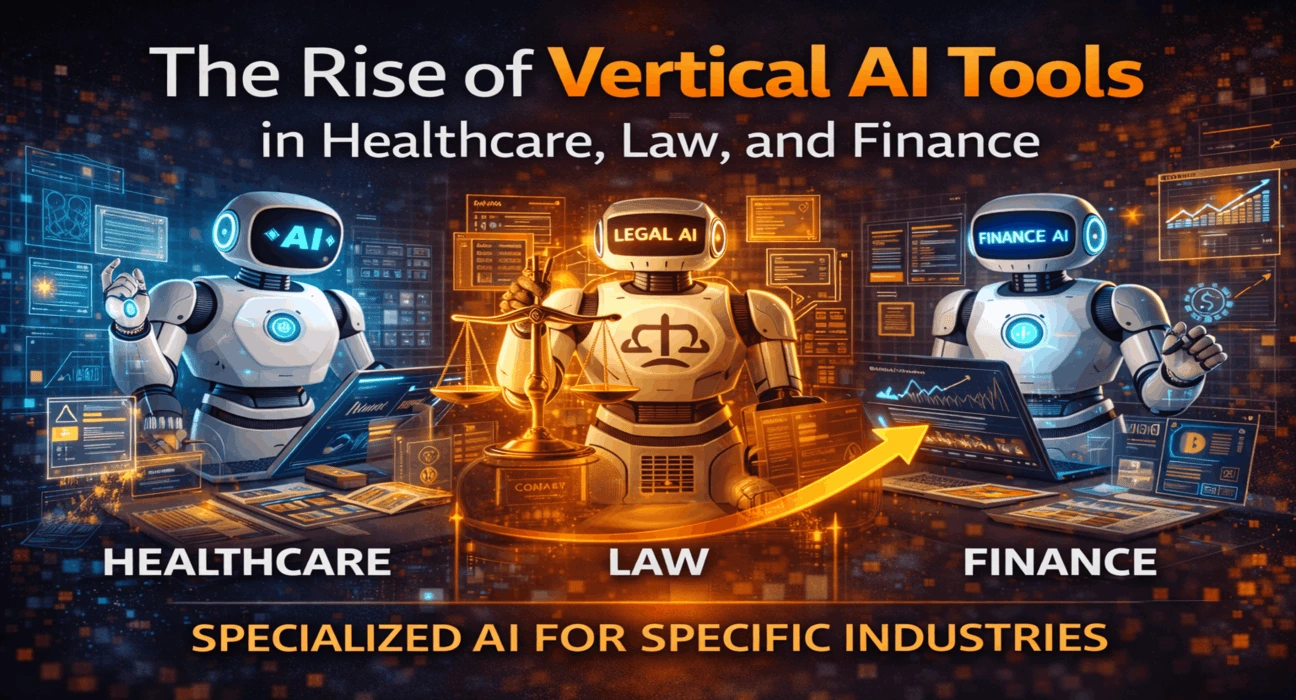
The Rise of Vertical AI Tools in Healthcare, Law, and Finance
Synopsis
For a while, the AI conversation was dominated by big, horizontal tools.
You know the ones — platforms designed to do a bit of everything: writing, coding, brainstorming, automation. Very powerful, sure. But also… a little generic.
And that’s starting to change.
In fact, if you’ve been watching the startup space closely, you’ve probably noticed a shift happening quietly in the background.
Instead of building one AI tool for everyone, founders are now creating highly specialized AI products designed for specific industries.
Healthcare.
Legal services.
Financial advisory.
These industries are complex, heavily regulated, and full of messy workflows — which, interestingly enough, makes them perfect candidates for vertical AI tools.
To be honest, many investors believe this could become one of the biggest startup trends of the next decade.
But what exactly are vertical AI tools, and why are they suddenly everywhere?
Let’s break it down.
What Are Vertical AI Tools?
Vertical AI tools are specialized artificial intelligence platforms designed for a specific industry, such as healthcare, law, or finance.
Unlike general-purpose AI software, vertical AI tools are trained on industry-specific data, regulations, and workflows, allowing them to perform highly specialized tasks with greater accuracy.
Examples include AI systems that can:
- Analyze medical records
- Review legal contracts
- Automate financial compliance checks
- Assist doctors with clinical documentation
Because they understand industry context, vertical AI tools often deliver more practical value than broad, general AI platforms.
Why Horizontal AI Tools Aren’t Always Enough
General AI platforms from companies like OpenAI and Anthropic have unlocked incredible capabilities.
But here’s the catch.
Most industries have unique rules, language, and data structures.
Healthcare, for instance, deals with sensitive patient records and strict compliance regulations. Legal firms work with highly structured contracts and case law. Financial institutions handle risk models and regulatory filings.
A general AI assistant can help with writing or summarizing documents.
But when you need deep domain expertise, generic tools sometimes fall short.
That gap is exactly where vertical AI startups are stepping in.
Vertical AI in Healthcare
Healthcare is one of the most promising sectors for vertical AI.
And honestly, it makes sense.
Doctors spend an enormous amount of time on administrative work — clinical documentation, patient notes, insurance paperwork.
AI-powered platforms like Abridge are helping automate medical documentation.
Abridge medical AI platform
The idea is simple but powerful.
Doctors focus on patients, while AI handles the paperwork.
Another example is Tempus, which uses AI to analyze clinical data and help doctors make better treatment decisions.
Tempus healthcare AI analytics
In an industry where every minute matters, even small efficiency gains can have massive impact.
Vertical AI in the Legal Industry
The legal profession is also undergoing a quiet transformation.
Law firms deal with huge volumes of text-heavy documents — contracts, case files, legal briefs.
Reviewing these manually can take hours.
Or sometimes days.
Companies like Harvey AI are building AI systems specifically trained on legal workflows.
Harvey AI legal assistant
These platforms can assist lawyers with:
• contract analysis
• legal research
• document drafting
• compliance reviews
To be clear, AI isn’t replacing lawyers.
But it’s dramatically speeding up repetitive tasks.
And for large law firms, that’s a pretty big deal.
Vertical AI in Finance
Finance might actually be one of the most natural environments for AI.
After all, the industry already relies heavily on data analysis.
AI-powered platforms like Kensho Technologies specialize in financial data modeling and market analysis.
Similarly, Upstart uses machine learning models to improve credit decision-making.
Instead of relying solely on traditional credit scoring systems, these AI models analyze broader datasets to evaluate risk.
And yes, the implications for banking and lending are huge.
Why Investors Are Betting on Vertical AI Startups
You might be wondering why venture capitalists are so excited about vertical AI.
The answer is actually pretty simple.
Specialization creates defensibility.
Horizontal AI tools compete with dozens of other platforms.
But vertical AI products become deeply embedded into industry workflows.
Healthcare systems, legal practices, and financial institutions rarely switch tools once they’ve integrated them into daily operations.
That means strong customer retention and long-term revenue potential.
Which investors love.
Challenges Vertical AI Startups Must Solve
Of course, building vertical AI products isn’t easy.
There are serious challenges.
First, many industries have strict compliance regulations. Healthcare companies must follow data protection rules. Financial institutions face regulatory scrutiny.
Second, training AI models requires high-quality industry data, which isn’t always easy to obtain.
And third, adoption takes time.
Industries like healthcare and law are cautious when adopting new technologies.
Which is understandable, honestly.
When people’s health, legal rights, or financial security are involved, reliability matters.
Final Thoughts
The AI boom initially focused on building large, general-purpose models.
But the next wave of innovation may come from something more focused.
Vertical AI tools.
By combining artificial intelligence with deep industry knowledge, these platforms can solve highly specific problems in healthcare, law, finance, and beyond.
And for startup founders, that creates an interesting opportunity.
Instead of building tools for everyone…
The smarter strategy might be building the best AI tool for one industry.
Because sometimes the biggest innovation doesn’t come from being broad.
It comes from going deep.
Summary
Article Name
Vertical AI Tools Are Transforming Healthcare, Law & Finance
DescriptionVertical AI tools are transforming healthcare, legal services, and finance. Discover why specialized AI startups are becoming the next big tech trend.
Author
Upstartzen Editorial Team
Publisher Name
Upstartzen
Publisher Logo