




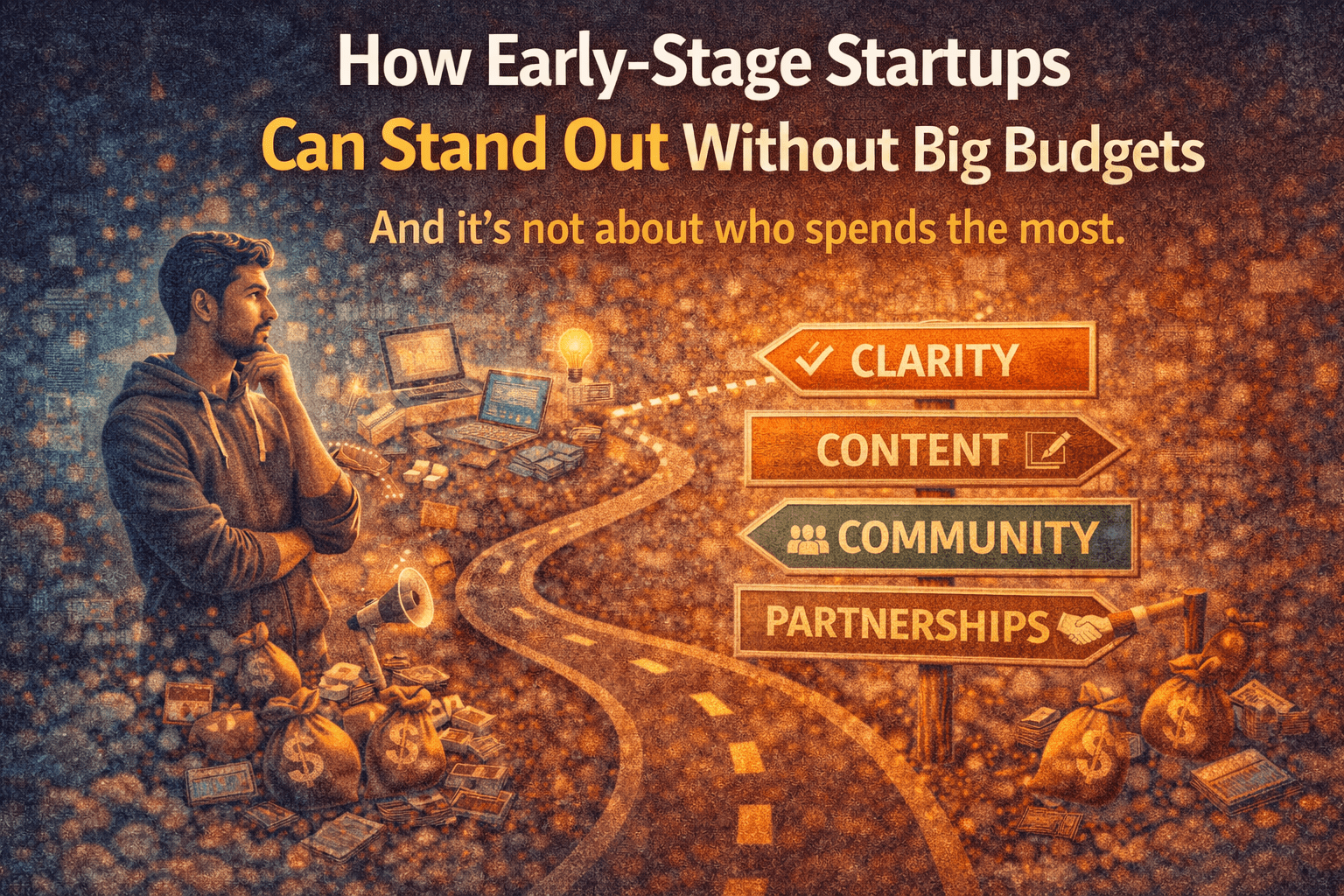
How Early-Stage Startups Can Stand Out Without Big Budgets

How can early-stage startups stand out without a big marketing budget?
By treating clarity and consistency as the actual strategy, not a placeholder until funding arrives. The startups that build lasting attention on a small budget tend to do one thing repeatedly and well — usually content, community, or partnerships — rather than spreading thin across every channel. Zerodha’s Varsity, a free stock market education platform built with no ad spend, became one of the clearest examples of this in India: it built enough trust with retail investors that Zerodha grew into the country’s largest stockbroker largely on word of mouth, without the marketing budgets its funded competitors were spending.
Money Doesn’t Create Differentiation — It Amplifies What’s Already There
A common but costly early-stage belief is “if we had more money, people would notice us.” Money mostly amplifies an existing message; if that message is weak, a bigger budget just spreads the weakness faster and more expensively.
The startups that earn attention on a small budget tend to do one specific thing obsessively well and repeat it until it compounds — a content format, a community, a distribution channel — rather than diluting effort evenly across everything available.
Clarity Beats Creativity
Before creativity, a first-time visitor to your website or product needs three things instantly: who it’s for, what problem it solves, and why it matters right now. Not after a brand video. Not after scrolling five times.
Many early-stage startups lose visitors by reaching for clever, abstract messaging instead of plain description. “We’re revolutionizing workflow synergies” tells a visitor nothing; “We help small teams finish work faster, without burning out” tells them everything they need in one sentence. Clarity is what actually gets remembered and repeated.
Content Is a Real Advantage — When It’s Built for Trust, Not Traffic
Zerodha’s Varsity is the clearest Indian example of content used as a trust mechanism rather than a lead-generation funnel. Rather than running ads, Zerodha published in-depth, free educational modules on investing and trading — content that had no immediate conversion goal but built enough credibility with retail investors that it became a meaningful driver of the brand’s word-of-mouth growth. Nykaa followed a similar logic earlier in its life, investing in beauty tutorials and product education on YouTube and Instagram before content marketing was a mainstream tactic in Indian e-commerce, treating content and community as the primary growth channel rather than a support function around paid ads.
The pattern in both cases: content that’s useful independent of whether the reader buys anything builds more durable trust than content built purely to convert. That’s a slower payoff than a paid campaign, but a compounding one — Varsity content published years ago still drives credibility for Zerodha today.
Focus on One Channel, Not All of Them
Being everywhere is expensive and, for a small team, unsustainable. Picking the one channel where your specific audience already spends time and going deep there — posting consistently, engaging like a person rather than a brand account — builds familiarity faster than a thin presence spread across five platforms. A B2B startup’s audience is likely concentrated on LinkedIn; a developer tool’s audience is more likely on X or GitHub; a consumer brand’s audience skews toward Instagram or YouTube Shorts. Depth on one channel outperforms breadth across many when the team and budget are both small.
Community Compounds Where Campaigns Don’t
Campaigns are a big-budget tool. Community is available at any budget, and it tends to outlast any single campaign’s effect. This doesn’t require an elaborate platform — a focused WhatsApp group for a niche professional audience, a monthly virtual meetup, or a newsletter that shares real insight rather than announcements can be enough to create a space where people talk about the product without being asked to.
Partnerships: Borrowed Trust Instead of Bought Attention
Co-creating content with complementary startups, industry newsletters, or niche communities effectively borrows an audience’s existing trust rather than paying to build attention from zero. It costs founder time rather than marketing budget, and it works best when the partnership is a genuine fit rather than a transactional cross-post.
Storytelling Over Feature Lists
People remember why a company exists more reliably than they remember its feature list. Why the problem was annoying enough to act on, and what nearly didn’t work — that kind of founder story humanizes a brand in a way a spec sheet can’t, and costs nothing beyond honesty.
Frequently Asked Questions
1. What’s a real example of an Indian startup that grew primarily through content instead of paid marketing?
Zerodha is one of the best-known examples. Its free educational platform, Varsity, attracted and educated millions of retail investors, helping build trust and brand authority while driving customer acquisition with minimal reliance on paid advertising.
2. Should an early-stage startup try to be active on every social platform?
No. Early-stage startups typically achieve better results by focusing on one or two platforms where their target audience is most active. Concentrated effort produces stronger engagement and more efficient use of limited marketing resources.
3. Does “building in public” actually help early-stage startups grow?
Yes, when done authentically. Sharing real product updates, lessons learned, customer feedback, and challenges can build credibility, attract early adopters, and create a loyal community around the startup.
4. What matters more for an early-stage startup: a polished product or clear messaging?
Clear messaging usually matters more. Early customers are more likely to adopt an evolving product if they clearly understand the problem it solves, the value it delivers, and the team’s vision. Clear communication builds trust, while unclear positioning often limits growth.
What to Watch Next
- Whether more India-based startups adopt long-form, trust-building content strategies similar to Varsity, as the funding environment continues rewarding capital-efficient growth
- How AI-assisted content production changes the economics of small-budget content marketing, and whether it raises or lowers the bar for what counts as differentiated
- Which partnership and community-led growth models prove durable versus which fade once the novelty wears off
The bottom line: a small budget limits how loud a startup can be, not how clear or how consistent it can be — and clarity and consistency are what actually compound into recognition over time.
Examples cited above draw from documented case studies of Zerodha’s Varsity platform and Nykaa’s early content-led marketing strategy in the Indian startup ecosystem.
Summary
Article Name
How Early-Stage Startups Can Stand Out Without Big Budgets
DescriptionEarly-stage startups don’t need big budgets to stand out. They need clarity, consistency, and smart storytelling. Here’s what actually works.
Author
Upstartzen Editorial Team
Publisher Name
Upstartzen


