





Why Indian Startups Are Expanding Operations Abroad — While Staying Headquartered at Home

Are Indian startups moving their headquarters abroad in 2025?
No — if anything, the dominant 2025 trend runs the opposite direction. Startups including Zepto, Meesho, PhonePe, Razorpay, and Pine Labs have completed or announced “reverse flips,” relocating their legal domicile from Singapore, Delaware, or the Cayman Islands back to India, largely to position for domestic IPOs. What is genuinely increasing is something different: Indian startups opening overseas sales offices, delivery operations, and market footholds — particularly in the Middle East, Africa, and Southeast Asia — while keeping their headquarters and primary operations in India. It’s international expansion, not relocation.
The Real Trend: Market Expansion, Not Headquarters Flight
It’s worth separating two things that get conflated in casual conversation about Indian startups “going abroad.” One is a legal and financial restructuring question — where a company’s holding entity is domiciled, which determines its regulatory home, tax exposure, and IPO pathway. The other is a market question — where a company sells, delivers, and operates.
On the first question, the direction of travel in 2025 has been unmistakably toward India, not away from it. Zepto completed its reverse flip from Singapore in January 2025, with formal approvals from both Singapore’s Accounting and Corporate Regulatory Authority and India’s National Company Law Tribunal. Meesho, originally incorporated in Delaware, followed a similar path in 2024 to align with its Indian IPO ambitions — a restructuring that reportedly triggered a lapse of $700 million in accumulated losses and required a new India-based ESOP plan. PhonePe, Razorpay, Pine Labs, and Flipkart have made or announced comparable moves.
On the second question — actual market presence — the picture looks quite different, and this is where the real “going abroad” story lives.
Where Indian Startups Are Actually Expanding
The Middle East and Africa have emerged as the most active new frontier for Indian startups seeking market growth beyond India’s borders, a shift from the historical default of the US or Southeast Asia. Zepto has been exploring Saudi Arabia’s ultra-fast delivery market, and Razorpay has been scouting the UAE’s digital payments sector for expansion — both companies now domiciled in India, operating internationally as a growth strategy rather than a structural relocation.
Lenskart offers a particularly clear example of the pattern: the eyewear company expanded into Southeast Asia and the Middle East through acquisitions, strengthening its market footprint and investor confidence ahead of its IPO — international operations built specifically to support, not replace, its India-based structure and listing plans.
Southeast Asian markets — Indonesia, Malaysia, Singapore — remain attractive for a related reason: shared characteristics with India’s own market, including large mobile-first populations, price-sensitive consumer behavior, and established Indian diaspora networks that ease market entry.
Why This Distinction Matters for Founders
Confusing “opening an overseas office” with “flipping the company’s legal domicile abroad” leads to bad planning. They have almost nothing in common structurally:
Opening an overseas sales or operations office is a market-entry decision — establishing a local entity or team to serve customers, handle logistics, or navigate local regulation in a new geography. It doesn’t change where your holding company is domiciled, doesn’t trigger the kind of tax events Meesho’s reverse flip did, and doesn’t affect your IPO pathway.
Flipping your holding structure abroad (the historical pattern, now reversing) changes your company’s ultimate legal parent, its regulatory home, and often its tax exposure — the kind of structural decision that, as covered in SEBI’s 2025 reforms, now cuts against most founders’ interests given how much easier and more IPO-relevant an India-domiciled structure has become.
If you’re a founder currently weighing “should we go abroad,” the more useful question is almost always about the first kind of decision — market entry — not the second.
What’s Actually Driving Market Expansion Abroad
A few forces show up consistently in why founders are choosing international market entry right now:
- Investor expectations around scalability. Startups backed by global venture capital are increasingly nudged toward demonstrating international reach, since investors see cross-border scalability as a signal of a larger addressable market and, often, a factor supporting higher valuations.
- Cost and talent advantages travel well. Indian startups’ software development and operations cost advantages let them compete on pricing even as they expand into new geographies.
- Digital adoption curves in MEA and Southeast Asia resemble India’s own recent history — rising smartphone penetration and digital payments adoption create market conditions Indian founders already understand well from building at home.
Frequently Asked Questions
1. Are Indian startups actually relocating their headquarters abroad in 2025?
No. The dominant trend in 2025 is reverse flipping, where startups move their legal headquarters back to India. Companies such as Zepto, Meesho, PhonePe, Razorpay, and Pine Labs have taken this approach to simplify governance and prepare for potential Indian IPOs.
2. What’s the difference between opening an overseas office and flipping a company’s domicile abroad?
Opening an overseas office expands business operations without changing the company’s legal home. In contrast, flipping a company’s domicile changes its legal parent entity, tax jurisdiction, and regulatory framework, making it a far more significant corporate restructuring decision.
3. Which regions are Indian startups expanding into most in 2025?
The Middle East, Africa, and Southeast Asia are among the fastest-growing expansion markets. Countries such as the UAE and Saudi Arabia are attracting Indian startups due to growing digital economies, while Southeast Asia remains appealing because of similar consumer and business environments.
4. Does international market expansion affect a startup’s IPO plans?
Yes, but indirectly. Successful international expansion can strengthen revenue growth, diversify markets, and improve investor confidence before an IPO. However, overseas expansion is separate from a company’s legal domicile, which determines where it can pursue a public listing.
What to Watch Next
- Whether more startups follow Zepto and Razorpay into the Middle East as a primary international growth market, given the digital-adoption parallels to India’s own recent history
- Whether the reverse-flip trend continues accelerating as more India-domiciled companies prepare for 2026’s IPO pipeline
- How Lenskart’s acquisition-led international expansion performs post-IPO as a model other India-based consumer startups might replicate
- Whether GIFT City’s expanding role as a financial hub gives founders a genuine middle path between full domestic domicile and full offshore structuring for specific functions
Details cited above are drawn from Lexology’s and Asian Legal Business’s 2025 reporting on reverse-flip transactions, TICE and Medium reporting on Indian startups’ Middle East and Africa expansion, and India-briefing.com’s coverage of 2025 redomiciliation trends.
Summary
Article Name
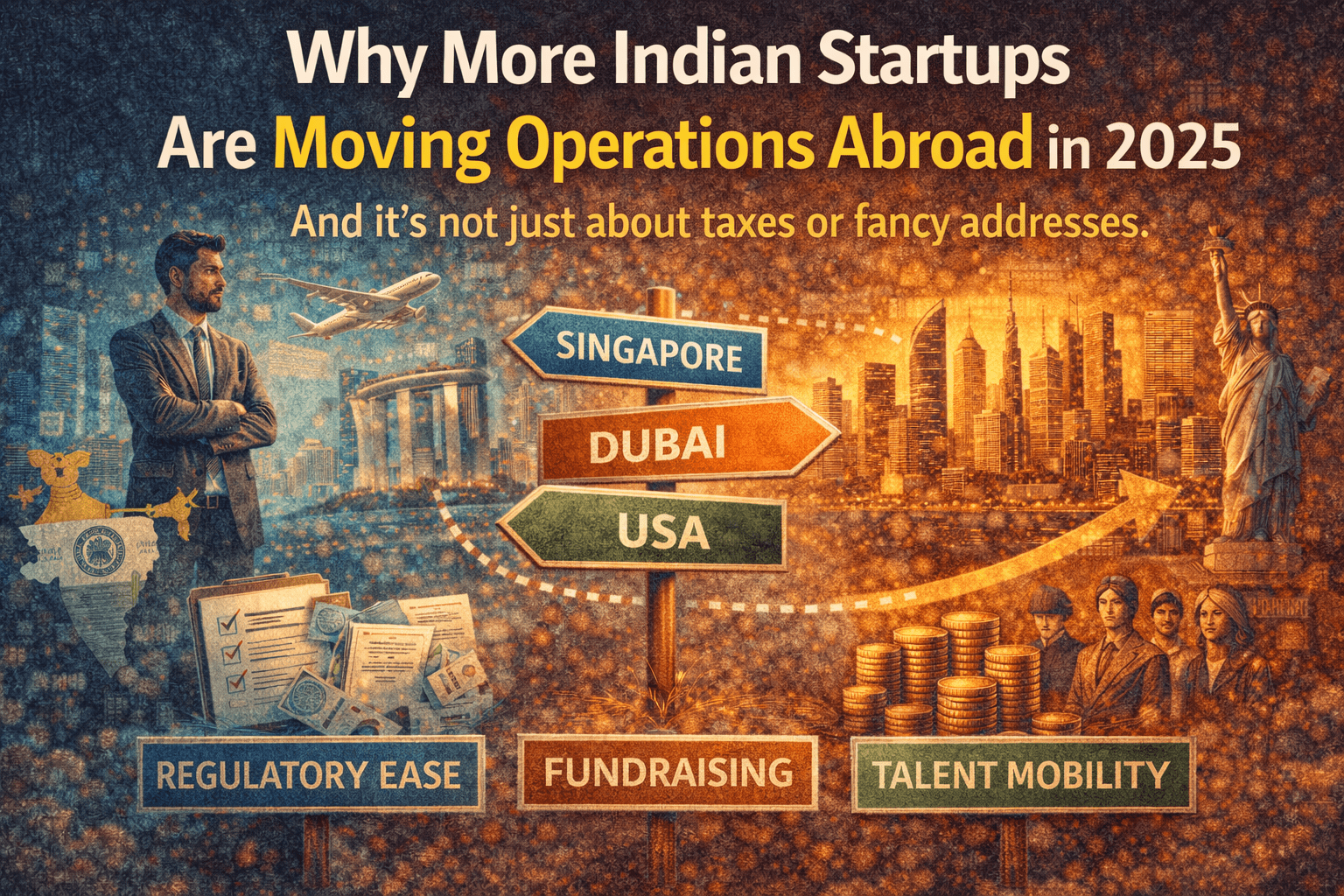
Why More Indian Startups Are Moving Operations Abroad in 2025
DescriptionIndian startups are quietly moving operations abroad. Not for hype — but for clarity, capital, and control. Here’s what founders should know.
Author
Upstartzen Editorial Team
Publisher Name
Upstartzen


