




From Seed to Survival: Why 2025 Is the Year of Revenue-First Pitch Decks
Synopsis
Startup fundraising in 2025 feels like the morning after a long party — hype is down and scrutiny is up. Early-stage founders are discovering that vision alone doesn’t pay salaries, and investors now want proof: real revenue, real customers, real market validation. This piece explains why pitch decks are shifting from big ideas to money engines, what VCs scan in the first three minutes, and how a revenue-first mindset is reshaping modern fundraising strategy.
From Seed to Survival: Why 2025 Is the Year of Revenue-First Pitch Decks
You might be wondering — when did pitch decks become so… serious?
A few years ago, you could walk into a VC meeting with a clean design, a bold market size slide, and a story about “changing the world.” Sprinkle in some hockey-stick projections, and boom, you had a shot. Not a guarantee, sure, but a shot.
Now? It’s different. The vibe in the room has shifted. You can feel it.
I spoke to a founder last month who told me, half-joking, half-exhausted, “They didn’t even ask about our vision. They asked how much cash we burn every month. First question. First slide they wanted to see.”
And honestly, that tells you everything you need to know about 2025.
The Funding Winter Isn’t Over. It’s Just Quieter.
Let’s get one thing out of the way. The so-called “funding winter” didn’t vanish. It just went underground.
Yes, deals are happening. Yes, rounds are closing. But the bar? The bar is way higher.
According to data from Crunchbase, global venture funding in 2024 was still down nearly 30% compared to the 2021 peak. And while some regions bounced back slightly in late 2024, early 2025 numbers show investors are still cautious. Very cautious.
What does that mean for founders?
It means storytelling alone doesn’t cut it anymore. Investors want to see a business, not just a brand.
The First 3 Minutes: What VCs Actually Scan Now
Let’s be real. Most investors don’t “read” your deck. They scan it. Fast. Like someone scrolling through Netflix at 1 a.m.
Here’s what many founders don’t realize: in the first 180 seconds, most VCs are subconsciously asking three questions:
- Is this making money yet?
- If not, is it clearly on the way?
- Will this die if the next round takes 12 months instead of 6?
So what slides are getting the most attention right now?
1. Revenue Snapshot (Yes, Even at Seed)
Monthly recurring revenue. Growth rate. Customer count. Average deal size. Churn.
If you’ve got numbers, they want them upfront. Not buried on slide 14 like it’s a side quest.
2. Burn & Runway
This one used to be awkward. Now it’s expected.
How much are you spending per month? How many months can you survive if nothing magical happens?
3. Go-To-Market Proof
Not strategy. Proof.
What channels are actually bringing customers in? Paid? Organic? Partnerships? Cold outreach? Word of mouth?
And only after that — only after — do many investors lean back and say, “Okay. Now tell me the big vision.”
Storytelling vs. Proof of Business
Don’t get me wrong. Story still matters. Humans are wired for it. But in 2025, story comes second.
Think of it like dating. The first thing someone wants to know isn’t your five-year life plan. It’s whether you can show up on time and pay for coffee. Stability before dreams.
That’s how investors are thinking too.
A VC partner at a mid-size fund in Bengaluru told me, “Every deck sounds like a unicorn story. What we’re hunting for now is a cockroach story. Something that survives when the lights go out.”
And yeah, it’s a little brutal. But it’s also kind of refreshing.
Why Revenue Became the New “Traction”
Back in the day, traction could mean anything. Waitlist signups. App downloads. Newsletter subscribers. Social buzz.
In 2025, traction means one thing first: paying customers.
Because revenue answers a very simple, very powerful question:
Will someone actually open their wallet for this?
Startups with even modest revenue — say, ₹5–10 lakhs in monthly recurring revenue — are suddenly punching way above their weight in fundraising conversations. Not because the number is huge, but because the signal is strong.
Money is the loudest form of feedback.
The Rise of the “Cash Flow Slide”
Here’s something you probably didn’t see coming five years ago.
Founders are now putting cash flow slides before product slides.
Let that sink in for a second.
Decks are opening with:
- Monthly burn
- Revenue growth chart
- Gross margins
- Break-even timeline
Only then do they show the shiny product UI.
Why? Because in a tight market, investors don’t want to fall in love with something that might starve.
Real-World Example: The Quiet Flip That Worked
Take the case of Zoho — not a startup in the traditional sense, but a perfect reference point. Zoho has famously grown without external VC funding, focusing on profitability and sustainable revenue for decades. Their story is often cited in Indian founder circles as the “anti-hype” playbook.
Now, newer SaaS startups are borrowing from that mindset. A founder I met in Hyderabad recently told me they restructured their pitch deck to lead with:
- Revenue per employee
- Customer lifetime value
- Payback period on sales spend
They closed their seed round in eight weeks.
Coincidence? Maybe. But probably not.
If you’re curious about Zoho’s long-term profitability-first philosophy, you can check their official story here:
Zoho’s bootstrapped growth journey
The New Hero Metric: Revenue Efficiency
Here’s a term you’ll hear a lot more in 2025: Revenue Efficiency.
It’s not just about how fast you grow. It’s about how clean that growth is.
Investors are now asking things like:
- How much revenue do you generate per dollar (or rupee) spent?
- How many people does it take to support your current ARR?
- How long before a customer becomes profitable?
In simple words: Are you building a machine, or a bonfire?
Founders Are Rewriting Their Decks — Literally
I’ve seen decks where the old structure was:
- Vision
- Problem
- Solution
- Market size
- Product
- Traction
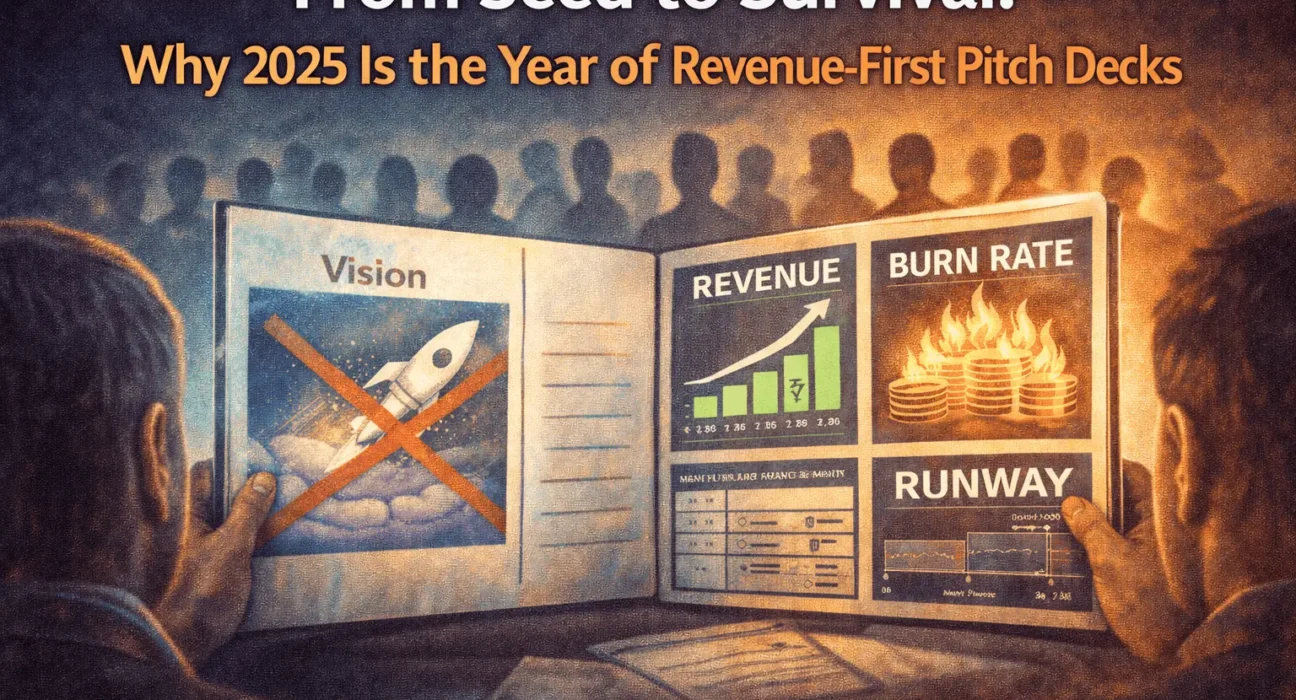
The new structure looks more like:
- Revenue & growth
- Burn & runway
- Go-to-market proof
- Unit economics
- Product
- Vision
And yeah, it feels upside down. But it’s working.
When “Big TAM” Isn’t Enough Anymore
Total Addressable Market used to be the mic-drop slide. A big circle with a massive number. $50B. $100B. Sometimes even $1T, because why not.
Now, VCs are quietly rolling their eyes.
They care less about how big the ocean is and more about whether you’ve caught any fish.
A small, loyal, paying customer base beats a giant hypothetical market every time in 2025.
What Do Investors Look for First in a 2025 Pitch Deck?
In 2025, most investors review a pitch deck’s revenue, burn rate, and go-to-market proof within the first three minutes. Instead of leading with vision or market size, they prioritize cash flow, customer traction, and unit economics to judge whether a startup can survive without immediate follow-on funding.
The Emotional Shift No One Talks About
Here’s the part founders don’t always admit.
Leading with revenue feels… vulnerable.
It’s easier to talk about what you will become than what you are right now. Numbers don’t care about your passion. They just sit there. Honest. Sometimes painfully so.
But the founders who embrace that honesty are building a different kind of trust with investors. Less hype. More handshake.
So, Is This a Bad Thing?
Not really.
In fact, it might be the healthiest phase startup culture has had in years.
We’re moving from:
“Look how big this could be”
to
“Look how real this already is”
And that’s a powerful shift.
Final Thought: Survival Is the New Status Symbol
In 2021, status was about valuation.
In 2023, it was about raising.
In 2025?
It’s about staying alive and growing anyway.
Revenue-first decks aren’t just a fundraising tactic. They’re a mindset. A signal that you’re building something meant to last, not just something meant to trend.
And maybe — just maybe — that’s the kind of startup story worth telling now.
Summary

Article Name
From Seed to Survival: Why 2025 Is the Year of Revenue-First Pitch Decks
DescriptionVCs now scan revenue and burn before vision. See how founders are flipping pitch decks in 2025 to survive funding winter and win serious investors.
Author
Upstartzen Editorial Team
Publisher Name
Upstartzen