




Hiring Freeze, Not Hiring Fear: How Lean Teams Are Outperforming Big-Budget Startups
Synopsis
As layoffs slow across tech and startups, companies aren’t returning to hiring sprees — they’re building leaner, sharper teams instead. This piece explains how 10–15 person startups are outperforming larger competitors through automation, ruthless prioritization, and process-first execution. Using real examples, revenue metrics, and founder insights, it shows why doing more with less is no longer just survival — it’s a competitive advantage.
What is a hiring freeze and why are lean teams outperforming big startups in 2025?
A hiring freeze is when a company pauses new recruitment to control costs and improve operational efficiency. In 2025, lean teams are outperforming larger startups because they scale systems instead of headcount — using automation, clearly defined workflows, and revenue-focused priorities to move faster, lower overhead, and respond to customers more directly.
Let’s get one thing straight.
The startup world isn’t “scared” of hiring anymore. That panic phase? Mostly over. But the hiring freeze? Oh, that’s still very much alive.
And to be honest, it’s not because founders are pessimistic. It’s because they’ve tasted something dangerous.
Efficiency.
A couple of years ago, growth meant one thing: more people, more desks, more Slack channels, more burn. You raised a round, you hired fast, you celebrated headcount like it was a revenue metric. I’ve been in those rooms. Free pizza, onboarding swag, big grins all around.
But now? Different vibe.
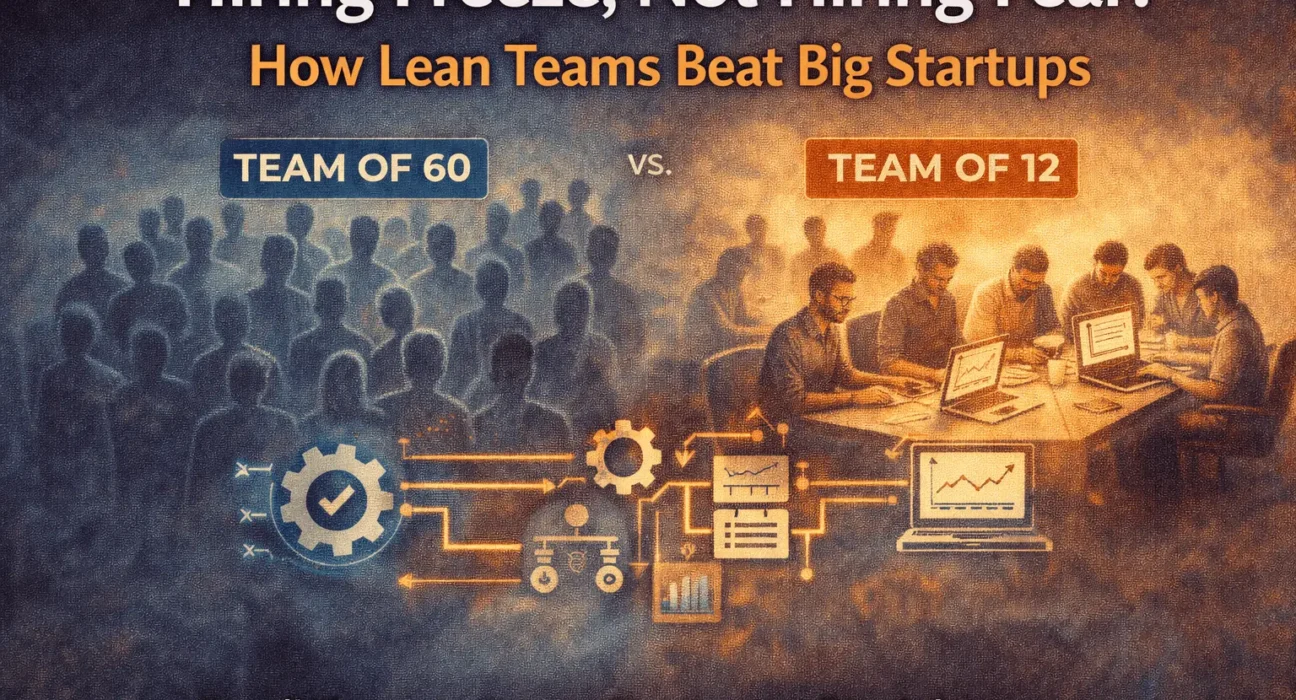
Now I’m seeing startups doing something almost rebellious in 2025. They’re winning with 12 people while their competitors are dragging around teams of 50 or 60 like a very expensive backpack.
And yeah, you might be wondering—how is that even possible?
Let’s unpack it.
Let’s get one thing straight.
The startup world isn’t “scared” of hiring anymore. That panic phase? Mostly over. But the hiring freeze? Oh, that’s still very much alive.
And to be honest, it’s not because founders are pessimistic. It’s because they’ve tasted something dangerous.
Efficiency.
A couple of years ago, growth meant one thing: more people, more desks, more Slack channels, more burn. You raised a round, you hired fast, you celebrated headcount like it was a revenue metric. I’ve been in those rooms. Free pizza, onboarding swag, big grins all around.
But now? Different vibe.
Now I’m seeing startups doing something almost rebellious in 2025. They’re winning with 12 people while their competitors are dragging around teams of 50 or 60 like a very expensive backpack.
And yeah, you might be wondering—how is that even possible?
Let’s unpack it.
The Quiet Shift Nobody’s Posting on LinkedIn
Scroll LinkedIn for five minutes and you’ll see it.
“Excited to welcome our new Head of Growth.”
“Thrilled to announce we’ve expanded the team to 40!”
Looks great. Feels great. But behind the scenes, something else is happening.
Founders are asking uncomfortable questions now, like:
“If we removed five roles tomorrow, would customers even notice?”
In many cases, the answer is… not really.
That realization hits hard.
Because once you see that systems can replace headcount, it’s tough to go back.
Case 1: The 12-Person SaaS That Beat a 60-Person Rival
Let me tell you about a B2B SaaS startup based in Bengaluru. I won’t name-drop for drama, but their numbers are public if you dig around on platforms like Crunchbase and G2.
They sell workflow automation software to logistics companies. Not sexy. Not flashy. But profitable.
Team size?
12 people.
Their closest competitor?
Roughly 60 employees, three offices, and a burn rate that would make most bootstrappers sweat.
Here’s the wild part:
The smaller team closed 20% more annual recurring revenue (ARR) in 2024.
How?
They automated almost everything that didn’t directly touch the customer.
- Onboarding emails? Automated via Customer.io
- Lead qualification? Handled by AI scoring models inside their CRM
- Support tickets? Routed and summarized by internal bots before a human ever looks at them
So when a real person finally steps in, they’re not buried in admin. They’re solving actual problems.
And customers feel that.
The New Math: Revenue Per Employee Is the Real Flex
Forget valuation screenshots for a second. The metric founders whisper about now is Revenue Per Employee (RPE).
Here’s why:
If you make $1 million ARR with 10 people, that’s $100,000 per employee.
If you make $2 million ARR with 50 people, that’s $40,000 per employee.
Which company would you rather be, especially when funding isn’t flowing like it did in 2021?
Investors are watching this closely too. According to a 2024 report by SaaS Capital, high-performing SaaS companies now average $190,000+ in revenue per employee, up from around $120,000 five years ago.
That’s not an accident. That’s pressure.
Automation Isn’t a Tool Anymore. It’s a Teammate.
Let’s be honest.
“Automation” used to mean Zapier connecting Google Sheets to Gmail. Helpful, sure. But basic.
Now? Automation is writing sales emails, tagging support tickets, forecasting churn, and even suggesting product features based on usage data.
Small teams are stacking tools like LEGO bricks:
- Notion for internal ops
- HubSpot for CRM + marketing
- Stripe for billing + revenue analytics
- AI copilots baked into everything
So instead of hiring:
- A data analyst
- A CRM manager
- A junior marketer
They hire one sharp generalist and give them a serious tech stack.
And somehow, it works.
Case 2: The D2C Brand With 9 People and a National Footprint
This one’s from Mumbai. A direct-to-consumer wellness brand selling herbal supplements.
Nine employees. That’s it.
They handle:
- Manufacturing (outsourced)
- Marketing (in-house)
- Customer support (in-house)
- Fulfillment (third-party logistics)
Their secret weapon? Process.
Every task has a playbook. Every campaign has a checklist. Every support issue has a decision tree.
So when someone goes on leave, the system doesn’t collapse. Someone else steps in, follows the doc, and keeps the wheel turning.
Their founder told me, half-joking:
“I don’t build teams anymore. I build manuals.”
And honestly? That mindset is spreading.
Big Teams Have Big Problems (Nobody Likes to Admit This)
More people means:
- More meetings
- More approvals
- More internal politics
- More “Let’s circle back next week” energy
Small teams don’t have time for that. They ship or they sink.
One founder I spoke to said something that stuck with me:
“We don’t have a product roadmap. We have a revenue roadmap.”
That’s not anti-vision. It’s just grounded.
Why This Matters for Founders Reading This Right Now
If you’re building in 2025, here’s the uncomfortable truth:
Your next hire should probably be a system, not a person.
Before you post that job listing, ask:
- Can this be automated?
- Can this be templated?
- Can this be simplified?
Because every salary you add isn’t just cost. It’s complexity.
And complexity compounds fast.
The “Unfair Advantage” Nobody’s Talking About
Lean teams move differently.
They:
- Test faster
- Kill bad ideas quicker
- Listen to customers more directly
- Pivot without internal resistance
Big teams? They need alignment. Decks. Meetings. Buy-in.
By the time they move, the small team is already shipping version three.
That’s the real advantage. Speed, not size.
A Reality Check (Because It’s Not All Roses)
Let’s not romanticize this too much.
Lean teams burn out if they’re not careful. Wearing five hats sounds cool on Twitter. It feels different at 11 PM on a Tuesday when support tickets, ad dashboards, and product bugs all hit at once.
The winning teams aren’t just small.
They’re structured.
They protect focus. They document everything. They automate aggressively.
Small doesn’t mean chaotic. Small means intentional.
What Investors Are Actually Looking For Now
Here’s a little insider detail.
Several early-stage VCs in India and Southeast Asia have started asking for:
- Revenue per employee
- Tool stack breakdown
- Automation workflows
Right alongside the pitch deck.
They want to know:
Can this founder scale without turning into a hiring machine?
That question didn’t exist five years ago. Now it’s front and center.
The Takeaway (Simple, But Not Easy)
This isn’t a “don’t hire” movement.
It’s a “hire last” movement.
Build systems first.
Automate second.
Document everything.
Then—and only then—add people where humans truly matter.
Because in 2025, the startups winning quietly aren’t the loudest on social media.
They’re the ones with 12 people, clean dashboards, happy customers, and revenue that shows up every month like clockwork.
And yeah, to be honest, that’s a way better flex than a crowded team photo.
Summary

Article Name
Hiring Freeze, Not Hiring Fear: How Lean Teams Beat Big Startups
DescriptionSmall teams are winning in 2025. Discover how lean startups use automation and smart systems to outperform big-budget competitors—even during a global hiring freeze.
Author
Upstartzen Editorial Team
Publisher Name
Upstartzen