




The Future of AI in Sales & Marketing: Industry Adoption & Risk Report
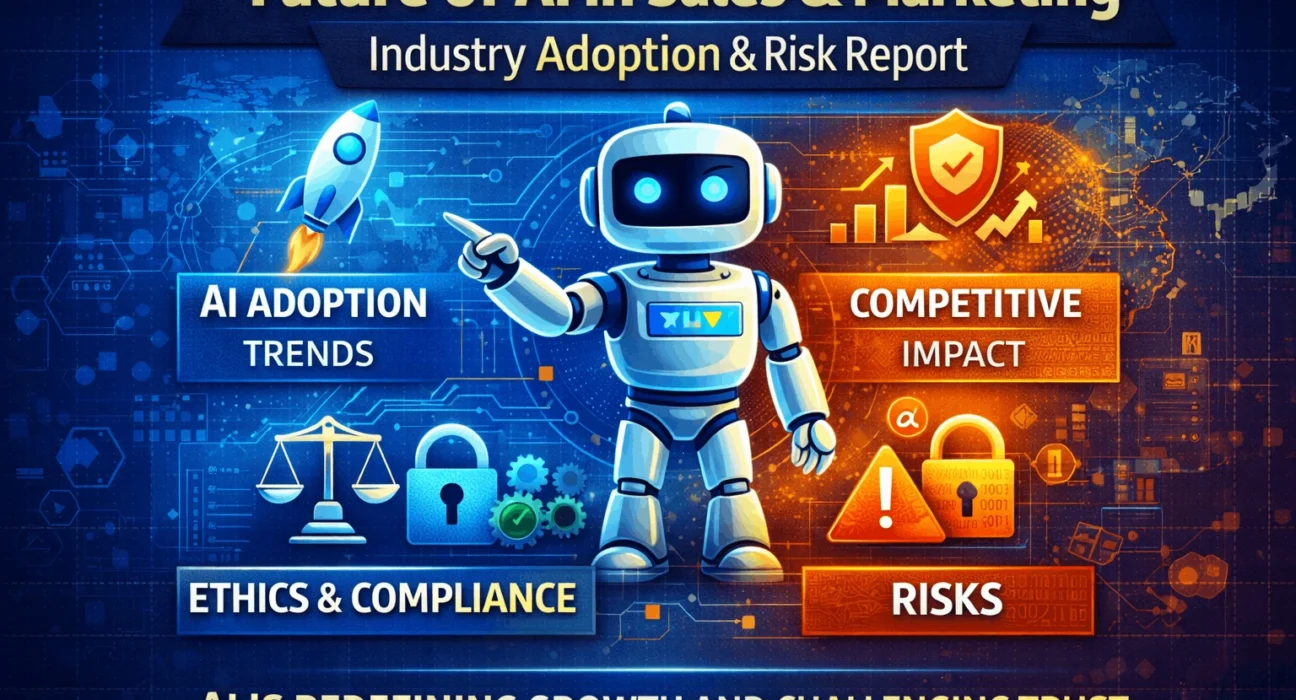
AI in Sales & Marketing: Adoption, Opportunities & Risk Report
Artificial Intelligence is rapidly transforming how brands generate leads, create content, predict customer behavior, and forecast revenue across B2B, SaaS, EdTech, and consumer industries. Companies integrating AI-driven growth systems are scaling faster, while others are still navigating automation’s impact on roles and workflows.
This industry report examines AI adoption trends, competitive advantages, compliance risks, ethical challenges, and long-term business implications across global and emerging startup ecosystems.
Key insight: AI delivers strong ROI when balanced with human creativity, brand authenticity, and responsible implementation. Over-automation can dilute brand voice, create compliance exposure, and weaken customer trust.
What is the Future of AI in Sales and Marketing?
The future of AI in sales and marketing includes automation of repetitive tasks, predictive customer insights, hyper-personalized campaigns, and AI-driven decision-making to improve performance and efficiency.
However, AI adoption also introduces risks such as data privacy concerns, compliance challenges, brand voice dilution, and over-automation that may reduce customer trust. Organizations that balance AI efficiency with human creativity and ethical marketing governance are likely to achieve sustainable growth.
The AI Boom in Revenue Teams: Why Adoption Is Exploding
You might be wondering — why is every marketing and sales tool suddenly shouting “AI-powered”?
Simple answer? Pressure.
Businesses are being pushed to generate more leads, shorten sales cycles, personalize outreach, and reduce operational costs. And doing that manually is like trying to fill a swimming pool using a coffee mug. Possible? Technically. Smart? Not really.
According to research published by McKinsey AI Insights (https://www.mckinsey.com/capabilities/quantumblack/our-insights/the-state-of-ai), over 60% of organizations are already integrating AI into revenue and customer experience workflows.
And here’s the interesting part…
Early adopters aren’t just improving efficiency. They’re redefining competitive positioning.
Major AI Adoption Trends Transforming Sales & Marketing
1. AI-Powered Lead Intelligence and Prospect Scoring
Sales teams are moving beyond traditional CRM filters. AI tools now analyze behavioral patterns, engagement signals, firmographic data, and intent tracking.
Platforms like HubSpot AI Sales Tools
👉 https://www.hubspot.com/products/ai
are helping teams identify which prospects are most likely to convert — before the first email even gets sent.
It’s kind of like predictive matchmaking. Except instead of dating compatibility, it predicts buying probability.
2. Content Automation and Dynamic Messaging
Marketing teams are using AI to scale content production across blogs, social media, ads, and email sequences.
But here’s where things get tricky…
AI can generate content volume. It cannot automatically generate emotional resonance or cultural nuance. At least, not consistently.
That’s why successful brands are using AI as a drafting assistant rather than a storytelling replacement.
3. Conversational AI and Customer Journey Personalization
Chatbots, AI assistants, and conversational interfaces are now handling customer support, onboarding flows, and lead qualification.
Solutions like Drift Conversational Marketing Platform
👉 https://www.drift.com
are enabling real-time engagement that feels personal and immediate.
And customers are responding. Because waiting 24 hours for a reply feels outdated in an instant-response economy.
4. Predictive Revenue Forecasting
AI is reshaping how companies forecast sales pipelines. Instead of relying on historical assumptions, predictive algorithms analyze real-time deal behavior, engagement frequency, and conversion trends.
And yes, it’s significantly improving revenue accuracy. But it also creates over-reliance risks — more on that later.
Competitive Impact: How AI Is Redefining Market Leadership
AI adoption is quietly creating two categories of companies:
- Growth Accelerators
- Manual Survivors
Organizations leveraging AI are achieving faster experimentation cycles, deeper audience insights, and scalable personalization. Meanwhile, companies delaying AI adoption are struggling with rising customer acquisition costs and slower campaign optimization.
According to Salesforce State of Marketing Report
👉 https://www.salesforce.com/resources/research-reports/state-of-marketing
High-performing marketing teams are 2.5x more likely to use AI for customer journey orchestration.
That’s not just a technology shift. That’s a market gap widening in real time.
The Dark Side: AI Risks Brands Can’t Ignore
Okay, let’s slow down for a second. Because AI isn’t just sunshine and growth graphs.
There are real, measurable risks businesses are facing.
⚠️ Brand Voice Dilution
When AI generates large volumes of content without human oversight, messaging can become generic. And honestly, customers can sense that. It’s like talking to someone who keeps repeating motivational quotes from the internet. Sounds polished. Feels hollow.
Brands that over-automate storytelling often lose emotional connection with their audience.
⚠️ Data Privacy and Compliance Threats
AI relies heavily on user data. And global regulations like GDPR, India’s Digital Personal Data Protection Act, and emerging compliance frameworks are tightening data usage governance.
Organizations using AI must align with regulatory standards explained by European Commission GDPR Overview
👉 https://commission.europa.eu/law/law-topic/data-protection_en
Failure to comply can result in financial penalties and reputational damage.
⚠️ Over-Automation Reducing Customer Trust
Customers still want human empathy. Especially during complex purchasing decisions or service escalations.
Brands that replace human touchpoints completely risk appearing transactional rather than relational.
⚠️ Bias and Ethical AI Concerns
AI models learn from existing datasets. And if those datasets contain bias, AI recommendations can unintentionally reinforce discrimination or unfair targeting.
This is becoming a growing concern in hiring funnels, loan approvals, and personalized advertising.
Ethical AI Marketing: The Emerging Trust Economy
The next wave of marketing leadership won’t be defined by who uses AI. It’ll be defined by who uses AI responsibly.
Companies are now building internal AI governance frameworks that include:
• Human content validation workflows
• Transparent customer data usage policies
• Ethical campaign review checkpoints
• AI bias testing models
• Brand tone consistency audits
And interestingly, ethical AI positioning is becoming a brand differentiator itself.
Customers trust brands that openly explain how automation supports — not replaces — customer experience.
AI Compliance and Regulatory Evolution: What Startups Must Prepare For
Governments worldwide are accelerating AI policy development. And while regulations differ by region, certain compliance expectations are becoming universal:
• Data consent transparency
• Automated decision disclosure
• AI-generated content labeling
• Customer data storage accountability
Startups that build compliance-ready AI workflows early are reducing long-term legal exposure and scaling faster internationally.
Where Human Creativity Still Wins (And Probably Always Will)
AI excels at pattern recognition, speed, and data processing. But it struggles with contextual empathy, cultural storytelling, and unpredictable creative innovation.
Think of AI as a high-performance engine. Humans remain the drivers.
The most successful marketing teams today follow a hybrid model:
AI handles research, optimization, and scalability.
Humans handle emotional connection, storytelling, and strategic intuition.
The Future Outlook: What Sales and Marketing Will Look Like by 2030
Industry projections suggest AI will become embedded in almost every customer interaction layer, including:
• Voice search and conversational commerce
• Hyper-personalized content ecosystems
• Predictive buying journey orchestration
• Real-time campaign self-optimization
• AI-generated multimedia brand storytelling
But. And this is important.
Customers will reward brands that maintain authenticity alongside automation.
Trust will become the ultimate competitive currency.
Strategic Recommendations for Businesses Adopting AI
Based on current adoption patterns and risk analysis, organizations should:
✔ Build AI implementation roadmaps aligned with business goals
✔ Maintain human review for customer-facing messaging
✔ Develop AI ethics and compliance policies early
✔ Invest in AI literacy training for marketing and sales teams
✔ Monitor AI performance analytics continuously
✔ Balance automation efficiency with brand storytelling authenticity
Companies treating AI as a growth partner — not a replacement — are seeing stronger long-term ROI and customer retention.
Final Thoughts: AI Is a Growth Multiplier, Not a Growth Shortcut
To be honest, AI won’t magically fix weak marketing strategies or broken sales processes. It amplifies whatever foundation already exists.
Strong brands become stronger with AI. Weak brand messaging becomes more visible when automated at scale.
The future of sales and marketing isn’t human vs AI. It’s human intelligence enhanced by artificial intelligence.
And the organizations that learn to orchestrate both… those are the ones building the next generation of global brands.
Summary

Article Name
Future of AI in Sales & Marketing: Adoption Trends & Risk Report 2026
DescriptionExplore the future of AI in sales and marketing with industry adoption trends, compliance risks, ethical challenges, and competitive impact shaping business growth strategies.
Author
Upstartzen Editorial Team
Publisher Name
Upstartzen