





Lead Generation Channels Performance Report: Google, Meta, LinkedIn & Email
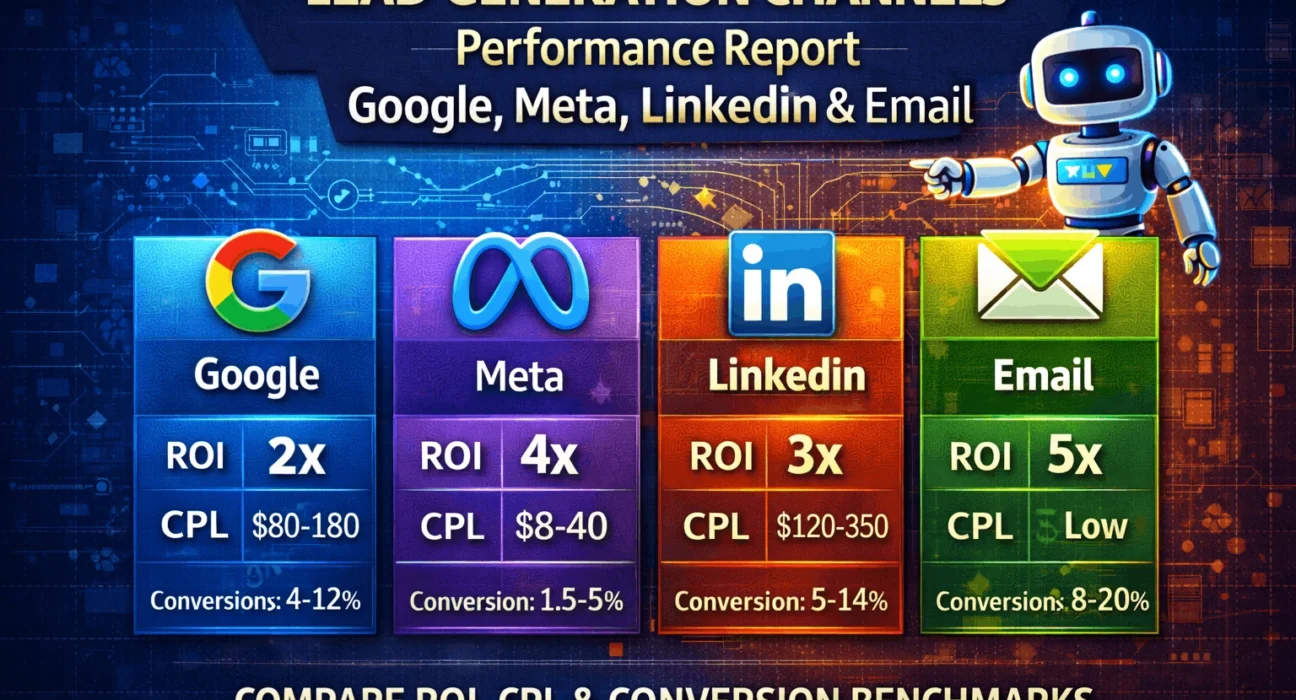
Lead Generation Channels Performance Report
Lead generation has become one of the most complex areas of modern marketing. While platforms and dashboards often highlight strong lead numbers, many businesses struggle to measure actual conversion quality, profitability, and scalability.
This performance report compares four major lead generation channels — Google Ads, Meta Ads, LinkedIn Marketing, and Email Marketing — using benchmark data across B2B, SaaS, EdTech, and service-driven startups. The analysis evaluates Cost Per Lead (CPL), ROI, lead quality, and long-term revenue contribution.
Key insight: There is no universal “best” channel. Each platform serves a different role in the growth funnel. Sustainable marketing success depends on balancing high-intent acquisition channels with cost-efficient nurturing strategies that drive predictable revenue growth.
Which Lead Generation Channel Delivers the Best ROI?
Google Ads typically generates high-intent leads with strong conversion rates but a higher cost per lead. Meta Ads produce lower-cost leads with broader audience reach but usually require nurturing workflows to convert effectively.
LinkedIn Marketing delivers premium B2B leads with higher deal value but often comes with expensive CPL. Email marketing offers strong long-term ROI by supporting lead nurturing, customer retention, and repeat conversions.
The most effective growth strategy combines multiple channels based on funnel stage, audience intent, and business objectives.
The Lead Generation Reality Check: Why Channel Comparison Matters
You might be wondering… if every platform generates leads, why compare them at all?
Because not all leads are equal.
Some leads are ready to buy. Others just downloaded an ebook because they were bored during lunch. And if marketing teams fail to differentiate between intent-driven and curiosity-driven leads, budgets disappear fast.
According to research from HubSpot Marketing Statistics
Companies using multi-channel lead generation strategies generate 3x higher engagement and 2.5x better conversion performance compared to single-channel dependency.
And that makes sense. Buyers don’t live on one platform. They research, compare, scroll, and evaluate across multiple touchpoints.
Channel Performance Benchmark Overview
Let’s break down how each channel performs across three major performance metrics:
• Cost Per Lead (CPL)
• Conversion Rate
• Return on Investment (ROI)
Google Ads Performance Benchmark
✔ Strength: High Intent Lead Acquisition
Google Ads operates on search behavior. That means users are actively searching for solutions. And honestly, that intent makes a huge difference in conversion quality.
Industries like SaaS, professional services, and EdTech often see stronger bottom-funnel conversions from Google search campaigns.
According to Google Economic Impact Report
Businesses earn an average of $2 revenue for every $1 spent on Google Ads.
✔ Benchmark Insights
Average CPL:
• B2B SaaS: $80 – $180
• EdTech: $60 – $150
• Professional Services: $70 – $200
Conversion Rate:
Typically ranges between 4% – 12% depending on keyword targeting and landing page optimization.
⚠ Limitation
Competition increases CPC costs rapidly. And poorly optimized keyword targeting can burn budgets quickly.
Meta Ads Performance Benchmark (Facebook & Instagram)
✔ Strength: Audience Discovery and Scalable Lead Volume
Meta Ads excel at audience targeting using behavioral and demographic insights. Brands use it heavily for awareness-stage and mid-funnel lead capture.
And honestly, Meta campaigns often generate leads at significantly lower costs.
According to Meta Business Advertising Insights
Meta platforms reach over 3 billion active users globally, making it one of the most scalable lead acquisition ecosystems.
✔ Benchmark Insights
Average CPL:
• B2C & EdTech: $8 – $40
• SaaS Trials: $25 – $70
• Coaching & Services: $15 – $60
Conversion Rate:
Usually 1.5% – 5% for direct conversions. Higher when combined with retargeting funnels.
⚠ Limitation
Lower purchase intent compared to search traffic. Leads often require nurturing through remarketing or email sequences.
LinkedIn Lead Generation Benchmark
✔ Strength: Premium B2B Lead Quality
LinkedIn is often expensive. No denying that. But it consistently delivers high-value professional leads, especially for enterprise SaaS, corporate training, and consulting services.
According to LinkedIn Marketing Solutions Data
LinkedIn generates 2x higher conversion rates for B2B compared to other social platforms.
✔ Benchmark Insights
Average CPL:
• Enterprise SaaS: $120 – $350
• Corporate Training: $90 – $280
• Consulting Services: $150 – $400
Conversion Rate:
Ranges between 5% – 14% for high-ticket services.
⚠ Limitation
Higher acquisition cost limits scalability for early-stage startups.
Email Marketing Performance Benchmark
✔ Strength: Highest Long-Term ROI Channel
Email marketing doesn’t usually generate cold leads. But it dominates in lead nurturing, retention, and repeat conversion.
And honestly… email remains one of the most undervalued growth channels.
According to Campaign Monitor Email ROI Research
Email marketing delivers an average ROI of $36 for every $1 spent.
✔ Benchmark Insights
Average CPL:
Extremely low when used for nurturing existing traffic.
Conversion Rate:
Ranges between 8% – 20% depending on segmentation and automation workflows.
⚠ Limitation
Email requires strong lead database quality. Poor list management reduces deliverability and engagement.
Comparative Channel ROI Summary
Google Ads:
Best for capturing high-intent buyers actively searching solutions.
Meta Ads:
Best for audience expansion and cost-efficient lead volume.
LinkedIn:
Best for premium B2B lead acquisition and enterprise deal pipelines.
Email Marketing:
Best for nurturing, upselling, retention, and long-term ROI growth.
The Multi-Channel Funnel Strategy Winning in 2025
Most high-growth startups are no longer relying on single-channel lead generation. They’re building funnel ecosystems.
Typical high-performing funnel structure looks like:
Top Funnel:
Meta Ads + Content Marketing
Mid Funnel:
Google Search + Retargeting Ads
Bottom Funnel:
LinkedIn Outreach + Email Nurturing
This integrated strategy improves lead quality while balancing acquisition costs.
AI and Automation Impact on Lead Channel Performance (AIO Optimization)
Artificial Intelligence is now optimizing channel performance using:
• Predictive audience targeting
• Automated bidding strategies
• Lead scoring automation
• Personalization engines
• Funnel performance forecasting
Platforms like Salesforce Marketing Cloud AI
…are helping organizations optimize cross-channel attribution and campaign optimization.
Geographic Growth Insights (GEO Optimization)
Emerging markets like India, Southeast Asia, and the Middle East are seeing:
• Faster Meta Ads adoption for EdTech and D2C brands
• Increasing Google Search competition for SaaS and service sectors
• Rising LinkedIn B2B campaign investments among enterprise startups
• Rapid email automation adoption for retention-based growth
These markets are driving the next wave of digital lead generation innovation.
Strategic Budget Allocation Recommendations
Based on benchmark performance trends, growth-stage startups should consider:
✔ 35% budget allocation to high-intent channels like Google
✔ 30% budget allocation to audience expansion channels like Meta
✔ 20% budget allocation to premium B2B targeting like LinkedIn
✔ 15% investment into email automation and retention workflows
But honestly, budgets should always adjust based on industry, ticket size, and sales cycle complexity.
Final Thoughts: Lead Generation Is No Longer About Volume
The marketing industry has shifted from lead quantity to lead profitability.
High-performing brands are tracking:
• Lead lifetime value
• Funnel conversion velocity
• Channel-assisted revenue attribution
• Customer retention impact
Because generating cheap leads that never convert isn’t growth. It’s just expensive noise.
The future of lead generation belongs to brands that combine multi-channel acquisition, automation-driven nurturing, and data-backed attribution tracking.
And the marketers who understand channel roles — not just channel performance — will lead the next growth era.
Summary

Article Name
Lead Generation Channels Report: Google, Meta, LinkedIn & Email ROI
DescriptionA detailed performance report comparing Google Ads, Meta Ads, LinkedIn, and Email marketing with ROI, CPL, and conversion benchmarks for startups.
Author
Upstartzen Editorial Team
Publisher Name
Upstartzen