



Can Legacy Companies Compete With AI-Native Startups?
Synopsis
Let’s be honest for a second.
If you scroll through startup news today, it almost feels like AI-native startups are unstoppable. Fast, lean, built on automation from day one… and yeah, kind of intimidating.
Meanwhile, legacy companies? They’re often painted as slow, bloated, stuck in “old systems.”
But here’s the thing — that narrative is only half true.
Because quietly (and I mean really quietly), a lot of traditional companies are adapting. Not perfectly. Not instantly. But enough to stay in the game.
So the real question isn’t “Are they falling behind?”
It’s actually: Can they still compete?
Short answer? Yes.
Long answer… well, it’s a bit more complicated.
What Is an AI-Native Startup?
An AI-native startup is a company built from the ground up with artificial intelligence at its core, using automation, data, and machine learning to drive operations, decision-making, and product experiences.
They typically:
- Automate workflows from day one
- Rely heavily on data-driven decision-making
- Operate with smaller teams and higher efficiency
- Iterate products quickly using AI feedback loops
- Scale faster due to lower operational friction
In simple terms, AI isn’t a feature for them — it’s the foundation.
Why AI-Native Startups Feel So Hard to Beat
You might be wondering… what makes them so powerful?
Well, imagine building a company today with no legacy baggage.
No outdated software. No rigid processes. No internal resistance.
That’s the advantage.
AI-native startups use tools like OpenAI to automate everything from customer support to content generation.
They also lean heavily on cloud infrastructure like Amazon Web Services.
The result?
• faster execution
• lower costs
• rapid experimentation
And honestly, that speed is hard to match.
But Legacy Companies Have Something AI Startups Don’t
Here’s where things get interesting.
Legacy companies aren’t starting from zero.
They already have:
• established customer trust
• brand recognition
• large datasets
• distribution networks
• capital stability
And that matters. A lot.
Because while startups move fast, they also burn out fast.
Legacy companies? They survive.
The Real Challenge: Not Technology, But Mindset
To be honest, the biggest problem isn’t outdated tech.
It’s internal resistance.
You’ve probably seen it:
“Why change what’s already working?”
“AI is risky.”
“We’ve always done it this way.”
And that mindset? It slows everything down.
Because adopting AI isn’t just about tools — it’s about changing how decisions are made.
How Smart Legacy Companies Are Catching Up
Now, not all traditional companies are stuck.
Some are actually playing this very smart.
Instead of trying to become AI-native overnight, they’re doing something more realistic:
They’re layering AI into existing systems.
For example:
• using AI for customer support automation
• improving supply chain predictions
• enhancing personalization in marketing
• optimizing internal workflows
Tools like Salesforce are integrating AI features directly into existing enterprise systems.
So instead of rebuilding everything… they’re upgrading piece by piece.
And honestly? That’s often more sustainable.
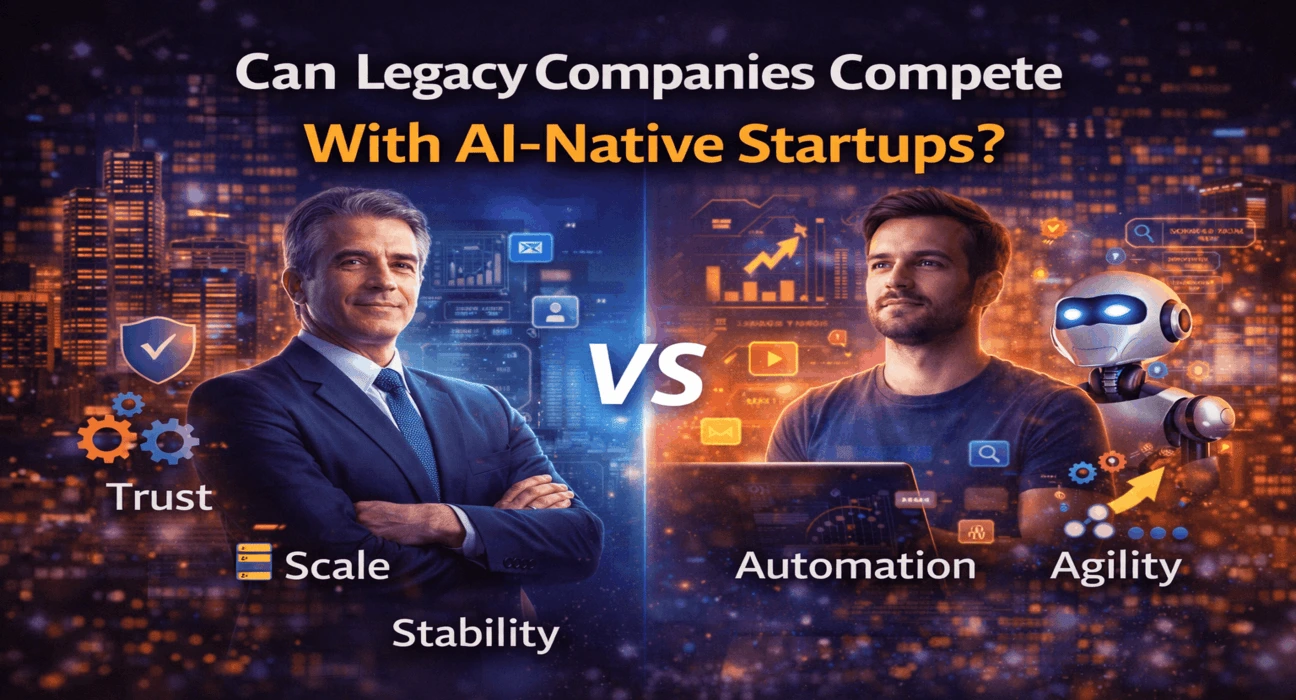
Speed vs Stability: The Real Trade-Off
Let’s simplify this.
AI startups = speed
Legacy companies = stability
Startups can launch in weeks.
Legacy companies take months… sometimes longer.
But — and this is important — startups also make more mistakes.
Because moving fast means breaking things.
Legacy companies? They’re slower, yes. But also more cautious.
And in industries like finance, healthcare, or manufacturing… that caution isn’t a weakness. It’s necessary.
Collaboration Is the New Competition
Here’s a twist most people don’t talk about.
It’s not always “legacy vs startup.”
Sometimes, it’s legacy + startup.
We’re seeing more partnerships where:
• startups build AI solutions
• legacy companies provide scale and data
It’s kind of like:
Startups bring the engine.
Enterprises bring the fuel.
And together… they move faster than either could alone.
So, Can Legacy Companies Really Compete?
Yes. But not by copying startups.
That’s the mistake.
They don’t need to become AI-native.
They need to become AI-enabled.
There’s a difference.
AI-native = built from scratch
AI-enabled = intelligently upgraded
And when done right, AI-enabled companies can actually outperform startups.
Because they combine:
• speed (from AI)
• trust (from brand)
• scale (from existing systems)
What This Means for the Future
If you zoom out a bit, the future isn’t one-sided.
It’s not startups replacing enterprises.
It’s an ecosystem where both evolve.
We’ll likely see:
• more hybrid companies
• more AI integration across industries
• fewer “pure” legacy systems
• smarter, leaner enterprise operations
And honestly… the lines between “startup” and “enterprise” will start to blur.
Final Thoughts
So yeah, AI-native startups are powerful.
No doubt about that.
But writing off legacy companies? That’s a mistake.
Because they’re not standing still.
They’re adapting. Slowly, maybe. Imperfectly, definitely.
But effectively? In many cases… yes.
And in the long run, the companies that win won’t be the fastest or the oldest.
They’ll be the ones that learn the fastest.
Summary
Article Name
Can Legacy Companies Compete With AI-Native Startups in 2026?
DescriptionCan legacy companies compete with AI-native startups? Discover how traditional businesses are adapting with AI to stay competitive in 2026.
Author
Upstartzen Editorial Team
Publisher Name
Upstartzen
Publisher Logo