





The Growth Mindset Every Entrepreneur Needs to Succeed
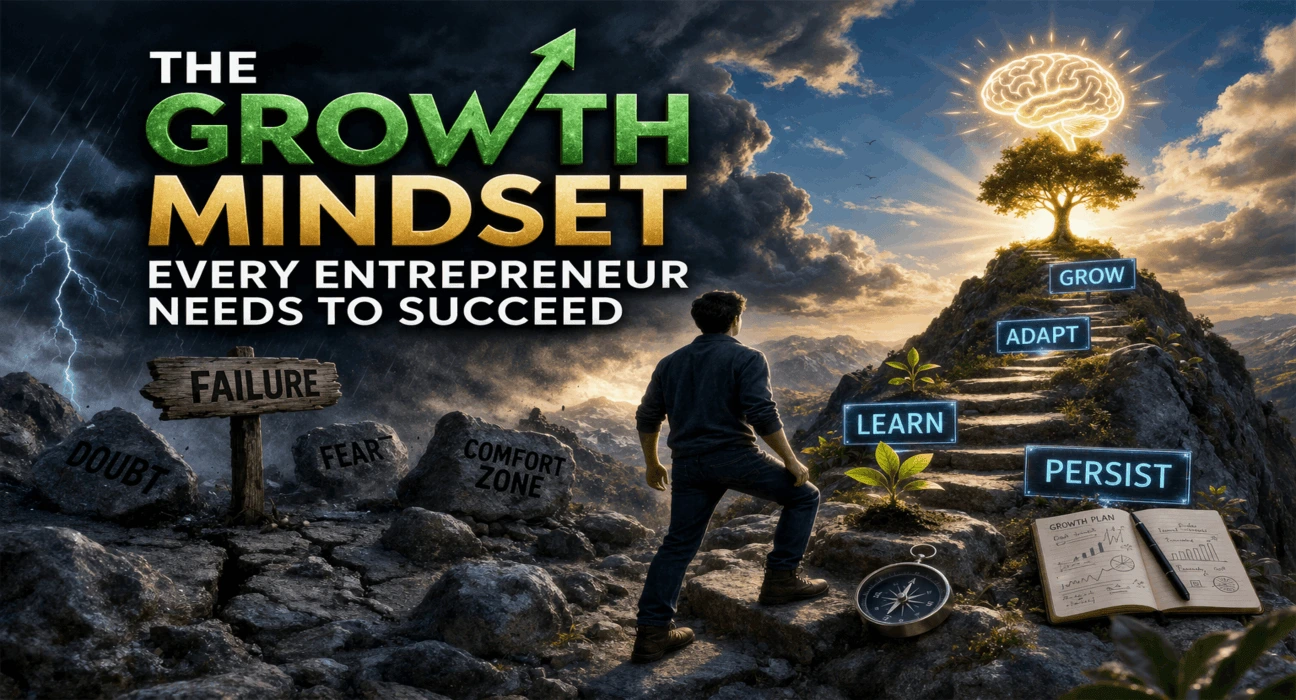
Why do some entrepreneurs bounce back stronger after failure…
while others quit after one setback?
It’s not luck.
It’s not funding.
It’s mindset.
Here’s the thing…
Your strategy might get you started.
But your mindset determines how far you go.
And the difference between stagnation and scale often comes down to one thing:
👉 How you think under pressure.
📊 Why Growth Mindset Is a Competitive Advantage
Entrepreneurship today is brutal.
- Markets change overnight
- Competition is global
- Attention spans are shrinking
And let’s be honest…
Even great ideas fail without the right mindset.
👉 According to multiple startup studies:
- Most failures happen due to execution and decision-making, not just product flaws
Which brings us to the core idea:
👉 Mindset isn’t soft—it’s a performance multiplier
What Is a Growth Mindset?
A growth mindset is the belief that skills, intelligence, and abilities can be developed through effort, learning, and persistence.
Key Characteristics
- Embraces challenges as opportunities to grow
- Learns from failures and feedback
- Believes effort leads to improvement
- Continuously seeks learning and development
In simple terms:
👉 You’re not fixed—you can improve with effort.
Core Breakdown: The Entrepreneurial Growth Mindset
1. The Learning Loop Mindset (Fail → Learn → Adapt → Repeat)
💡 The Lesson:
Entrepreneurs with a growth mindset don’t avoid failure.
They use it as feedback.
🧠 Framework: The Learning Loop
- Take action
- Measure outcome
- Extract lessons
- Adapt strategy
📊 Real Insight:
Startups that iterate faster:
👉 Increase survival probability
⚠️ Contrarian Insight:
Failure isn’t valuable by default.
👉 Only analyzed failure creates growth
2. The Anti-Fragile Thinking Model
💡 The Lesson:
Some entrepreneurs don’t just survive stress…
They grow from it.
🧠 Framework: Anti-Fragility
- Fragile → Breaks under pressure
- Resilient → Survives pressure
- Anti-fragile → Improves with pressure
🎯 Application:
- Treat volatility as opportunity
- Experiment more during uncertainty
3. Identity-Based Growth (Who You Become > What You Achieve)
💡 The Lesson:
Most people focus on goals.
Top entrepreneurs focus on identity.
🧠 Framework: Identity Shift
Instead of saying:
👉 “I want to build a successful startup”
Say:
👉 “I am someone who solves problems consistently”
🎯 Why It Works:
Identity drives behavior.
Behavior drives results.
4. The Long-Term Thinking Bias
💡 The Lesson:
Short-term thinking kills startups.
Growth mindset = playing long-term games
🧠 Framework: Time Horizon Thinking
Ask:
- Will this matter in 1 year?
- Will this matter in 5 years?
📊 Example:
- Viral growth hacks → Short-term spike
- Strong brand building → Long-term dominance
5. The Controlled Risk Framework
💡 The Lesson:
Growth mindset doesn’t mean reckless risk.
It means calculated experimentation.
🧠 Framework: Controlled Risk
- Limit downside
- Maximize upside
- Test before scaling
🎯 CEO Behavior:
They don’t gamble.
They design asymmetric bets.
📊 Real-World Patterns in Entrepreneurial Mindset
🧩 Pattern 1: Emotional Detachment from Outcomes
Top founders:
- Care deeply
- But don’t attach identity to results
🧩 Pattern 2: Obsession with Feedback
They:
- Track metrics
- Listen to users
- Iterate constantly
🧩 Pattern 3: Consistency Over Motivation
Let’s be honest…
Motivation fades.
👉 Systems sustain growth.
Tools That Reinforce Growth Mindset
Tools That Reinforce Growth Mindset (Monetization Friendly)
- Notion → Track learning loops & reflections
- Roam Research → connect ideas & insights
- Google Analytics → data-driven decisions
- Trello → execution tracking
- Slack → team feedback loops
Growth Mindset Framework (Step-by-Step)
Develop a growth mindset by reframing failure, building feedback systems, focusing on identity, thinking long-term, and taking calculated risks.
-
Reframe Failure
- Treat failure as data, not defeat
- Extract lessons instead of emotions
-
Build Feedback Loops
- Track what matters
- Use data to improve continuously
-
Focus on Identity
- Shift from goals to identity
- Become the person who executes consistently
-
Think Long-Term
- Avoid short-term distractions
- Prioritize compounding growth
-
Take Controlled Risks
- Experiment with calculated decisions
- Avoid reckless or uninformed risks
In simple terms:
👉 Learn → Measure → Become → Think Long-Term → Experiment.
Quick Action Tips
- Write weekly lessons from failures
- Track 3 key metrics consistently
- Replace goals with identity statements
- Avoid reacting emotionally to setbacks
- Build systems for consistency
🧠 Non-Obvious Insight
Here’s something most entrepreneurs miss…
👉 A growth mindset without structure leads to chaos.
You can:
- Learn constantly
- Experiment endlessly
But without direction…
👉 You’ll stay busy, not successful.
Growth mindset works only when paired with focus and systems.
🔚 Conclusion
Success in entrepreneurship isn’t just about ideas.
It’s about:
- How you think
- How you respond
- How you adapt
The best entrepreneurs don’t just work harder.
They evolve faster.
And that’s the real edge:
👉 Growth mindset isn’t optional anymore
👉 It’s your competitive advantage
Frequently Asked Questions (Growth Mindset in Entrepreneurship)
1. What is a growth mindset in entrepreneurship?
A growth mindset in entrepreneurship is the belief that skills and success can be developed through learning, persistence, and adaptation.
2. Why is a growth mindset important for entrepreneurs?
It helps entrepreneurs handle failure, adapt to change, and continuously improve their strategies.
3. How can I develop a growth mindset?
Focus on learning from failures, track progress, seek feedback, and adopt long-term thinking.
4. What is anti-fragile thinking?
Anti-fragile thinking is the ability to grow stronger under stress and uncertainty rather than just surviving it.
5. Can mindset really impact business success?
Yes, mindset directly influences decision-making, resilience, and execution, which ultimately affect business outcomes.
Summary
Article Name
The Growth Mindset Every Entrepreneur Needs to Succeed
DescriptionLearn the growth mindset every entrepreneur needs to succeed with proven frameworks, real insights, and actionable strategies to build resilience and scale.
Author
Upstartzen Editorial Team
Publisher Name
Upstartzen
Publisher Logo