




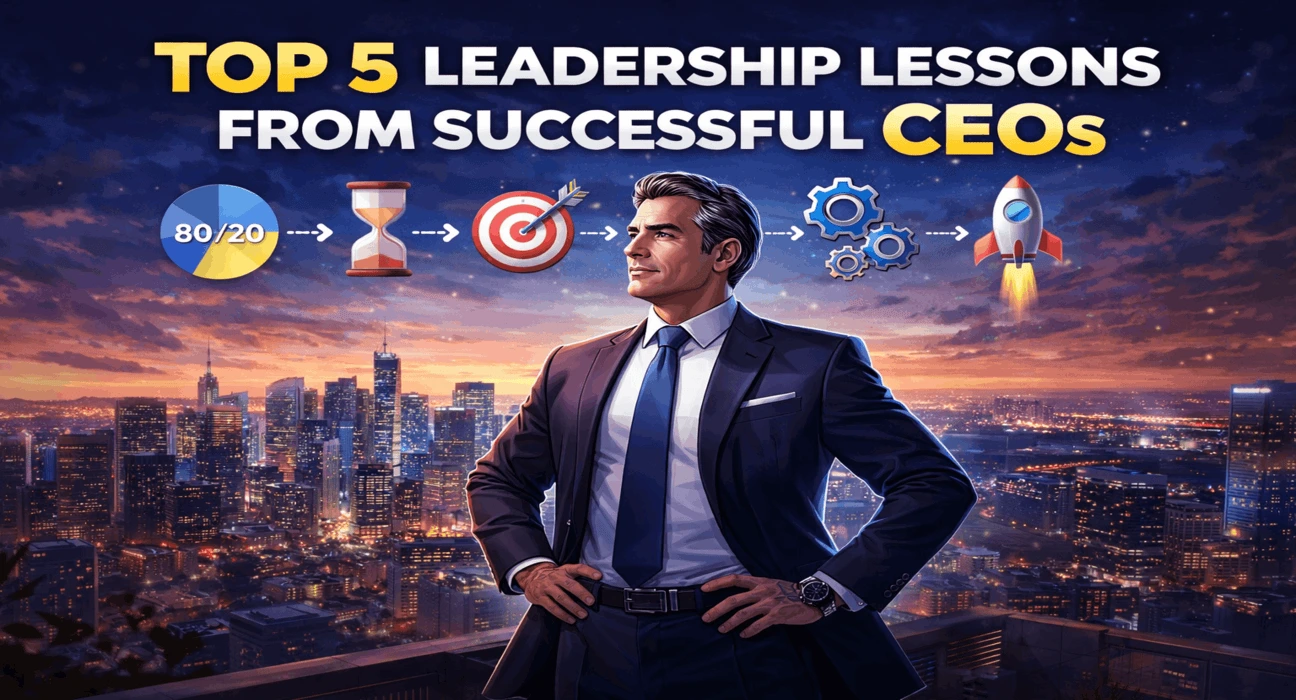
Top 5 Leadership Lessons from Successful CEOs
What separates great CEOs from average leaders?
It’s not just intelligence.
It’s not just experience.
It’s how they think, decide, and lead under pressure.
Here’s the thing…
The best CEOs don’t rely on motivation or instincts alone.
They use repeatable frameworks that guide their leadership decisions.
And once you understand these frameworks…
👉 You can apply them, regardless of your role or industry.
📊 Why CEO-Level Leadership Matters Today
Leadership has changed.
We’re no longer in a world where:
- Authority drives execution
- Experience guarantees success
Instead, today’s leaders operate in:
- Uncertainty
- Rapid change
- Information overload
👉 Which means leadership is now about:
- Decision quality
- Clarity of thinking
- Speed of execution
And that’s exactly what top CEOs optimize for.
What Are Leadership Lessons from CEOs?
Leadership lessons from CEOs are proven principles and decision-making frameworks used by top executives to guide teams, manage risk, and drive long-term business success.
What These Lessons Focus On
- Strategic decision-making under uncertainty
- Building and leading high-performance teams
- Managing risk and navigating challenges
- Driving sustainable growth and vision
In simple terms:
👉 How top leaders think, decide, and execute at scale.
Why It Works:
- Markets reward speed
- Delayed decisions = lost opportunities
Contrarian Insight:
Perfection is often a disguised form of fear.
3. Focus on High-Leverage Decisions (The 80/20 Leadership Rule)
💡 The Lesson:
Not all decisions are equal.
Some decisions create 10x impact.
Framework: 80/20 Rule (Pareto Principle)
- 20% of decisions → 80% of outcomes
CEO Behavior:
They:
- Delegate low-impact decisions
- Focus only on critical ones
Example:
A CEO might:
- Spend hours on hiring a key leader
- Spend minutes approving minor budgets
4. Think in Second-Order Consequences
💡 The Lesson:
Good leaders think about outcomes.
Great CEOs think about:
👉 Outcomes of outcomes
Framework: Second-Order Thinking
Ask:
- What happens next?
- And then what happens after that?
Example:
Decision: Cutting marketing budget
- First-order: Cost savings
- Second-order: Reduced growth → lower revenue
Result:
Better long-term decisions.
5. Build Systems, Not Just Effort (The Leverage Framework)
💡 The Lesson:
CEOs don’t scale effort.
They scale systems.
Framework: Leverage Thinking
Leverage = Output / Input
Types of leverage:
- Technology
- People
- Capital
CEO Approach:
Instead of asking:
👉 “How do I work harder?”
They ask:
👉 “How do we build systems that work without me?”
Real-World Patterns from CEOs
Pattern 1: Decision Fatigue Reduction
Top CEOs:
- Limit daily decisions
- Standardize repetitive choices
Pattern 2: Extreme Ownership
They:
- Take responsibility
- Avoid blame culture
Pattern 3: Ruthless Prioritization
They constantly ask:
👉 “What’s the most important thing right now?”
What Is the 70% Rule in Decision-Making?
The 70% Rule states that decisions should be made when you have about 70% of the required information, instead of waiting for complete certainty.
Why It Works
- Avoids Overthinking – Prevents analysis paralysis
- Improves Speed – Enables faster execution and iteration
- Captures Opportunities – Helps act before competitors
How to Apply
- Gather sufficient (not perfect) data
- Assess risks and potential outcomes
- Make the decision and execute quickly
- Adjust based on feedback and results
In simple terms:
👉 Don’t wait for 100% clarity—act at 70% and learn faster.
Non-Obvious Insight
Here’s something most people miss…
👉 Great leadership is NOT about making more decisions.
It’s about:
- Making fewer
- But better ones
And designing systems where:
👉 You don’t need to decide everything
Conclusion
The best CEOs don’t lead with chaos.
They lead with clarity.
They don’t react.
They operate with frameworks.
And that’s the real takeaway:
👉 Leadership isn’t about working harder
👉 It’s about thinking better
If you can:
- Simplify decisions
- Focus on impact
- Build systems
You’re already thinking like a CEO.
FAQs: Leadership Lessons from CEOs
1. What are the most important leadership lessons from CEOs?
The most important leadership lessons include clarity, speed in decision-making, prioritization, second-order thinking, and building scalable systems.
2. Why do CEOs focus on frameworks?
Frameworks help reduce complexity, improve decision quality, and enable faster execution under uncertainty.
3. What is the 80/20 rule in leadership?
The 80/20 rule means focusing on the 20% of decisions that create 80% of results.
4. How can I improve my leadership skills?
You can improve leadership skills by focusing on high-impact decisions, removing distractions, and applying structured thinking frameworks.
5. What is second-order thinking in leadership?
Second-order thinking involves analyzing the long-term consequences of decisions beyond immediate outcomes.
Summary
Article Name
Top 5 Leadership Lessons from Successful CEOs
DescriptionDiscover 5 powerful leadership lessons from successful CEOs, with proven frameworks and actionable strategies to improve your leadership skills.
Author
Upstartzen Editorial Team
Publisher Name
Upstartzen
Publisher Logo