




Are LinkedIn Highlights Making Founders Delusional? A Data-Driven Reality Check
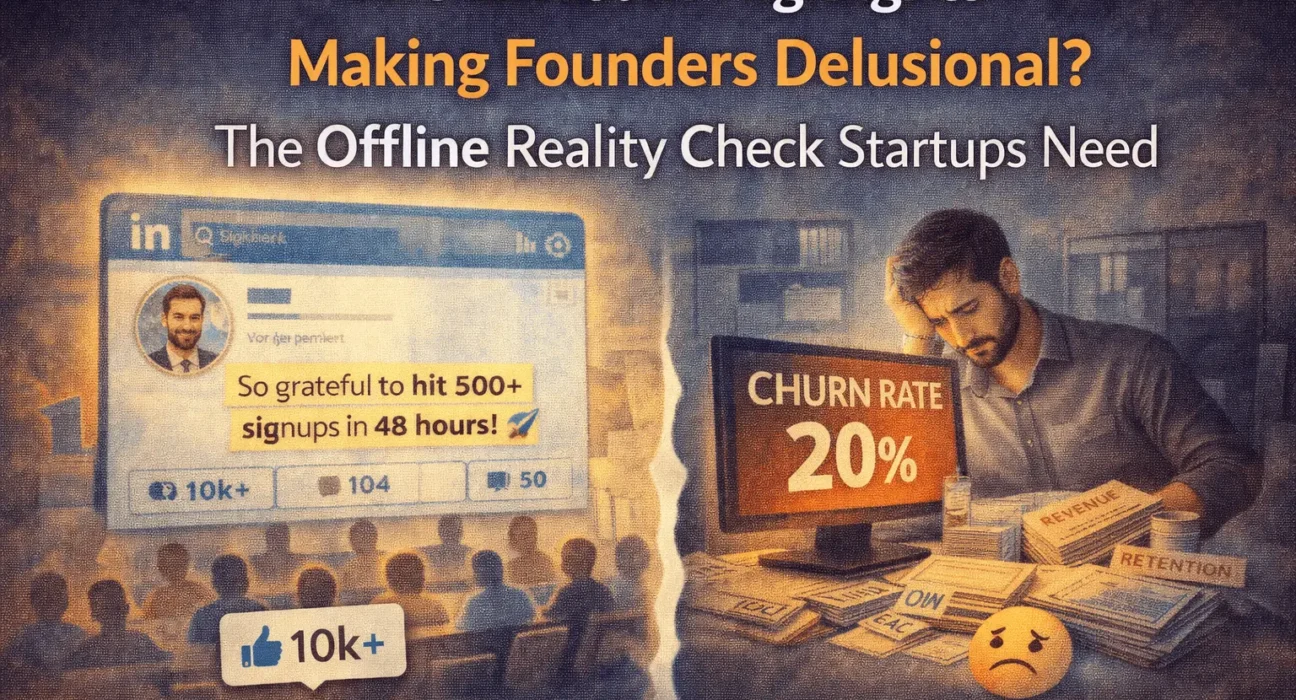
Does social media visibility actually correlate with whether a startup survives?
Not reliably — and the data on why startups actually fail makes the disconnect clear. CB Insights’ analysis of 431 VC-backed startups that shut down found “ran out of capital” as the final, proximate cause in 70% of cases, but the company is explicit that this is almost always the symptom, not the root problem. The real leading causes sit further upstream: poor product-market fit (43%), bad timing (29%), and unsustainable unit economics (19%). None of those show up in a LinkedIn feed. A founder can generate real engagement and visibility while a company is quietly failing on exactly the dimensions that data says actually matter.
Why “Ran Out of Cash” Is the Wrong Headline
CB Insights’ own framing is useful here: capital running out is where the failure story ends, not where it begins. The companies in their dataset had raised a combined $17.5 billion before shutting down — a median of $11 million each — meaning most weren’t undercapitalized in any simple sense. What killed them, per the post-mortem data, was upstream: building something the market didn’t need urgently enough, misjudging timing, or running on unit economics that never actually worked. Visibility and social proof can mask exactly these problems, because engagement metrics measure attention, not whether the underlying product-market fit is real.
The Structural Gap Between What Gets Posted and What Gets Measured
Founder social content is, almost by design, curated toward wins — a funding announcement, a partnership, a growth milestone. None of the leading failure causes CB Insights identified (weak product-market fit, poor timing, broken unit economics) are things a founder is likely to post about in real time, even if they’re actively happening. That’s not necessarily dishonesty; it’s simply that the format rewards a specific kind of update, and the metrics that actually predict survival — retention, unit economics, realistic timing against market conditions — don’t compress into a shareable post the way a funding close does.
A Practical Framework: Five Questions That Cut Through Visibility
Rather than relying on impressions from a feed, a more useful diagnostic is asking direct questions that map to what actually predicts survival:
- Would customers still buy if the company went silent online for 60 days? If pipeline depends on continuous posting, that’s a media presence, not yet a durable business.
- What’s the repeat purchase or renewal rate this quarter? This maps directly to the retention question that sits underneath product-market fit — the leading failure cause in CB Insights’ data.
- How many deals closed through direct conversations versus inbound interest generated by a viral post? A pipeline built primarily on post-driven inbound is a fragile growth channel, not a repeatable one.
- What would the core health metric be if social platforms didn’t exist? Revenue retention, CAC payback, or gross margin — the metrics that actually correlate with the causes of failure in the data.
- Who would recommend the product without being asked? Unprompted advocacy is a stronger product-market-fit signal than engagement on a founder’s personal content.
Why This Matters More in a Tighter Funding Environment
With Indian startup funding down roughly 8% in 2025 and investor participation falling sharply, the tolerance for a company whose visible momentum outpaces its underlying fundamentals has shrunk. Investors conducting diligence increasingly probe past a founder’s public presence toward the specific metrics — retention, unit economics, realistic timeline to profitability — that the CB Insights failure data suggests actually determine outcomes.
The Real Risk: Confusing the Feed for the Business
The more precise version of the risk isn’t that founders are being “delusional” in some vague sense — it’s a specific measurement error: treating a proxy (engagement, followers, impressions) as though it were the target (product-market fit, retention, durable unit economics). CB Insights’ data suggests the actual predictors of failure are almost entirely invisible in a social feed, which means a founder optimizing primarily for visibility is optimizing for a metric with a weak, and possibly nonexistent, relationship to survival.
What a Reality-Focused Practice Actually Looks Like
Founders navigating this well tend to build a few specific habits: reviewing retention and unit economics on a fixed schedule regardless of how the week’s content performed, talking directly to a minimum number of customers weekly rather than relying on inbound interest as a proxy for demand, and sharing wins internally with the team before ever posting them externally — a simple check on whether a “win” is real before it becomes content.
Frequently Asked Questions
1. What is the actual leading cause of startup failure, according to data?
Poor product-market fit is the most commonly cited root cause. CB Insights’ analysis of failed venture-backed startups identified lack of market demand as the leading reason for failure. While many startups eventually run out of cash, funding shortages are often the result of deeper issues such as weak customer demand, poor timing, or unsustainable unit economics.
2. Does having a strong LinkedIn presence indicate a startup is actually doing well?
No. Social media visibility reflects audience attention, not business performance. A startup’s long-term success is better measured through metrics such as product-market fit, customer retention, revenue growth, unit economics, and customer satisfaction.
3. How much capital do startups typically raise before failing?
Many failed startups raise substantial funding before shutting down. This demonstrates that access to capital alone does not guarantee success. Sustainable growth depends on solving a real customer problem, maintaining healthy unit economics, and building a repeatable business model.
4. What’s a practical way for founders to check whether their startup’s fundamentals match its public perception?
Track operational metrics instead of relying on online engagement. Regularly monitor customer retention, revenue quality, unit economics, sales conversion rates, and customer feedback. These indicators provide a more accurate picture of business health than social media reach or brand visibility alone.
What to Watch Next
- Whether investor diligence increasingly incorporates direct checks on founder social visibility versus underlying metrics, as capital efficiency scrutiny continues
- Whether more startups publish real retention and unit economics data publicly, giving founders and observers better benchmarks than curated social updates
- How the CB Insights failure-cause framework evolves as more recent startup cohorts, including AI-native companies, are studied
Startup failure data cited above is drawn from CB Insights’ analysis of 431 VC-backed companies that shut down since 2023. Indian funding context is drawn from Inc42’s Annual Indian Startup Trends Report 2025.
Summary

Article Name
Are LinkedIn Highlights Making Founders Delusional? The Offline Reality Check Startups Need
DescriptionExplore how LinkedIn culture can distort founder perception of success. Learn the offline reality check framework to measure real startup growth beyond social validation.
Author
Upstartzen Editorial Team
Publisher Name
Upstartzen