


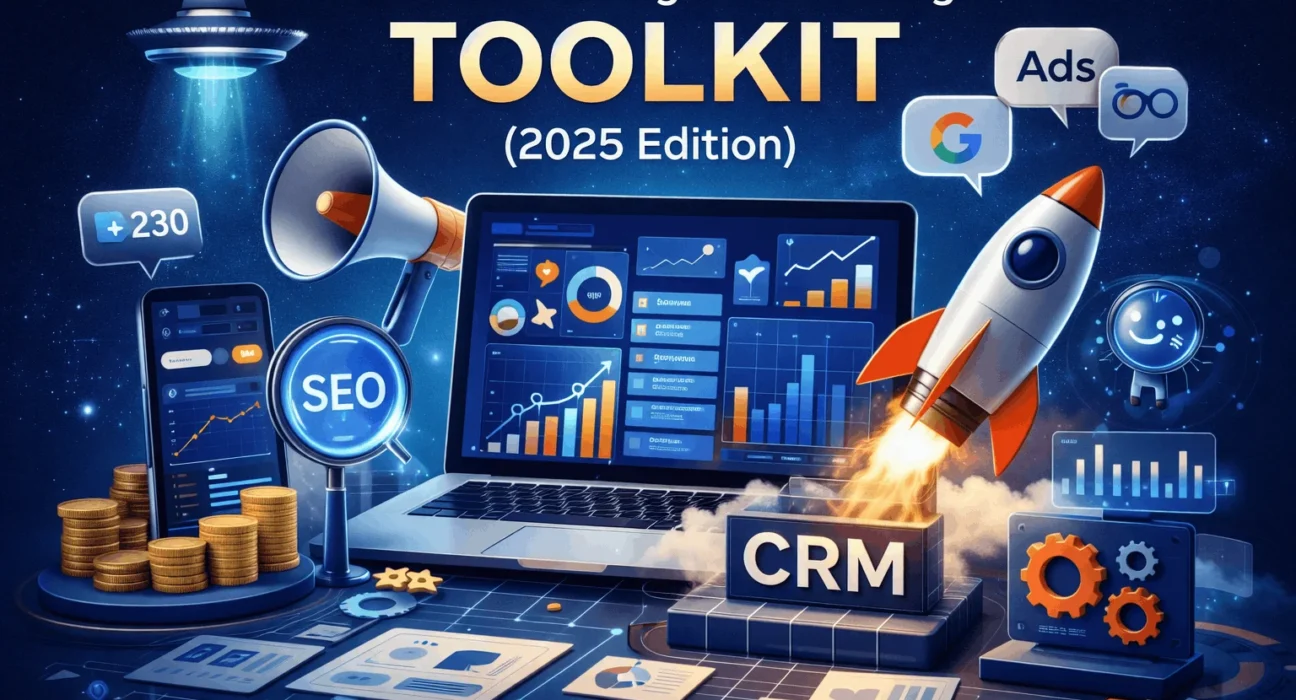
The Ultimate Digital Marketing Toolkit for High-Growth Businesses – 2025 Edition
Synopsis
As high-growth startups face rising customer acquisition costs and increasingly complex buyer journeys, a well-built digital marketing toolkit has become a competitive advantage. This 2025 edition explores a practical, real-world growth stack across SEO, paid advertising, automation, CRM, analytics, and AI — complete with real use cases. Instead of chasing every new platform, the guide focuses on building connected systems that help founders reduce burn, improve lead quality, and scale sustainably in a crowded digital market.
The Stack That Quietly Buys You Time
You might be wondering why anyone would call a bunch of marketing tools “a runway extender.” Sounds dramatic, right?
But here’s the honest version. The right toolkit doesn’t just help you get more leads. It gives you space. Space to breathe, to test things without panic, to stop refreshing your ad dashboard every ten minutes like it’s going to whisper the meaning of life back to you.
And in 2025, when every startup is fighting higher ad costs, shorter attention spans, and AI-powered competitors who move fast and don’t sleep, that space is kind of priceless.
So yeah, this isn’t a logo parade. This is a real-world, lived-in, coffee-stained digital marketing stack for teams that actually want to grow — not just look busy on LinkedIn.
The New Reality of Growth in 2025
To be honest, marketing used to be a little… simpler.
You ran some Google Ads. You published a few blogs. You sent emails when you remembered. And if the stars aligned, leads showed up.
Now? Your customer might discover you on Instagram, read your case study on Google, check your pricing from a retargeting ad, and finally book a demo from an email — all in the same week.
And if your tools don’t talk to each other, that journey turns into a black hole of missing data and awkward handovers.
That’s why modern growth isn’t about tools. It’s about systems. Tools are just the bricks. The system is the house.
What Is a Digital Marketing Toolkit for High-Growth Businesses?
A digital marketing toolkit for high-growth businesses is a connected stack of tools that covers SEO, paid advertising, marketing automation, CRM, analytics, and AI. Its purpose is to attract qualified traffic, convert leads into customers, track performance across channels, and scale growth efficiently without increasing operational costs at the same pace as revenue.
Layer 1: SEO — The Quiet Engine That Never Stops
SEO is the friend who doesn’t talk much but always shows up.
It won’t give you overnight wins. But when it starts working, it just… keeps working. Even when your ad budget takes a break or your campaign goes sideways.
Tools That Actually Pull Their Weight
Ahrefs
Think of this as a market X-ray. You see what your competitors rank for, where their links come from, and what content gaps you can sneak into.
SEMrush
More of a growth command center. SEO, PPC insights, technical audits, keyword intent — all living under one roof.
Google Search Console
Not glamorous. But brutally honest. It tells you what Google really thinks about your site.
Real Use Case
Let’s say you’re building a SaaS product for remote HR teams. You use Ahrefs to find low-competition keywords like “onboarding tools for distributed teams,” build content around that, and then monitor impressions and clicks in Search Console.
It’s slow at first. Then one day, leads start showing up while you’re in a meeting. That’s when SEO feels like magic.
Layer 2: Paid Ads — Speed with a Price Tag
Ads are like a sports car.
Fun. Fast. Expensive if you don’t know how to drive.
In 2025, the smartest teams don’t use ads to “figure things out.” They use them to scale what’s already working.
The Core Platforms
Google Ads
High-intent traffic. People are actively searching for solutions. You just need to show up without paying rent-level CPCs.
Meta Ads (Facebook & Instagram)
Still a powerhouse for discovery, storytelling, and retargeting.
LinkedIn Ads
Expensive, yes. But when you need to reach founders, VPs, or procurement heads, it’s hard to beat.
Real Use Case
Run Google Search ads for “best CRM for startups,” then retarget those visitors on Meta with a short founder story or case study video.
It’s like a second conversation. Only quieter. And usually more convincing.
Layer 3: Automation — The Part That Saves Your Sanity
No one dreams of building a startup so they can manually send follow-ups at 11:47 PM.
Automation is what lets you grow without turning your team into a group of very tired, very polite robots.
Tools Worth Your Time
HubSpot
CRM, email marketing, workflows, lead scoring, reporting. It’s a full growth ecosystem in one place.
Zapier
If two tools don’t talk, Zapier introduces them.
ActiveCampaign
Excellent for behavior-based email journeys and smart lead nurturing.
Real Use Case
Someone fills out a demo form. HubSpot logs the lead. Zapier sends a Slack alert to sales. ActiveCampaign starts a three-email onboarding flow.
You didn’t touch anything. But things moved.
Layer 4: CRM — Your Single Source of Truth
If your sales lead says you closed 12 deals, and your dashboard says 9, you don’t have a growth problem.
You have a visibility problem.
Solid Options
Salesforce
Powerful. Customizable. Built for scale. Also, a bit of a beast to set up properly.
Zoho CRM
More startup-friendly. Affordable. Flexible. Surprisingly deep.
Layer 5: Analytics — Where Guessing Becomes Knowing
Data doesn’t make decisions for you.
But it does stop you from lying to yourself.
Essentials
Google Analytics 4
Event-based tracking. Cross-device journeys. A learning curve that pays off.
Hotjar
Heatmaps and session recordings. You literally watch users get stuck — and then fix what’s breaking their flow.
Layer 6: AI — The Intern That Never Gets Tired
AI isn’t here to replace your strategy.
But it is here to make your execution ridiculously fast.
Tools Teams Actually Use
ChatGPT
Ad copy ideas, blog outlines, email drafts, SEO briefs. It’s a brainstorming partner on demand.
Jasper
Great for maintaining brand voice across large content teams.
Midjourney
Social visuals, ad creatives, landing page graphics — without waiting a week for every small change.
How This Stack Quietly Extends Your Runway
Here’s the part most people miss.
When SEO brings consistent traffic, your ad costs drop. When your CRM is clean, your sales team closes faster. When automation works, you don’t need to double your headcount just to handle double the leads.
And just like that, your burn rate slows down.
Not because you cut corners. But because your system got smarter.
That’s the kind of growth that doesn’t show off on social media. But it shows up very clearly in your cash flow.
The Founder’s Shortcut (That Isn’t Really a Shortcut)
If you’re early-stage, don’t build this entire stack in one weekend.
Start simple:
- One SEO platform
- One ad channel
- One CRM
- One automation layer
Make them talk to each other. Then expand.
It’s like building a house. You don’t hang art on the walls before you pour the foundation. Or at least, you probably shouldn’t.
Final Thought
Growth in 2025 isn’t about having the most tools.
It’s about having the right ones. The ones that give you clarity instead of chaos, systems instead of spreadsheets, and momentum instead of constant firefighting.
And yeah, it’s not glamorous.
But it works.
Summary

Article Name
The Ultimate Digital Marketing Toolkit for High-Growth Businesses - 2025 Guide
DescriptionExplore the 2025 digital marketing toolkit for high-growth businesses — SEO, ads, automation, CRM, analytics, and AI tools with real use cases.
Author
Upstartzen Editorial Team
Publisher Name
Upstartzen