



Startup Growth Loops Explained: The Secret to Scalable Growth
Why Most Startups Struggle to Scale
Here’s the thing…
Most startups don’t fail because of bad products.
They fail because growth doesn’t compound.
You get a few users. Maybe a spike from a campaign. Then… it plateaus.
And you’re back to square one.
Let’s be honest — if your growth depends on constant effort, it’s not growth. It’s grinding.
The real game?
👉 Building systems that grow by themselves
That’s where growth loops come in.
What Are Growth Loops & Why They Matter
Growth loops are self-reinforcing systems where each new user or action helps generate more users, creating continuous and compounding growth.
Why Growth Loops Matter
- Reduce dependency on paid marketing
- Enable sustainable, compounding growth
- Align product, marketing, and user behavior
- Scale without proportional increase in cost
In simple terms:
👉 Growth loops act as a predictable engine that drives long-term startup growth.
The 3 Core Growth Loops Every Startup Needs
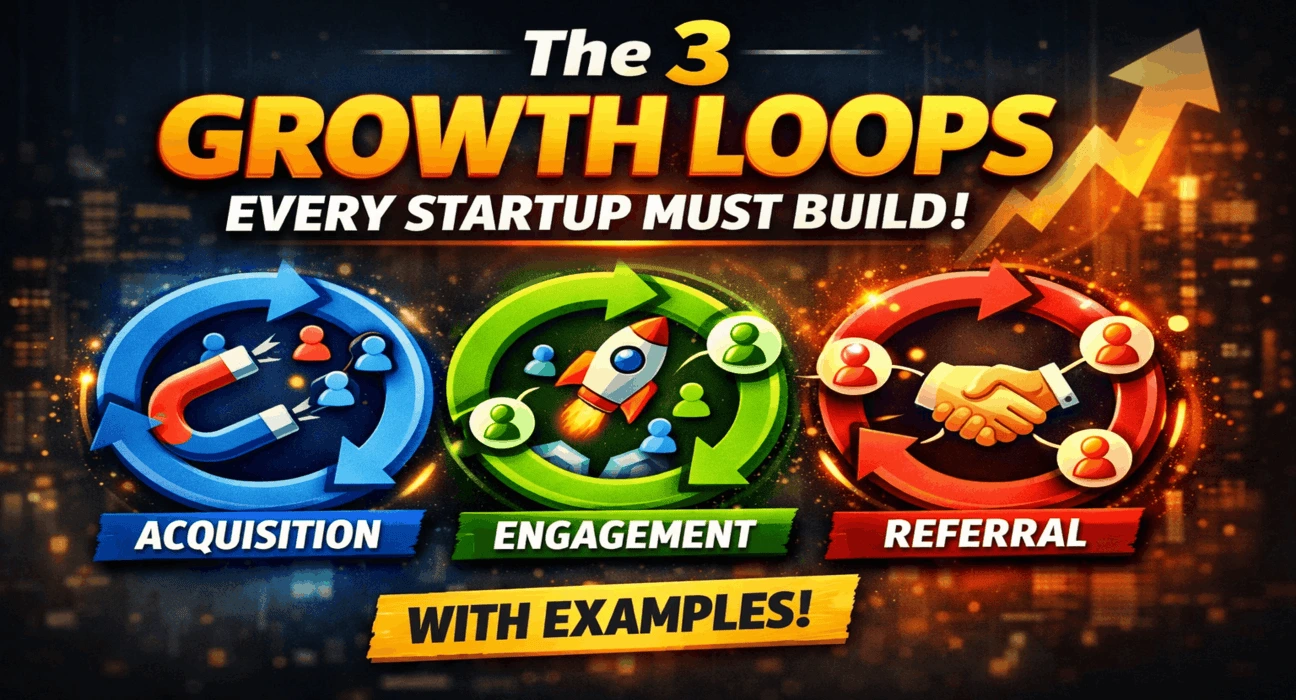
Successful startups rely on three core growth loops that drive user acquisition, engagement, and expansion.
- Acquisition Loop: Bringing in new users through channels like content, SEO, or outreach
- Engagement Loop: Keeping users active and consistently using the product
- Referral Loop: Encouraging users to bring in more users
In simple terms:
👉 If even one loop is missing, your growth system becomes incomplete and breaks over time.
Core Breakdown: The 3 Growth Loops Explained
1. Acquisition Loop (The Entry Engine)
This is where growth starts.
How It Works:
- You create content / ads / distribution
- Users discover your product
- They sign up or engage
But here’s the twist…
👉 In a loop, output feeds input
Example:
- Content → Traffic → Users → More content signals → More traffic
Real Example:
Platforms using SEO loops rely heavily on tools like:
- Ahrefs
- Semrush
They:
- Publish content
- Rank on Google
- Attract users
- Analyze performance
- Create more optimized content
👉 That’s a loop, not a one-time effort.
Key Insight:
Acquisition loops work best when:
- Content compounds
- Channels have network effects
- Data improves future acquisition
2. Engagement Loop (The Retention Engine)
Getting users is one thing.
Keeping them? That’s where real growth happens.
How It Works:
- User signs up
- Experiences value
- Returns to use product
- Generates activity/data
- Product improves
- User gets more value
👉 Loop continues
Example:
Think about product-led tools.
Every time a user interacts:
- They learn more
- They get better results
- They become dependent
Tools That Enable Engagement Loops:
- Mixpanel → Track behavior
- Intercom → Improve communication
Key Insight:
👉 Retention isn’t a metric. It’s a loop.
If users don’t come back:
- Acquisition becomes expensive
- Growth collapses
3. Referral Loop (The Multiplication Engine)
This is where things get interesting.
And honestly… this is what separates good startups from great ones.
How It Works:
- User gets value
- Shares product with others
- New users join
- They repeat the process
👉 Growth multiplies
Example:
Dropbox’s referral loop:
- Invite friends → Get extra storage
- Friends join → They invite more
Result?
👉 Explosive growth with minimal ad spend
Modern Referral Channels:
- Social sharing
- Community mentions
- User-generated content
Key Insight:
Referral loops work best when:
- Sharing is frictionless
- Incentives are aligned
- Product naturally encourages sharing
📊 Data & Real Insights
- 📈 Startups with strong referral loops grow 2–4x faster
- 📉 Paid-only growth increases CAC over time
- 📊 Retention improvements can increase LTV by 3x
- 📈 SEO-based acquisition loops compound over months
Growth Loop Framework (Step-by-Step)
To build an effective growth loop, startups must design a system where user actions continuously generate more users and value.
-
Identify Your Core User Action
What creates value? (e.g., posting, sharing, using the product)
-
Map Input → Output
Determine which user actions lead to generating more users
-
Remove Friction
Make key actions simple, fast, and intuitive
-
Add Incentives
Give users a compelling reason to participate and share
-
Optimize Continuously
Use data and feedback to refine and improve the loop over time
In simple terms:
👉 Design actions → reduce friction → reward users → scale growth.
What You Can Learn / Apply
1. Stop Thinking in Funnels
Funnels are linear.
Loops are circular.
👉 Funnels end. Loops don’t.
2. Build Loops Into Your Product
Don’t treat growth as marketing.
👉 It should be part of your product experience
3. Focus on One Loop First
Trying to build all 3 at once?
Bad idea.
👉 Start with:
- Acquisition OR
- Engagement
Then expand.
4. Measure Loop Efficiency
Track:
- Input (users, traffic)
- Output (new users generated)
👉 Improve conversion inside the loop
5. Align Teams Around Loops
Growth isn’t just marketing.
It’s:
- Product
- Engineering
- Customer success
Contrarian Insight: More Users ≠ Better Growth
Here’s something most founders overlook…
👉 Not all growth is good growth.
If your loops are weak:
- Users churn
- Referrals don’t happen
- Acquisition costs rise
👉 Focus on quality of growth, not just quantity.
Conclusion: Growth Loops Are Your Real Moat
Let’s wrap this up simply.
If your startup depends on:
- Ads → You pay forever
- Campaigns → You restart constantly
But if you build loops?
👉 Growth compounds
👉 Costs decrease
👉 Scaling becomes predictable
And honestly… that’s the difference between:
A struggling startup
and
A scalable business
Frequently Asked Questions (Growth Loops)
1. What is a growth loop in startups?
A growth loop is a system where each user action contributes to acquiring or engaging more users, creating continuous and compounding growth.
2. How are growth loops different from funnels?
Funnels are linear and end after conversion, while growth loops are cyclical systems that continuously generate new users and engagement.
3. Which growth loop should startups focus on first?
Startups should begin with acquisition or engagement loops, depending on their product type and target audience.
4. Can startups grow without paid ads?
Yes, startups can achieve organic growth by building strong acquisition, engagement, and referral loops.
5. Why do most startups fail to build growth loops?
Most startups fail because they prioritize short-term tactics over building long-term, scalable growth systems.
Summary
Article Name
Startup Growth Loops Explained: The Secret to Scalable Growth
DescriptionLearn the 3 essential growth loops every startup must build to scale sustainably, with real examples, frameworks, and actionable insights.
Author
Upstartzen Editorial Team
Publisher Name
Upstartzen
Publisher Logo