




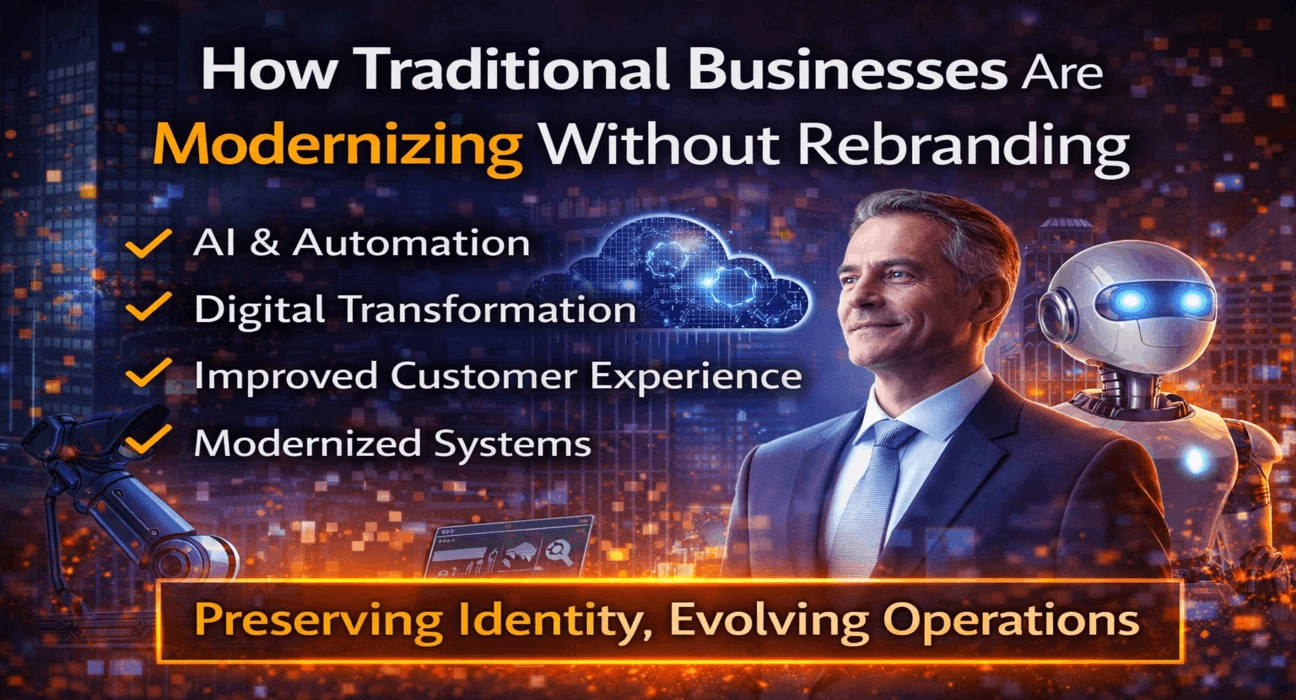
How Traditional Businesses Are Modernizing Without Rebranding
Synopsis
Let’s be honest — when people hear “modernization,” they usually think of flashy rebrands.
New logo. New colors. Maybe a redesigned website.
But here’s the thing… that’s not where the real transformation is happening.
In fact, some of the most successful traditional businesses in 2026 haven’t changed their names, logos, or even their core identity — and yet, they’ve completely reinvented how they operate.
Sounds a bit contradictory, right?
But if you look closer, you’ll notice something interesting: modernization today is less about how a company looks… and more about how it works.
And honestly, that shift is changing everything.
What Does Modernizing Without Rebranding Mean?
Modernizing without rebranding means upgrading a company’s operations, technology, customer experience, and business processes without changing its brand identity, name, or visual image.
Instead of focusing on external changes, companies prioritize:
- Digital transformation of internal systems
- Automation and AI integration
- Improved customer experience
- Data-driven decision-making
- Faster and more efficient operations
This approach allows businesses to stay relevant while preserving brand trust and recognition.
Why Companies Are Avoiding Rebrands
You might be wondering… why not just rebrand entirely?
Well, rebranding is risky.
Established companies have spent years — sometimes decades — building trust with customers. Changing the brand too drastically can confuse or even alienate loyal users.
Take companies like IBM.
They’ve evolved massively over time — from hardware to cloud and AI — but their core identity remains intact.
IBM digital transformation strategy
And that’s the key idea here: evolve the engine, not the logo.
The Real Shift: Internal Transformation
Modernization today is happening behind the scenes.
Traditional businesses are quietly upgrading their systems, often without customers even noticing directly.
For example, many companies are adopting cloud infrastructure through platforms like Microsoft Azure.
Microsoft Azure cloud solutions
This allows them to:
• scale operations faster
• reduce infrastructure costs
• improve system reliability
And honestly, customers don’t care how it works — they just notice things becoming smoother, faster, and more reliable.
AI Is Driving Invisible Change
Now here’s where things get even more interesting.
AI isn’t always visible to the end user.
But it’s everywhere.
Companies are using tools like Salesforce to automate customer relationship management and personalize interactions.
Customer support? Often powered by AI chat systems.
Marketing? Data-driven and automated.
Operations? Optimized using predictive analytics.
But from the outside, the brand still feels the same.
And that’s intentional.
Customer Experience Is the New Brand
Here’s a subtle shift many businesses are realizing:
Your brand isn’t just your logo anymore.
It’s the experience.
If your website loads faster, your support responds quicker, and your product works seamlessly — customers perceive your brand as modern.
Even if nothing visual has changed.
That’s why companies are investing heavily in UX improvements, mobile optimization, and seamless digital journeys.
Because, in a way, experience has replaced aesthetics as the primary signal of innovation.
Legacy Systems Are Being Rebuilt Quietly
One of the biggest challenges for traditional companies has always been legacy systems.
Old software. Slow processes. Manual workflows.
But instead of scrapping everything overnight, many companies are taking a gradual approach.
They’re modernizing piece by piece.
Replacing outdated systems with flexible tools. Integrating APIs. Automating repetitive tasks.
It’s not glamorous work.
But it’s effective.
The Risk of Doing Nothing
Of course, not every company is adapting.
Some still rely heavily on outdated systems and resist change.
And to be honest, those are the ones struggling the most.
Because today’s customers expect:
• speed
• convenience
• personalization
• digital accessibility
If a company can’t deliver these, it doesn’t matter how strong their brand used to be.
Relevance fades quickly.
Real-World Example: Subtle but Powerful Change
Think about traditional banks.
Many of them haven’t rebranded dramatically.
But their mobile apps, digital services, and customer experiences have improved significantly.
Behind the scenes, they’ve adopted modern infrastructure, AI tools, and automation systems.
But to the customer?
It just feels like the bank “got better.”
And that’s exactly the goal.
What Startups Can Learn From This
This isn’t just a story about large corporations.
Startups can learn a lot from this approach.
You don’t always need to reinvent your brand to stay competitive.
Sometimes, improving:
• product performance
• user experience
• backend systems
• operational efficiency
…can create a bigger impact than a full rebrand.
The Future of Modernization
So where is this heading?
We’re moving toward a world where companies evolve continuously — not through big, visible changes, but through constant, behind-the-scenes improvements.
Modernization is becoming quieter.
More strategic.
More focused on outcomes rather than appearances.
Final Thoughts
Rebranding might grab attention.
But modernization builds longevity.
And in 2026, the companies winning the game aren’t necessarily the ones that look the newest…
They’re the ones that work the smartest.
Summary
Article Name
How Traditional Businesses Modernize Without Rebranding
DescriptionDiscover how traditional businesses are modernizing using AI, automation, and digital transformation—without changing their brand identity or rebranding.
Author
Upstartzen Editorial Team
Publisher Name
Upstartzen
Publisher Logo