





The Silent Filter: When VCs Only Bet on Founders With Personal Brands
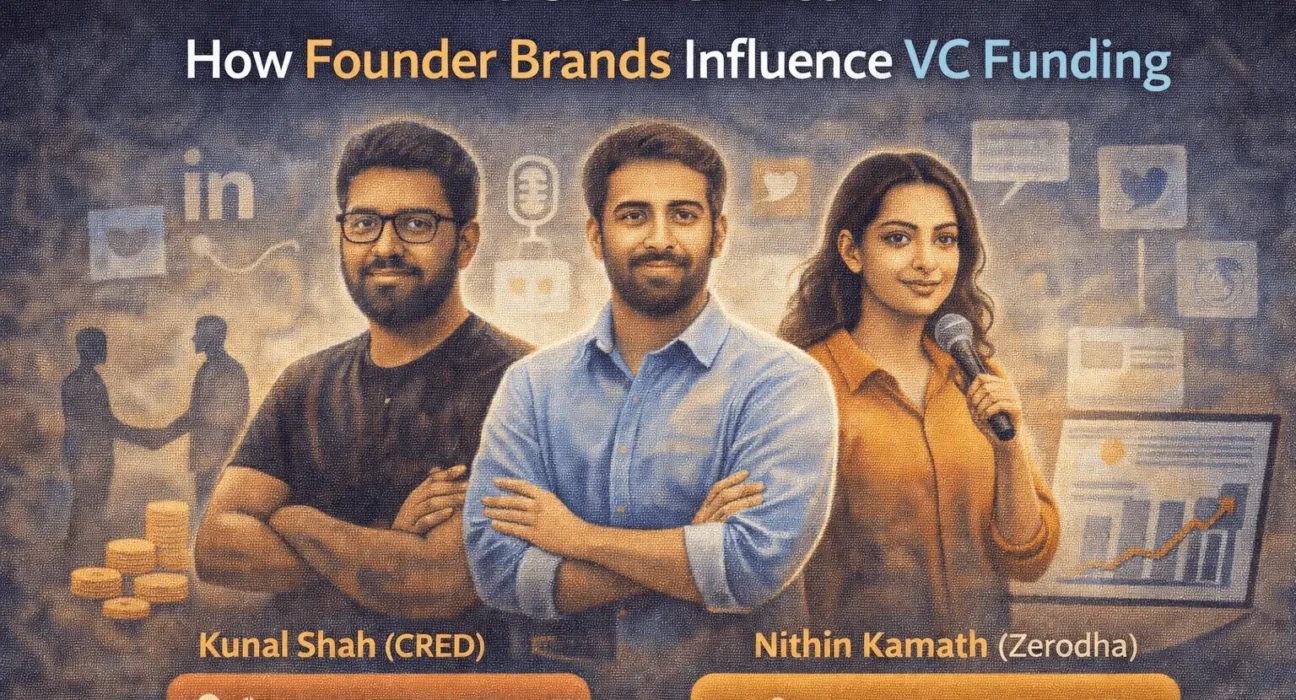
Why do some founders seem to raise funding faster than others with comparable traction?
Largely because of two well-documented mechanics in how venture capital actually sources and evaluates deals: warm introductions and pattern matching. Roughly half of VC deals originate from professional networks or co-investor referrals rather than cold outreach, and investors themselves openly acknowledge relying on pattern matching — comparing a founder against previous successful bets — especially at the earliest stages, where there’s little hard data to evaluate against. Visibility (a strong public presence, a known network) doesn’t replace traction, but it does measurably affect which founders get a fair look in the first place.
Warm Introductions Aren’t a Minor Advantage — They’re the Default Channel
Investor-side data indicates that around 50% of VC deals originate from professional networks or co-investor referrals rather than direct outreach — meaning a founder without access to that network isn’t just at a disadvantage, they’re outside the channel most deals actually flow through. The mechanism is straightforward: a referral from someone the investor already trusts — a portfolio founder, a co-investor, an existing relationship — functions as an immediate credibility signal, letting the investor skip past the initial skepticism a cold pitch has to overcome on its own.
Not all warm intros carry equal weight, either. According to sourcing research from venture firms, an introduction from a founder the investor has already backed tends to carry more credibility than one from a general professional connection, because the introducing founder’s own reputation is implicitly on the line for the recommendation.
Pattern Matching: A Documented, Openly Acknowledged Practice
Venture investors, particularly at the earliest stages where financial data is thin, rely heavily on pattern matching — comparing a founder or company against previous successful (or unsuccessful) bets to make a fast decision under real uncertainty. This isn’t a hidden practice; investors discuss it openly as a core part of how early-stage decisions get made, precisely because there often isn’t enough hard data yet to evaluate a company on numbers alone.
The problem is what pattern matching tends to reward: research has found that roughly a third of investors acknowledge gravitating toward familiar founder archetypes — a particular educational background, a particular look, a particular communication style — largely because those archetypes match previous successful bets, not necessarily because they predict success independently. Harvard research examining this dynamic found that VCs relying on more homogeneous, narrow networks for sourcing deals actually underperformed those with more diverse sourcing — pattern matching, in other words, isn’t just a fairness concern, it appears to leave real returns on the table.
The Uneven Outcomes This Produces
The clearest evidence of pattern matching’s real-world effect shows up in funding distribution data: women-led startups have consistently received a small fraction of total VC funding — commonly cited around 8% — a gap that’s difficult to explain by deal quality alone and more consistent with a sourcing and evaluation process that favors familiar patterns over comprehensive access.
This is the actual mechanism worth understanding, separate from any specific tactic a founder might use in response to it: visibility, in this context, functions partly as a way of manufacturing legibility for investors who would otherwise be pattern-matching against unfamiliar signals — a founder who’s written publicly about their thinking, been introduced by a trusted connection, or built some track record investors can reference gives the evaluator something to pattern-match toward, even without a large personal following.
Why “Just Build a Personal Brand” Isn’t a Complete Answer
It’s worth being precise about what visibility actually does and doesn’t solve here. A strong public presence can partially substitute for network access — it gives investors legibility signals without requiring a warm introduction specifically. But it doesn’t address the underlying pattern-matching bias directly, and for founders from backgrounds already underrepresented in venture-backed archetypes, visibility alone hasn’t closed the roughly 8% funding gap for women-led startups, suggesting the bias operates on more than just “does this founder seem legible.”
The more complete response, according to founders and investors focused on this specific problem, tends to combine a few things: building metrics-first pitches that make traction legible independent of founder archetype, deliberately seeking introductions through customers and specific-problem-adjacent operators rather than only general investor networks, and — where available — engaging funds and networks explicitly built to counteract narrow pattern matching, since Harvard’s underperformance finding suggests those funds have a real incentive to source more broadly.
Frequently Asked Questions
1. What percentage of VC deals come through warm introductions rather than cold outreach?
Warm introductions account for a significant share of venture capital deals. Industry estimates suggest that around half of VC investments originate through trusted founder, investor, or professional network referrals, making relationship-building an important part of the fundraising process.
2. Is pattern matching in venture capital a documented bias or just founder speculation?
Pattern matching is a well-documented investment practice. Venture capitalists often use previous successful founder profiles and company characteristics as decision-making shortcuts, particularly when evaluating early-stage startups with limited operating data. While useful in some cases, it can also introduce bias.
3. Does relying on pattern matching and narrow networks hurt VC returns?
Research suggests it can. Firms that source opportunities through more diverse networks may discover overlooked founders and markets, potentially improving investment performance compared with relying exclusively on familiar founder profiles or referral networks.
4. Can building a public personal brand fully offset network-based bias in fundraising?
No. A strong founder brand can improve visibility, credibility, and access to investors, but it cannot eliminate structural biases within venture capital. Successful fundraising typically combines public visibility, demonstrated traction, strategic networking, and strong business fundamentals.
What to Watch Next
- Whether funds citing the Harvard homogeneity-underperformance finding shift sourcing practices to reduce reliance on narrow existing networks
- Whether the gap in funding for underrepresented founder groups narrows as more data-driven, metrics-first evaluation approaches gain adoption
- How AI-assisted deal sourcing and evaluation tools affect pattern matching — potentially reducing bias through more data-driven screening, or replicating existing bias if trained on historically skewed funding data
- Whether pattern-breaking-focused funds and networks (explicitly built to counteract narrow sourcing) grow their share of overall deal flow
Data cited above is drawn from Evalyze.ai’s 2026 analysis of VC deal sourcing, WinSavvy’s data report on VC pattern matching, Forbes’ reporting on pattern-breaking founders in venture capital, and Harvard research on VC network diversity and fund performance, as referenced in industry reporting on warm introduction dynamics.
Summary

Article Name
The Silent Filter: When VCs Only Bet on Founders With Personal Brands
DescriptionWhy visible founders raise faster in 2025. Explore how personal branding quietly shapes VC trust, deal flow, and funding outcomes in startups.
Author
Upstartzen Editorial Team
Publisher Name
Upstartzen