




How to Set Up a Full-Funnel Tracking System Using GA4, GTM & CRM
Full-Funnel Tracking: The New Growth Truth for Startups
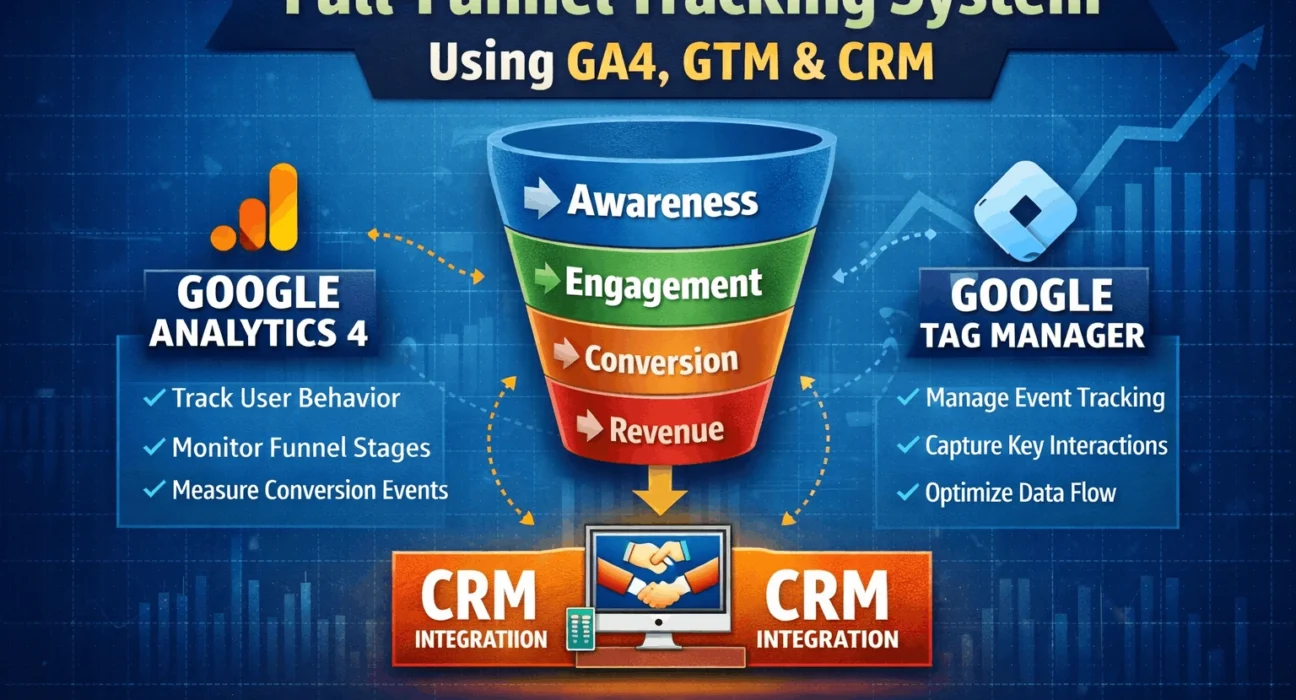
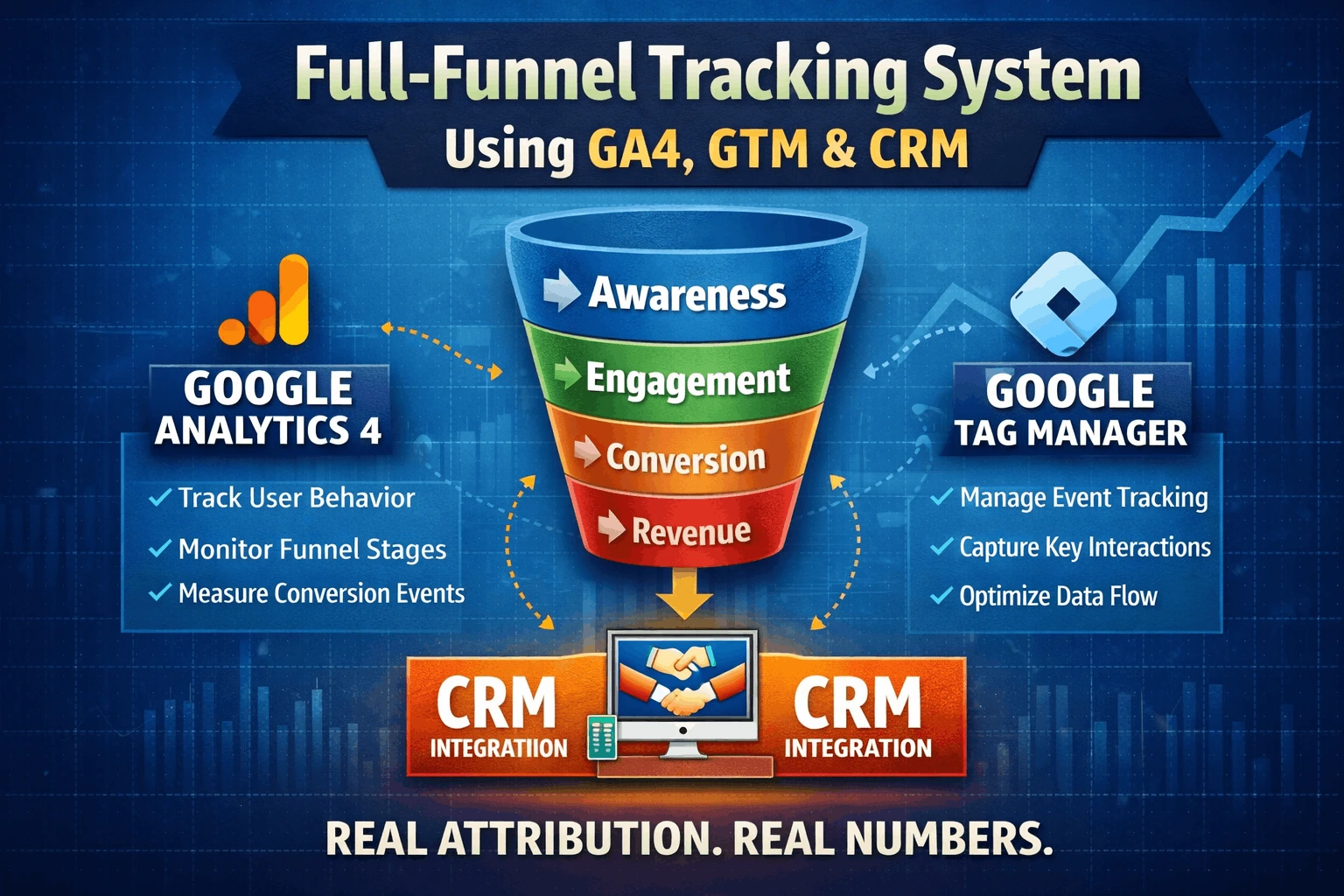
Real attribution. Real numbers. No guessing.
For years, startups have been making decisions based on partial data. Clicks without context. Leads without clarity. Revenue reports that don’t quite match what marketing dashboards show. And to be honest, most teams know something’s off — they just don’t know where.
That’s where full-funnel tracking comes in.
A proper full-funnel tracking system connects user behavior from the first touchpoint (like a Google search or LinkedIn ad) all the way to revenue inside your CRM. No gaps. No assumptions. Just real attribution and real numbers you can actually trust.
This guide breaks down how modern startups are setting up end-to-end tracking using Google Analytics 4 (GA4), Google Tag Manager (GTM), and a CRM system. Not in a textbook way. But in a practical, slightly messy, real-world way — the kind you’d want if your growth depends on it.
Why Most Startup Tracking Systems Are Broken
Let’s start with the uncomfortable truth.
Most startups think they’re tracking everything. But they’re not.
They see traffic in GA4. Leads in the CRM. Maybe conversion events in GTM. But these systems don’t talk to each other properly. So when a founder asks, “Which channel actually drives revenue?” the answer is usually… a guess.
And guessing doesn’t scale.
In fact, Google itself acknowledges that modern customer journeys are fragmented across devices, platforms, and sessions (Google Analytics documentation:
Google Analytics 4 Overview
Without a full-funnel approach, attribution breaks somewhere in the middle. That’s where money leaks happen.
What Full-Funnel Tracking Actually Means (In Simple Terms)
You might be wondering — what does “full-funnel” really mean?
Here’s the clean version:
Full-funnel tracking means you can follow a user from:
- First visit
- To engagement
- To lead submission
- To sales qualification
- To closed revenue
…without losing the thread.
Not just pageviews. Not just form fills. But the entire journey.
And yes, this is exactly what AEO, GEO, and AIO systems expect too — structured, connected data that AI and search engines can understand and trust.
What is a Full-Funnel Tracking System?
A full-funnel tracking system connects marketing, analytics, and CRM data to track users from their first interaction to final conversion. It helps businesses measure true attribution, understand complete customer journeys, and make data-driven growth decisions without guesswork.
The Core Stack: GA4, GTM & CRM (And Why Each Matters)
1. Google Analytics 4 (GA4): The Behavior Brain
GA4 isn’t just “new Universal Analytics.” It’s event-based, privacy-first, and built for cross-platform journeys.
But here’s the thing — GA4 alone isn’t enough.
GA4 tracks:
- Page views
- Scrolls
- Clicks
- Form submissions
- Custom events
But it doesn’t know what happens after a lead is submitted. That’s where most funnels break.
Still, GA4 is the backbone. It’s where behavioral signals live.
GA4 setup guidelines from Google:
GA4 Setup Guide
2. Google Tag Manager (GTM): The Glue Layer
If GA4 is the brain, GTM is the nervous system.
GTM lets you:
- Fire events without touching code
- Track button clicks, form submissions, scroll depth
- Pass custom parameters (like lead type or page category)
To be honest, this is where many teams mess up. They track everything… but structure nothing.
A good GTM setup tracks:
- Micro-conversions (engagement signals)
- Macro-conversions (leads, demos, purchases)
- Funnel drop-offs
Google’s official GTM documentation:
Google Tag Manager Fundamentals
3. CRM: Where Revenue Truth Lives
This is the most ignored piece. And also the most important.
Your CRM (HubSpot, Salesforce, Zoho, etc.) holds:
- Lead status
- Sales stages
- Deal value
- Revenue
If CRM data isn’t connected back to GA4, your attribution is incomplete. Period.
For example:
- GA4 says “50 leads from SEO”
- CRM says “3 deals closed”
- But which SEO pages? Which keywords? Which campaigns?
Without CRM integration, you’ll never know.
HubSpot’s GA4-CRM integration reference:
HubSpot Analytics Integration
Step-by-Step: Building the Full-Funnel Tracking System
Step 1: Define Your Funnel (Before Tools)
Before touching GA4 or GTM, define your funnel stages clearly.
Example:
- Awareness → Page view, time on site
- Engagement → Scroll, video view, CTA click
- Conversion → Form submit, demo request
- Qualification → SQL, opportunity
- Revenue → Deal won
Sounds obvious. But skipping this step causes 80% of tracking confusion later.
Step 2: Event Mapping in GA4
Map each funnel stage to GA4 events.
Use:
- Standard events where possible
- Custom events only when necessary
Name events clearly. Not “event_1” or “button_click_23.” You’ll regret that later.
This structured approach improves AIO and GEO readiness because AI systems rely on consistent event naming.
Step 3: GTM Implementation (Clean, Not Noisy)
Use GTM to:
- Track form submissions accurately
- Capture click text, page path, and referrer
- Send event parameters to GA4
And please… test everything in Preview mode. Every time.
Step 4: CRM Attribution Sync
Pass key identifiers from GA4 → CRM:
- Source / Medium
- Campaign
- Landing page
- User ID (where allowed)
This is how real attribution happens.
Not “last click.” Not “first click.” But informed, multi-touch context.
Analytics Mapping: Turning Data into Decisions
Once everything’s connected, the magic starts.
You can now answer:
- Which channels bring revenue, not just leads?
- Which content assists conversions?
- Where does the funnel leak?
GA4 exploration reports help here:
GA4 Funnel Exploration
And yes, this is where founders finally stop arguing with marketers about numbers.
AEO, GEO & AIO: Why Full-Funnel Data Matters Now
Here’s the bigger picture.
Search engines and AI systems are moving toward experience validation. They don’t just want content — they want proof of usefulness.
Structured analytics data supports:
- AEO (clear answers + user intent validation)
- GEO (context-rich, entity-based understanding)
- AIO (training AI models to trust your brand signals)
In simple words, better tracking = better visibility.
Common Mistakes (We’ve All Made Them)
- Tracking only form submissions
- Ignoring CRM data
- Using inconsistent event names
- Not documenting the tracking setup
- Trusting dashboards without validation
But fixing these doesn’t require a huge budget. Just clarity and discipline.
Final Thoughts
To be honest, full-funnel tracking isn’t glamorous. It doesn’t look good on a pitch deck. But it quietly decides whether your growth strategy works… or collapses under pressure.
GA4 shows behavior.
GTM connects intent.
CRM confirms revenue.
Put them together, and you stop guessing.
And in today’s startup ecosystem, that’s not a “nice to have.” It’s survival.
Summary
Article Name
Full-Funnel Tracking System Using GA4, GTM & CRM (Complete Guide)
DescriptionLearn how to build a full-funnel tracking system using GA4, Google Tag Manager, and CRM integration. Discover real attribution strategies that connect marketing data to revenue without guesswork.
Author
Upstartzen Editorial Team
Publisher Name
Upstartzen