




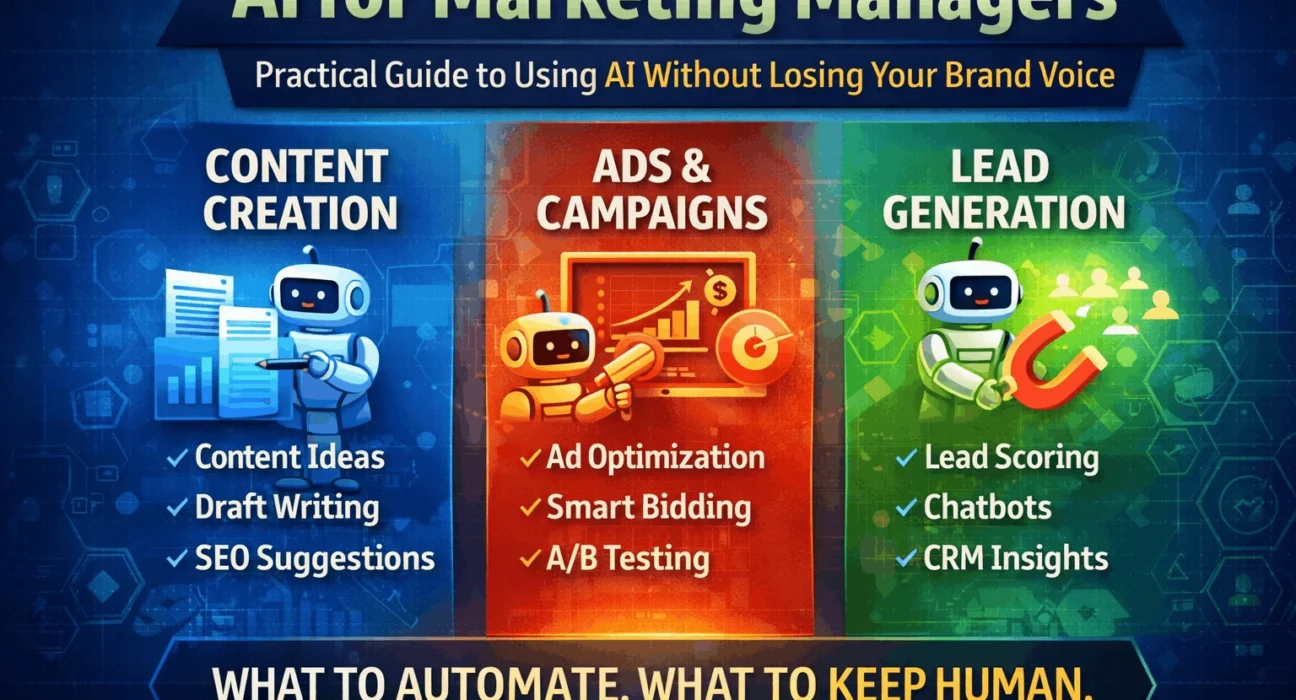
AI for Marketing Managers: Practical Guide to Using AI in Content, Ads & Lead Gen
Synopsis
Artificial Intelligence is no longer a futuristic buzzword — it’s already embedded in modern marketing workflows. From content creation and ad optimization to lead scoring, AI is helping startups scale faster with leaner teams.
But unchecked automation can flatten brand voice, create repetitive messaging, and weaken customer trust. Startups are now balancing efficiency with authenticity, deciding what to automate and what must stay human.
This guide explores practical AI use across marketing functions, focusing on real workflows, tools, and decision boundaries — while answering one critical question: where should AI stop and human creativity begin?
What is AI Marketing Automation?
AI marketing automation is the use of artificial intelligence tools to create, optimize, and personalize marketing activities such as content creation, advertising campaigns, audience targeting, and lead qualification while improving efficiency and decision-making accuracy.
Why AI is Becoming Non-Negotiable for Marketing Teams
To be honest, marketing has quietly become one of the most data-heavy departments in any startup. Campaign dashboards, attribution models, behavioral analytics, CRM pipelines — it’s overwhelming. Humans simply can’t process that much data in real time.
AI fills that gap.
According to recent industry studies, companies using AI-powered marketing personalization see significantly higher engagement and conversion rates. And it makes sense. AI doesn’t just analyze data. It spots patterns humans might miss.
But here’s the twist…
AI doesn’t understand emotional nuance the way humans do. It predicts behavior. It doesn’t always understand intent. That difference? It’s huge.
And that’s why smart marketing managers are not replacing teams with AI. They’re building hybrid intelligence workflows — combining automation with human strategy.
Using AI in Content Marketing
What AI Should Automate in Content Creation
Let’s start with the obvious win.
1. Content Research & Topic Discovery
AI tools like ChatGPT, Jasper AI, and Copy.ai can analyze search trends, competitor content gaps, and audience intent signals within minutes.
Instead of spending days brainstorming blog topics, marketing teams can generate entire content clusters almost instantly.
It’s like having a research assistant who never sleeps.
2. First Draft Generation
And yes, AI is surprisingly good at creating rough drafts. Not final content — rough drafts. That distinction matters.
AI can help generate:
- Blog outlines
- Social media captions
- Email campaign drafts
- Landing page frameworks
It saves time. A lot of time.
3. SEO Optimization Suggestions
Tools like Surfer SEO and Clearscope use AI to recommend keyword density, readability structure, and topical relevance.
You might be wondering — does this replace SEO experts?
Not really. It just gives them faster data insights.
What Humans Must Keep Control Of
Brand Voice & Storytelling
AI often produces technically correct content. But emotionally… it can feel flat. Slightly robotic. Sometimes painfully generic.
Brand voice is built through lived experiences, customer interactions, and cultural understanding. AI can mimic tone. But it can’t truly own it.
And customers can sense that difference.
Thought Leadership Content
Founder stories. Industry opinions. Vision-driven messaging. These should remain human-led. AI can support editing and structuring, but the raw perspective must stay authentic.
AI in Paid Advertising & Campaign Optimization
Paid ads are honestly where AI is flexing the hardest right now.
Where AI Dominates
Smart Bidding & Budget Optimization
Platforms like Google Performance Max and Meta Advantage+ campaigns already use AI to adjust bidding strategies dynamically.
Google Ads AI uses predictive signals like user intent, browsing patterns, and conversion probability.
Google Performance Max Guide
This means marketing managers no longer manually adjust bids every few hours. AI does it continuously.
Creative Testing at Scale
AI tools can generate multiple ad variations — headlines, visuals, CTAs — and automatically test them against different audience segments.
Honestly, manual A/B testing feels painfully slow compared to AI-driven multivariate testing.
Where Human Judgment Still Matters
Brand Safety & Messaging Sensitivity
AI might optimize for clicks. But it doesn’t always understand cultural sensitivity or brand positioning.
And sometimes chasing high CTRs can actually attract low-quality leads. Been there. Seen that happen.
Campaign Strategy Direction
AI can optimize existing campaigns. But it doesn’t define business goals or market positioning.
That still requires human strategic thinking.
AI in Lead Generation & CRM Intelligence
Lead generation is shifting from volume-based marketing to predictive quality marketing.
AI-Powered Lead Scoring
CRM platforms like HubSpot AI and Salesforce Einstein analyze behavioral signals to predict which leads are most likely to convert.
They track:
- Website engagement patterns
- Email interaction signals
- Content consumption journeys
- Purchase intent triggers
It’s like having a sales assistant whispering which prospects deserve attention first.
Conversational AI & Chatbots
Modern AI chatbots don’t just answer FAQs anymore. They qualify leads, schedule demos, and even personalize product recommendations.
And customers? They actually prefer quick AI responses over waiting hours for email replies.
But — and this is important — escalation to human agents must remain seamless. Nobody likes being stuck in chatbot loops.
The Real Risk: Losing Your Brand Voice
Here’s where most companies mess up.
They automate content, emails, social media, and customer responses simultaneously. Everything becomes optimized. Efficient. Scalable.
And suddenly… every brand sounds the same.
AI tends to learn from existing internet content. That means it often reproduces average messaging patterns. Not distinctive ones.
If your startup’s competitive advantage is storytelling, emotional resonance, or community trust — full automation can quietly erode those strengths.
Think of AI like background music. Helpful. Enhancing. But if it becomes the main performer… the show feels off.
Practical AI Workflow for Marketing Managers
Here’s a balanced workflow many high-performing teams are adopting:
Step 1: AI for Research & Drafting
Use AI for brainstorming, outlines, and data analysis.
Step 2: Human Strategy Layer
Define messaging direction, brand positioning, and emotional storytelling.
Step 3: AI Optimization Layer
Use AI for SEO scoring, readability improvements, and campaign testing.
Step 4: Human Final Approval
Ensure brand voice, trust signals, and customer relevance remain intact.
Measuring AI Marketing Success
AI adoption should never be judged by productivity alone.
Track:
- Conversion quality improvement
- Customer engagement depth
- Brand sentiment signals
- Lead-to-revenue attribution accuracy
Because honestly… faster content means nothing if customer trust drops.
Future Trends: Where AI Marketing is Headed
Marketing AI is moving toward real-time personalization and predictive customer journey orchestration.
Soon, AI tools will dynamically adjust:
- Website layouts
- Email messaging
- Product recommendations
- Pricing offers
All based on individual user behavior.
Exciting? Absolutely. Slightly terrifying? Also yes.
Final Thoughts
AI is not replacing marketing managers. It’s redefining them.
The best marketing leaders today are becoming workflow architects — deciding which processes should be automated and which moments require human creativity.
And the truth is, the brands that win won’t be the ones using the most AI tools. They’ll be the ones using AI responsibly.
Because marketing, at its core, is still about trust. And trust is deeply human.
Summary

Article Name
AI for Marketing Managers: Content, Ads & Lead Gen Guide
DescriptionLearn how marketing managers can use AI in content, advertising, and lead generation without losing brand voice. Practical automation workflows explained.
Author
Upstartzen Editorial Team
Publisher Name
Upstartzen