




How This D2C Brand Stopped Discounting and Increased Revenue by 33%
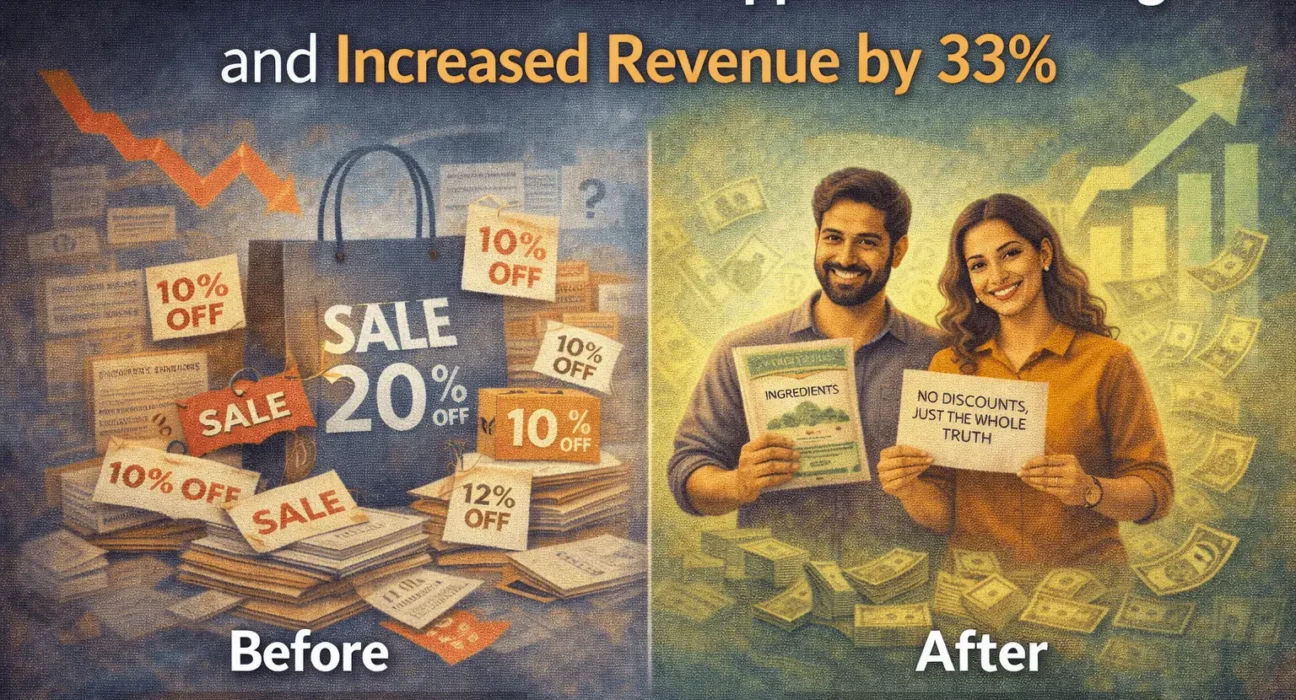
How did an Indian D2C brand grow significantly while refusing to run discounts?
The Whole Truth Foods, a clean-label packaged food brand founded by Shashank Mehta, built its growth almost entirely on transparency and full-price selling rather than the discount-driven playbook common across Indian D2C. The results are genuinely striking: revenue grew from ₹65.3 crore in FY24 to ₹216 crore in FY25 — well over 200% year-on-year growth — and the company’s most recent funding round valued it at more than ₹3,600 crore. Mehta has been publicly explicit about the strategy behind it, writing that skipping discounts “may not” be the smartest growth strategy on paper, “but it lets us look you in the eye. And sleep well at night.”
The Founder’s Real Motivation, Not a Marketing Angle
The Whole Truth’s no-discount, full-transparency positioning traces directly back to Shashank Mehta’s personal history. After struggling with his own weight through his teens and twenties — losing and regaining 40 kilograms multiple times before age 26 — Mehta grew frustrated that “healthy” packaged foods routinely hid sugar and additives behind scientific-sounding ingredient names. After an MBA from IIM Lucknow and nearly a decade at Hindustan Unilever, where he saw firsthand how food marketing decisions actually got made, he started a blog called FITSHIT — part fitness journal, part food-industry myth-busting — years before launching a company at all.
That blog became the brand’s genuine first growth engine. Mehta had built trust with tens of thousands of readers before The Whole Truth, co-founded with Rachna Aggarwal in 2019, ever sold a product. Those readers became the company’s first customers, and its core operating rule was set from day one: every ingredient in every product listed in full, in plain language, on the front of the package — not buried in fine print on the back.
The Real Growth Trajectory
The company’s actual revenue path illustrates just how gradual the early years were before the growth accelerated: an estimated ₹2–3 crore in its first year of operations, growing to roughly ₹8–10 crore in year two, driven largely by repeat customers rather than paid acquisition. From there, growth accelerated substantially — revenue reportedly moved from ₹36 crore to over ₹70 crore in a subsequent single year, then to ₹65.3 crore in FY24 and ₹216 crore in FY25. The company has raised $37.6 million across seven funding rounds from 40 investors, with its angel roster notably including Zerodha’s Nithin Kamath — itself a signal of the kind of investor The Whole Truth’s philosophy tends to attract, given Zerodha’s own no-discount, transparency-oriented brand identity.
What “No Discounts” Actually Looks Like in Practice
Rather than running the seasonal sale calendar common across Indian D2C — festival discounts, flash sales, first-order coupons — The Whole Truth built its content and marketing around ingredient education: explaining why specific ingredients cost more, how food labels can mislead, and what actually goes into sourcing decisions. Email and social content shifted away from urgency-driven “sale ends tonight” messaging toward founder notes, customer stories, and direct explanations of pricing.
Why This Strategy Fits This Specific Category
It’s worth being clear that The Whole Truth’s approach isn’t a universal formula — it works because of a specific alignment between the company’s positioning and its category. Packaged food, particularly in the “clean label” and health-conscious segment, is a category where trust and ingredient credibility are the primary purchase driver, which makes transparency-led marketing unusually well-matched to what customers are actually evaluating. A category driven more by price comparison or impulse purchasing might see a different result from the same discount-free approach.
The Broader Signal for Indian D2C
The Whole Truth’s growth arrives at a moment when profitability and capital efficiency have become more central to how Indian investors evaluate D2C companies generally — consistent with the broader shift toward efficiency-focused growth across Indian startups since 2024–2025. A brand that can grow substantially without leaning on discount-driven acquisition demonstrates a specific kind of unit economics investors have grown more interested in during a tighter funding environment.
Frequently Asked Questions
1. How much did The Whole Truth Foods’ revenue actually grow?
The Whole Truth Foods recorded revenue growth of more than 200% year over year. Revenue increased from approximately ₹65.3 crore in FY24 to ₹216 crore in FY25, reflecting strong demand, expanded distribution, and continued brand growth.
2. Does The Whole Truth Foods really never run discounts?
The brand’s strategy emphasizes selling at full price rather than relying on frequent discounts. Founder Shashank Mehta has consistently positioned ingredient transparency and product quality as the company’s primary growth drivers. This should be understood as a long-term brand philosophy rather than a guarantee that discounts are never offered under any circumstances.
3. What makes The Whole Truth’s no-discount strategy work?
Trust is a major competitive advantage in the clean-label food category. Consumers purchasing health-focused products often prioritize ingredient quality and transparency over the lowest price, allowing premium brands to compete on credibility instead of discounts.
4. Who are The Whole Truth Foods’ investors?
The Whole Truth Foods has raised funding from both angel and institutional investors. Its investors include Nithin Kamath, co-founder of Zerodha, along with multiple venture capital firms that participated in later funding rounds supporting the company’s expansion.
What to Watch Next
- Whether The Whole Truth’s growth trajectory continues as it expands into physical retail alongside its D2C-first roots
- Whether other Indian D2C brands adopt similar transparency-first, discount-free positioning, particularly in categories where ingredient or sourcing trust is a strong purchase driver
- How The Whole Truth’s reported IPO ambitions develop, and whether its no-discount model translates into the kind of durable margins public investors typically favor
Revenue and funding figures cited above are drawn from The Hot Startups’ and Karo Startup’s reporting on The Whole Truth Foods, and founder Shashank Mehta’s public statements on the company’s growth philosophy.
Summary

Article Name
How a D2C Brand Stopped Discounting and Boosted Revenue by 33%
DescriptionDiscover how an Indian D2C brand escaped discount addiction, rebuilt trust, and increased revenue by 33% using transparency, storytelling, and smarter growth.
Author
Upstartzen Editorial Team
Publisher Name
Upstartzen