


Skills-to-Employment Pipeline: Education & Industry Alignment Study
Skills-to-Employment Pipeline: Industry Readiness Report
A growing contradiction exists in the global job market — companies struggle to find skilled talent while graduates struggle to find employment. The gap between academic learning and workforce readiness has become a major structural challenge, especially across emerging sectors like VLSI, semiconductor design, AI engineering, SaaS development, and advanced manufacturing.
This report explores how education institutions, corporate training ecosystems, and industry hiring patterns are evolving to close this disconnect. It analyzes workforce readiness benchmarks, hiring expectations, skill mismatch trends, and the rise of outcome-driven training models.
As skills become a primary driver of economic growth, organizations and training providers that successfully align education with real industry demand are building stronger talent supply chains.
The whitepaper highlights how structured skill pipelines are transforming hiring across VLSI, AI, cloud computing, enterprise software, and advanced technology industries while showcasing the growing role of startups, training institutes, and industry partnerships in shaping workforce readiness.
What is a Skills-to-Employment Pipeline?
A Skills-to-Employment Pipeline is a structured framework that connects education, skill training, and industry hiring through curriculum alignment, real-world projects, certifications, and employer partnerships. It helps learners develop job-ready skills aligned with current workforce demands, reducing skill gaps and improving employment outcomes.
The Growing Skill Gap Nobody Talks About Enough
Let’s be real. For years, education followed a predictable path — study theory, pass exams, earn degrees, and eventually get hired. But the job market doesn’t operate like that anymore.
Technology evolves faster than academic curriculums. By the time students graduate, half of what they learned may already be outdated. Harsh? Maybe. But also accurate.
And industries like VLSI design or AI engineering can’t afford outdated skills. Companies need engineers who understand current design tools, automation workflows, and real-world production challenges — not just textbook fundamentals.
In fact, a report from the World Economic Forum suggests nearly 44% of workforce skills will shift by 2027.
World Economic Forum Future of Jobs Report
That’s massive. And honestly, it explains why companies now invest heavily in training partnerships rather than relying purely on academic degrees.
Why Startups and EdTech Companies Are Leading the Alignment Revolution
Large universities often move slowly when updating curriculum frameworks. Meanwhile, EdTech startups operate differently. They iterate. They experiment. And sometimes they fail fast — which, ironically, helps them stay industry-relevant.
EdTech companies focusing on outcome-based learning are building training ecosystems around employability rather than certification alone.
For example, VLSI training institutes are designing programs aligned with semiconductor hiring requirements, including chip design workflows, simulation tools, and verification frameworks.
Semiconductor Industry Workforce Trends
This shift toward employment-linked training is quietly reshaping the learning economy.
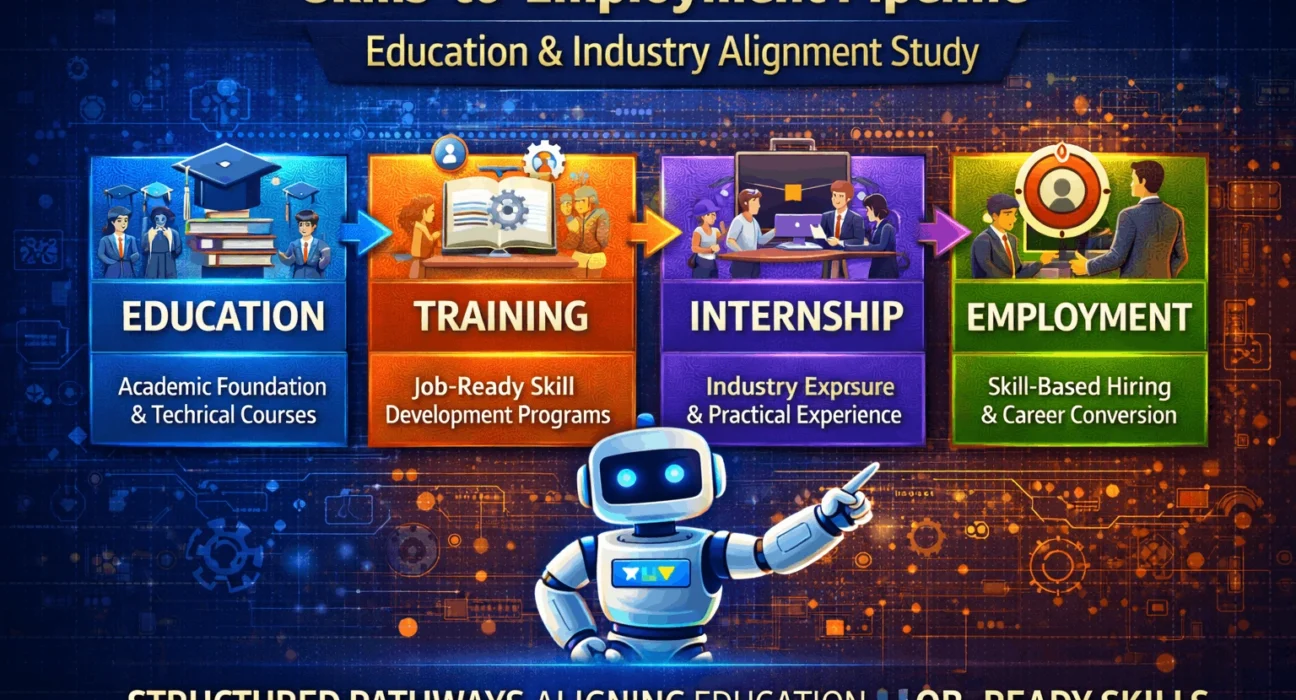
The Four Stages of the Skills-to-Employment Pipeline
1. Industry Demand Mapping
This is where everything begins. Companies define hiring requirements based on current and future project demands. These insights help training providers design relevant curriculum structures.
And honestly, this stage is often ignored in traditional education systems.
2. Curriculum Alignment & Skill Training
Once demand is mapped, training modules are designed around practical execution rather than theoretical depth alone.
Courses now include:
• Real industry tools
• Capstone projects
• Simulation-based assignments
• Certification assessments
3. Industry Exposure & Internship Integration
Students who work on real projects gain contextual understanding. And employers gain confidence in hiring them.
Internship-led pipelines significantly improve hiring success rates.
4. Employment Conversion & Career Support
Placement support, employer collaborations, and recruitment pipelines convert training outcomes into employment outcomes.
And here’s something interesting — companies prefer hiring from training partners with consistent success records rather than open recruitment drives.
The Role of VLSI & Semiconductor Training in Skill Pipeline Innovation
If there’s one sector where skill-to-employment alignment matters deeply, it’s semiconductor technology.
Chip design involves high-cost production cycles, complex verification processes, and advanced simulation environments. Companies simply cannot hire untrained graduates and spend months on foundational skill training.
This is why specialized VLSI training ecosystems have emerged as critical workforce contributors.
India’s semiconductor growth ambitions are further increasing demand for trained professionals.
India Semiconductor Mission Overview
And interestingly, training institutes partnering with semiconductor firms are seeing higher placement conversions compared to traditional degree pathways.
How AI Is Reshaping Skill-Based Hiring
Artificial Intelligence is not just creating new jobs. It’s redefining skill evaluation itself.
Recruiters now use AI-driven hiring platforms that evaluate candidate performance through simulations, coding tests, and behavioral assessments.
AI in Hiring and Workforce Automation Research
This means certifications alone are no longer enough. Demonstrated capability matters more.
Analytics Mapping: Measuring Training ROI & Employment Outcomes
Training providers are increasingly tracking performance metrics such as:
• Course completion rates
• Placement conversion ratios
• Average salary outcomes
• Employer satisfaction metrics
• Skill retention scores
And honestly, analytics-driven training optimization is becoming a competitive differentiator for EdTech companies.
GEO & AIO Perspective: Why Skill Pipelines Matter Globally
From a Geographic Expansion Optimization (GEO) perspective, countries competing in high-tech manufacturing need reliable talent supply chains.
Meanwhile, Artificial Intelligence Optimization (AIO) is pushing training systems toward personalized learning paths based on performance analytics and behavioral insights.
Together, these models are shaping future workforce development strategies.
Challenges Slowing Down Education-Industry Alignment
Let’s not pretend everything is working perfectly. Several structural challenges still exist:
• Curriculum update delays
• Limited faculty industry exposure
• High cost of advanced training infrastructure
• Inconsistent employer partnerships
• Certification inflation without skill validation
And yes, these challenges require collaboration across government, academia, and industry stakeholders.
The Rise of Employer-Led Learning Ecosystems
One emerging trend worth watching is employer-driven education models. Companies are increasingly designing learning frameworks aligned with their internal workforce needs.
These programs include sponsored training, apprenticeship pipelines, and job-linked certification tracks.
And honestly, this model might eventually redefine higher education itself.
Future Outlook: The Workforce Will Be Skill-Centric, Not Degree-Centric
The next decade will likely see hiring decisions driven by verified skills rather than traditional academic credentials.
Training ecosystems that integrate learning, project execution, and recruitment pathways will dominate workforce development.
And institutions that fail to adapt may struggle to stay relevant.
Final Thoughts
The Skills-to-Employment Pipeline isn’t just an education trend. It’s becoming an economic necessity.
Companies need job-ready talent. Learners need career clarity. And training providers sit right in the middle of this transformation.
The organizations that successfully align education with industry demand won’t just improve employment outcomes — they’ll shape the future of workforce development itself.
FAQ
Why is industry-aligned training important?
Industry-aligned training ensures learners gain practical skills that match real job requirements, improving employability and reducing hiring skill gaps.
Which industries benefit most from skill pipeline models?
Technology sectors like VLSI, AI, SaaS, semiconductor manufacturing, and cloud engineering benefit significantly from structured skills-to-employment pipelines.
Summary

Article Name
Skills-to-Employment Pipeline Report: Education & Industry Alignment Study
DescriptionExplore how education and industry partnerships are closing the skill gap through job-ready training, VLSI workforce programs, and EdTech-driven employment pipelines.
Author
Upstartzen Editorial Team
Publisher Name
Upstartzen
Publisher Logo