



Why Many Startups Look Successful Online but Are Struggling Offline
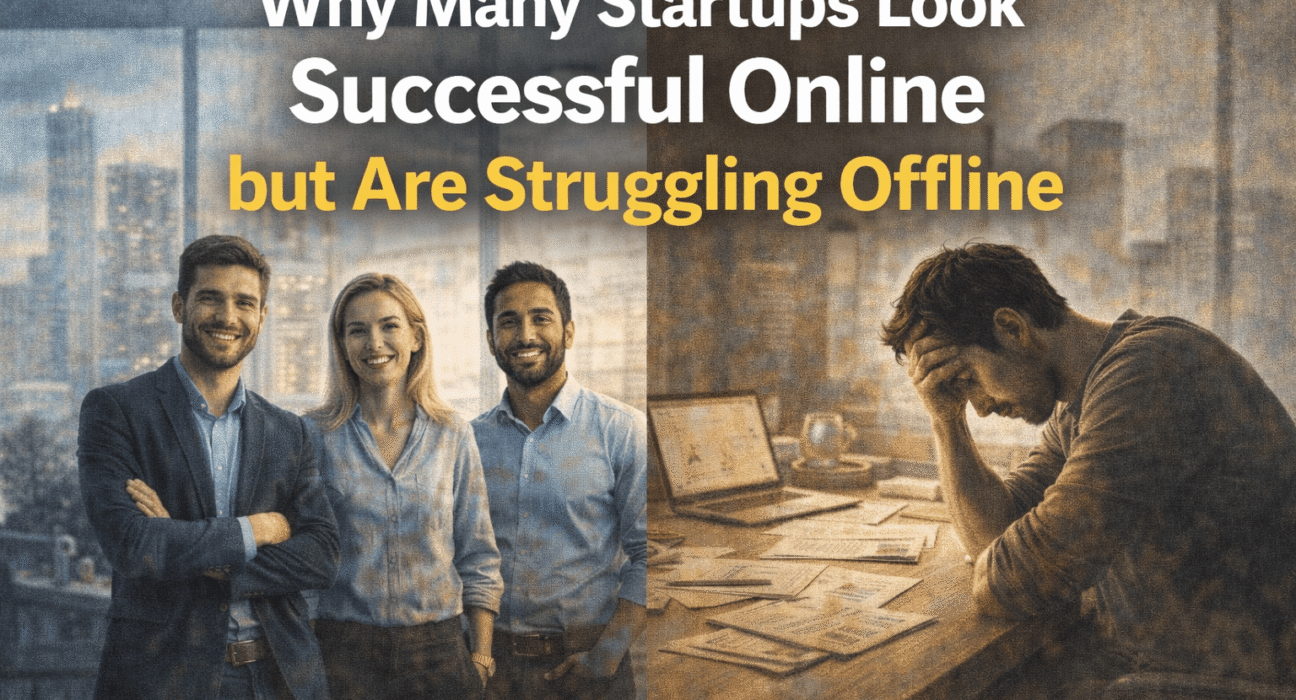
Why do so many startups appear thriving on social media while facing real struggles behind the scenes?
Because what founders post is shaped by what sociologist Erving Goffman called impression management — the deliberate curation of a “front stage” persona distinct from the messier “back stage” reality, a framework researchers have found applies directly to how professionals and companies present themselves on platforms like LinkedIn. Founders aren’t typically lying; they’re managing perception because perception has real, measurable consequences for fundraising, hiring, and customer trust. The gap becomes visible only when the back stage eventually surfaces — as it did publicly in 2025 with companies like BluSmart, whose founders projected a confident, scaling public image before a fraud case at an affiliated company forced them out entirely.
The Theory Behind the Gap, and Why It’s Not Deception
Goffman’s dramaturgical framework, developed decades before social media existed, describes everyday social interaction as a kind of performance: people act differently on a public “front stage” than they do in the private “back stage” where the real, unpolished version of events plays out. Recent academic research applying this framework to LinkedIn specifically has found professionals — and by extension, founders — actively curate their online presence to appear as polished and credible as possible, particularly early in their public visibility, when there’s little else to establish credibility beyond the image itself.
This isn’t unique to bad actors or fragile companies. It’s structural. A 2026 bibliometric review of impression management research identified strategic self-presentation and branding as one of the dominant themes in how individuals and companies now manage digital identity — the behavior is close to universal, not a red flag specific to companies actually in trouble.
Why the Incentive Is So Strong for Founders Specifically
Public confidence isn’t vanity for a founder — it’s functional. A visibly uncertain post about cash flow or missed targets doesn’t just risk embarrassment; it risks investor confidence, employee retention, and customer trust simultaneously, since all three audiences are typically watching the same public channels. That’s why founders tend to translate real difficulty into specific, softened language rather than silence or overt struggle-sharing — “restructuring” for cost cuts, “refocusing strategy” for something that didn’t work, “exploring new opportunities” for a stalled initiative. This is less deception than a learned survival dialect, shaped by watching what gets rewarded publicly and what doesn’t.
Growth and Health Are Genuinely Different Things
The core mechanism creating the online/offline gap is that visible growth signals — new funding, new logos, headcount growth — are easy to post about, while the underlying financial health of a company is not something a LinkedIn post format is built to convey. A company can be adding users while losing money on every one, closing deals that pay late, or scaling headcount faster than revenue — all fully compatible with an upward-looking public narrative, and all invisible from outside until the underlying numbers force a public reckoning.
This is precisely the story that played out across parts of India’s startup ecosystem in 2025: total funding fell to roughly $11 billion, down from $12 billion in 2024, even as some companies kept a confident public posture right up until layoffs or restructuring became unavoidable. Inc42’s Layoff Tracker recorded more than 6,700 job losses across Indian startups in 2025 — a scale of internal disruption that, in most individual cases, wasn’t matched by proportionate public acknowledgment in real time.
Where This Becomes a Real Governance Problem
Most of the online/offline gap is ordinary impression management with no larger consequence. Occasionally, it becomes something more serious. BluSmart’s founders, Anmol Singh Jaggi and Puneet Singh Jaggi, maintained a public image of a scaling, well-regarded EV mobility company before both stepped away entirely following a fraud case that emerged at an affiliated promoter firm, Gensol Engineering. That’s a useful boundary case: it illustrates that the online/offline gap exists on a spectrum, from completely normal selective self-presentation on one end, to a genuine, eventually-exposed governance failure on the other — and from outside, in real time, the two can look identical.
What Founders Who Handle This Well Actually Do
The founders whose public communication holds up best over time don’t abandon impression management entirely — that’s neither realistic nor necessary. They tend to narrow the gap rather than eliminate it: naming a real, specific reason when something goes publicly wrong (as Cars24’s CEO did, directly attributing 2025 layoffs to overhiring rather than vague “market conditions” language), and following up later with a visible, checkable outcome rather than letting the story go quiet. That pattern — specificity now, follow-through later — is what separates founders whose credibility survives a hard period from founders whose credibility erodes once the gap between the online story and the offline reality becomes visible to everyone at once.
Frequently Asked Questions
1. Is it dishonest for founders to only post positive updates about their startup?
Not necessarily. Most founders naturally highlight milestones, customer wins, and product launches on public platforms. This becomes problematic only when important information is intentionally withheld in ways that materially mislead investors, employees, customers, or other stakeholders.
2. What’s a real example of the gap between a startup’s public image and its private reality?
BluSmart became a notable example in 2025. The company’s leadership maintained a confident public image before stepping away following governance issues linked to an affiliated company. The case highlighted how differences between public perception and internal realities can become significant when transparency breaks down.
3. How can outside observers tell the difference between normal founder optimism and a company actually in trouble?
There is no single indicator, but consistent transparency is a useful signal. Startups that communicate clearly about challenges, explain strategic decisions, and follow through on commitments generally inspire greater confidence than those relying on vague messaging or repeated optimistic claims without measurable progress.
4. Why did the online/offline gap become more visible in India’s startup ecosystem in 2025?
Tighter funding conditions, increased cost-cutting, and greater investor scrutiny exposed differences between public narratives and business performance. As startups prioritized profitability and operational efficiency, financial realities became harder to separate from public branding, making transparency more important than ever.
What to Watch Next
- Whether founder communication norms shift toward more specific, less euphemistic public language, following examples like Cars24’s direct acknowledgment of overhiring
- Whether more governance failures surface following the BluSmart pattern, as investor and regulatory scrutiny of Indian startups increases ahead of continued 2026 IPO activity
- How impression management research specifically addressing founder and startup communication develops, given how much of the current academic literature focuses on individual professionals rather than company-level curation
- Whether investor diligence increasingly screens for the online/offline gap directly, treating euphemistic public communication as a diligence flag rather than accepting it at face value
Details cited above draw from academic research on impression management theory (Goffman’s dramaturgical framework) as applied to LinkedIn and digital corporate communication, Inc42’s Indian Startup Layoff Tracker 2025, and reporting on the BluSmart and Gensol Engineering case.
Summary

Article Name
Why Many Startups Look Successful Online but Are Struggling Offline
DescriptionMany startups look successful online but struggle behind the scenes. Here’s why social media optics often hide cash stress, burnout, and tough realities.
Author
Upstartzen Editorial Team
Publisher Name
Upstartzen