




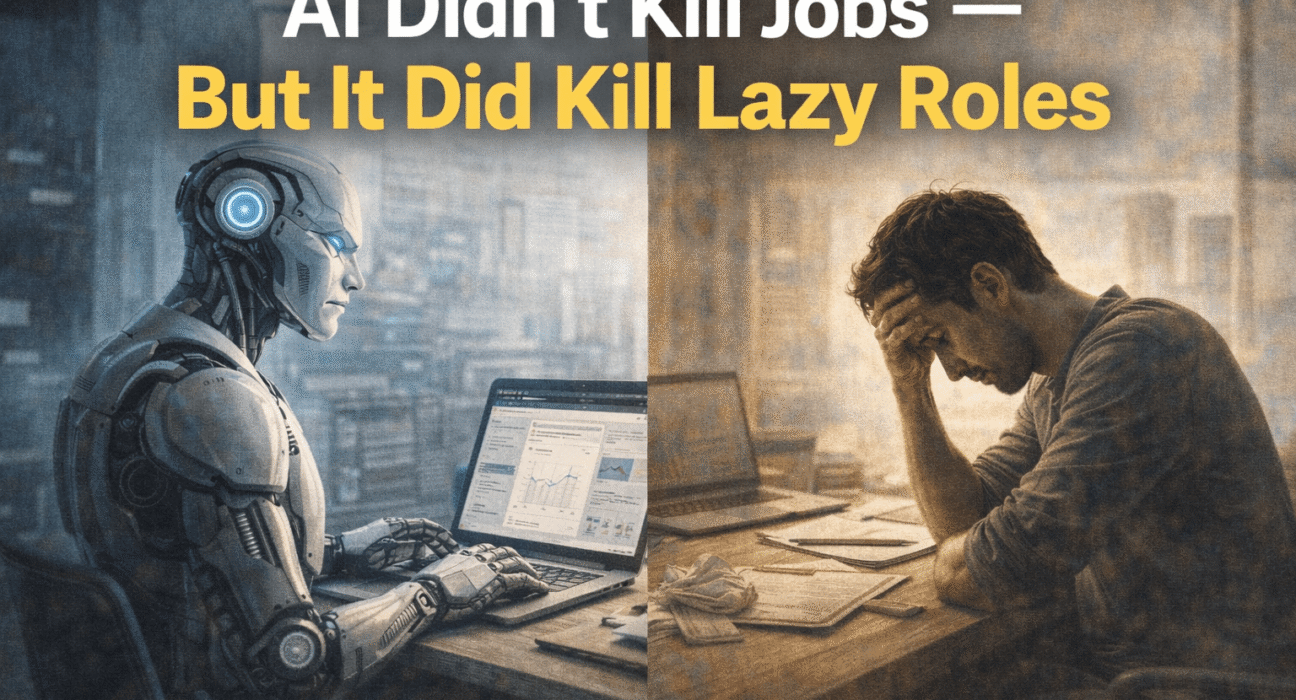
AI Didn’t Kill Jobs — But It Did Kill Lazy Roles
Which specific job tasks has AI actually automated, as opposed to entire roles?
The clearest, most consistently automated tasks are narrow and repetitive: Tier-1 customer support resets and FAQ handling, boilerplate code generation, basic data entry and invoice processing, first-draft content and email writing, and routine transaction bookkeeping. India’s BPO sector — which employs roughly 2.8 million people, about 60% in voice-based customer service — is the clearest real-world case study: Tier-1 support automation is already well underway (2024–2026), while relationship-management and complex-escalation roles within the same sector remain structurally protected. The pattern holds across functions: automation moves fastest on tasks with narrow scope and low variance, and stalls on tasks that require judgment or context.
Customer Support: The Clearest Case Study
India’s customer service industry offers the sharpest, most measurable example of task-level automation happening right now. Tier-1 queries — password resets, order status, basic FAQ handling — have reached a point where large language models perform at human-level on many of these tasks, and that automation is already well underway. Tier-2, more complex queries requiring some judgment, is following on a longer 2026–2029 timeline.
The numbers show both sides of this clearly. Startup layoffs tied partly to this shift totaled roughly 5,649 in the first nine months of 2025, and TCS alone cut more than 12,000 roles. At the same time, contact-center hiring grew roughly 7% — about 7 lakh new positions — showing routine task automation and overall sector growth happening simultaneously rather than one simply replacing the other. One specific, almost overlooked detail: accent-neutralization software, historically used by over 42,000 Indian call center agents to soften accents for Western callers, is itself now being displaced by AI voice tools that can adjust tone and accent automatically — a narrow but telling example of how specific, previously-manual sub-tasks get absorbed one at a time.
Coding: Boilerplate Goes First, Judgment Stays
In software development, the automated layer is fairly specific: generating boilerplate code, first-pass functions, basic unit tests, and routine debugging suggestions — the kind of work tools like GitHub Copilot and similar AI coding assistants now handle quickly. What hasn’t been automated is architectural decision-making, judging whether AI-generated code actually fits the system it’s being dropped into, and debugging genuinely novel problems.
The effect shows up sharply at the entry level specifically. UK junior tech job postings dropped 67% between 2023 and 2024, and separate research has found employment for developers aged 22–25 has fallen sharply since 2024 even as demand for experienced developers held steady — the automated task (writing routine code) sits disproportionately in what junior developers used to do to build experience, which is part of why the entry-level squeeze has been so pronounced globally.
Data Entry, Invoice Processing, and Routine Bookkeeping
This is among the most completely automated task categories, and among the least discussed publicly, likely because it rarely produces a dramatic headline. AI now handles a meaningful share of invoice matching, expense categorization, and routine transaction processing — tasks that used to justify early operational or junior finance hires. India’s roughly 6.7 lakh Chartered Accountants aren’t at risk here; the routine transaction-processing and standard report-generation work that used to sit underneath that role — often performed by accounting assistants and bookkeepers — is what’s facing the sharpest automation pressure.
Content and Communications: Drafting Goes First, Judgment and Distribution Stay
First-draft blog posts, ad copy, email variants, and meeting summaries are now routinely AI-generated as a starting point rather than a finished product. What hasn’t automated: deciding what’s worth writing about, editing for brand voice and accuracy, and the distribution and relationship-building work that determines whether content actually reaches anyone. The task that’s disappeared is “produce a first draft from scratch.” The tasks that remain — and have arguably gotten more valuable — are judgment, editing, and strategy.
Recruitment: Screening Automates, Deciding Doesn’t
Resume screening, keyword and skill matching, and interview scheduling are now commonly AI-assisted across Indian startups and larger companies alike. The final hiring decision — assessing cultural fit, judgment, and the qualities a resume can’t capture — has not moved to AI in any meaningful, widely-adopted way. This is a genuinely clean example of a role where a well-defined sub-task automated cleanly while the core decision-making function of the role stayed fully human.
What’s Growing Alongside What’s Shrinking
Task-level automation isn’t a one-directional story. New roles have emerged specifically to manage, audit, and extend AI systems: AI trainers, prompt engineers, LLMOps specialists, and multilingual CX specialists in the BPO context; AI Reliability Engineers and Model Evaluation Specialists more broadly, roles focused on stress-testing AI systems and checking for bias. Machine learning engineer job postings grew roughly 40% in 2025, among the fastest-growing titles in tech hiring. The International Labour Organization’s 2025 report estimated a generative AI task-exposure score of 0.29 across occupations globally — high exposure to AI-assistable tasks, but a figure well short of full automation, reflecting real limits from adoption costs, regulatory friction, and the judgment gap that persists across almost every function examined here.
The Pattern That Holds Across Every Function
Looking across customer support, coding, finance, content, and recruitment, the same shape repeats: the specific sub-task that’s narrow, repetitive, and low-variance automates first and most completely. The task that requires judging context, handling exceptions, or making a final call stays human — for now. That’s a more precise and more useful way to think about “AI and jobs” than a binary jobs-lost-versus-jobs-created framing, because it tells a specific professional exactly which part of their current role is exposed and which part isn’t.
Frequently Asked Questions
1. Which customer service tasks has AI automated in India’s BPO sector?
AI has primarily automated repetitive Tier-1 customer support tasks. These include password resets, order tracking, account verification, frequently asked questions, and other routine inquiries. More complex Tier-2 interactions that require judgment, negotiation, or problem-solving still rely heavily on human agents.
2. Are junior coding jobs disappearing because of AI?
No, but entry-level software roles are changing. AI can generate boilerplate code, automate testing, and assist with documentation, reducing demand for routine programming tasks. However, software architecture, system design, debugging, and complex problem-solving continue to require skilled developers.
3. What new AI-related jobs are being created to offset automated roles?
AI adoption is creating new specialized careers. Emerging roles include AI trainers, prompt engineers, LLMOps specialists, AI reliability engineers, model evaluation specialists, and machine learning engineers who build, monitor, and improve AI systems.
4. Is resume screening fully automated by AI now?
No. AI is widely used to screen resumes, rank candidates, and match skills with job requirements. However, final hiring decisions, interviews, cultural fit assessments, and employment offers remain predominantly human-led at most organizations.
What to Watch Next
- Whether Tier-2 customer service automation accelerates faster than the projected 2026–2029 timeline as language models continue improving on judgment-heavy queries
- Whether India’s contact-center hiring growth (currently ~7% even amid automation) continues absorbing displaced Tier-1 roles, or whether the balance shifts as automation deepens
- Whether entry-level coding roles stabilize as companies redesign junior positions around AI-output supervision rather than eliminating them outright
- How quickly new AI-oversight roles (reliability engineers, model evaluators) scale relative to the pace of task automation they’re meant to offset
Figures and examples cited above are drawn from Dheya Career Mentors’ 2026 automation risk analysis, Nucamp’s 2025 analysis of AI in Indian customer service, DesignRush’s 2026 AI in BPO report, and the International Labour Organization’s 2025 generative AI exposure report.
Summary

Article Name
AI Didn’t Kill Jobs — But It Did Kill Lazy Roles
DescriptionAI hasn’t wiped out jobs — it’s forced them to evolve. Here’s how roles are changing, what skills matter now, and how to stay relevant in 2025.
Author
Upstartzen Editorial Team
Publisher Name
Upstartzen