




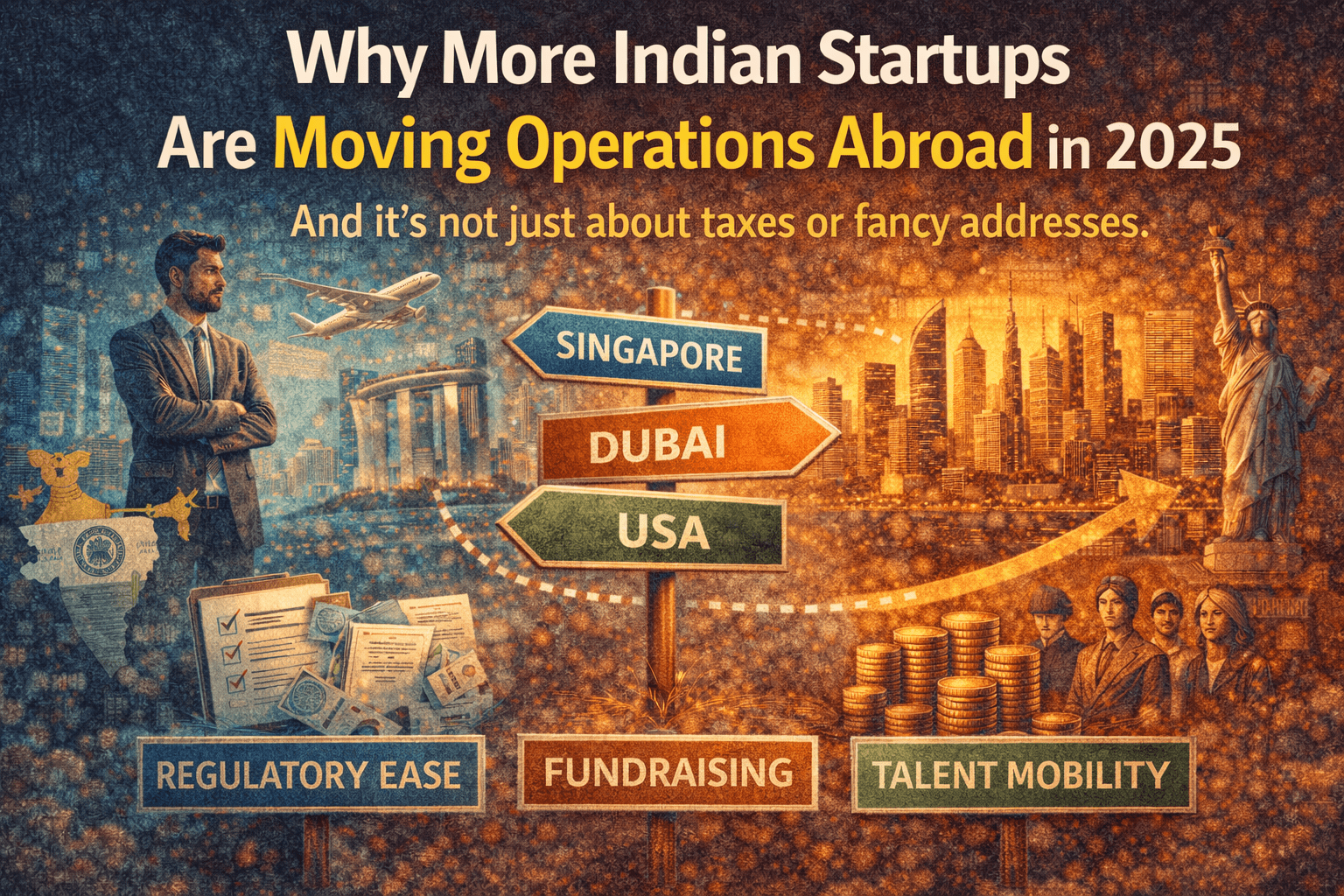
Why More Indian Startups Are Moving Operations Abroad

(And no, it’s not just about taxes or fancy global addresses.)
Let’s start with the obvious question you might already be asking yourself.
Why would a startup born in India — built here, funded here, scaled here — even think about moving operations abroad?
To be honest, a few years ago, this sounded dramatic. Almost unpatriotic, even. But today? It’s becoming… normal. Quietly normal.
Founders aren’t announcing it on LinkedIn with celebratory posts. There’s no drumroll. No emotional goodbye letters. They’re just… doing it. Registering entities overseas. Shifting holding companies. Moving IP. Opening ops teams in Singapore, Dubai, the US, or even Estonia of all places.
And before we jump to conclusions, no — this isn’t about “India bad, abroad good.” It’s more nuanced than that. Much more. Let’s unpack what’s really going on.
The shift isn’t loud — it’s strategic
What’s happening right now isn’t a mass exodus. It’s a calculated shuffle.
Founders are still building for India. Selling to Indian customers. Hiring Indian talent. But structurally? Legally? Financially? They’re choosing to anchor key parts of the business elsewhere.
Why? Because running a startup is already hard. Running it with extra friction doesn’t help.
In fact, many founders say the same thing in private conversations:
“We love the market. We’re just tired of the maze.” And yeah, that maze includes regulations, compliance overhead, uncertainty, and slower decision cycles.
Compliance fatigue is real (and it adds up)
India has made progress. No denying that. But compliance is still… heavy.
You’re dealing with multiple filings, changing rules, overlapping authorities, and interpretations that can vary based on who you’re talking to. One missed filing? Penalties. One unclear structure? More paperwork.
Compare that with jurisdictions like Singapore or Dubai, where:
- Rules are clearer
- Compliance timelines are predictable
- And you don’t need three advisors just to interpret one clause
For a founder trying to move fast (or at least not move painfully slow), that difference matters. You might be wondering — “Isn’t compliance everywhere?”
Yes. But friction isn’t equal everywhere.
Fundraising logic is changing
Here’s a big one. And founders don’t always say this publicly.
Global investors are more comfortable investing into familiar structures. Period.
A US-based fund wiring money into a Delaware entity is simple. Clean. Familiar. The paperwork? Standardized. The exit pathways? Clearer.
But when the same fund looks at an India-only structure, suddenly there are more questions:
- FEMA implications
- Exit timelines
- Secondary sale restrictions
- Regulatory uncertainty
None of this means Indian startups can’t raise money. They clearly can. But adding a foreign holding company often smooths the process.
That’s why many YC-backed or globally funded Indian startups use an overseas parent entity. It’s not a flex. It’s plumbing.
If you want to see how popular this has become, just look at data from platforms like
Tracxn – https://tracxn.com
or Inc42 – https://inc42.com
The pattern is hard to miss.
Talent mobility has changed the game
Another quiet shift? Founders themselves are more mobile now.
Remote-first teams, global customers, distributed engineering — the old “HQ must be here” rule is kind of outdated.
So when a founder is already spending time across regions, setting up a base in Singapore or the UAE doesn’t feel radical. It feels… practical.
Also, let’s be honest. Some countries make it easier to:
- Hire global talent
- Offer ESOPs cleanly
- Handle cross-border payments
And when you’re competing globally, these things aren’t “nice to have.” They’re survival tools.
Taxes aren’t the main reason (but they’re not irrelevant)
This might surprise some people.
Most founders aren’t running away purely to save taxes. In fact, many still pay significant taxes in India through operations, salaries, and GST.
But predictable tax regimes matter.
Founders prefer environments where:
- Tax rules don’t change overnight
- Interpretations are consistent
- Disputes don’t drag on forever
It’s less about paying less. More about knowing what you’re paying, and why.
Why are Indian startups moving operations abroad?
Indian startups are increasingly moving parts of their operations abroad to reduce regulatory friction, simplify fundraising, access global capital, enable talent mobility, and operate under more predictable compliance and tax frameworks — while still serving Indian markets.
This doesn’t mean India is losing its startup edge
Let’s be clear about something.
India is still one of the strongest startup markets in the world. Massive consumer base. Deep talent pool. Growing digital adoption. That’s not changing.
What is changing is how founders structure companies to survive longer and scale smarter.
Think of it like this:
India is the engine.
But some founders are choosing to build the chassis elsewhere.
Not because they want to leave.
But because they want the engine to run without overheating.
The bigger takeaway for founders
If you’re building today, this trend isn’t a mandate. It’s a signal.
A signal that:
- Structure matters more than optics
- Sustainability beats speed
- And founders are thinking long-term, not just headline growth
Some startups will stay fully India-based and thrive. Others will go global on paper and local in execution. Both paths are valid. What’s not working anymore? Blindly copying what worked in 2018.
Final thought (and a small reality check)
This isn’t about abandoning India. It’s about adapting to a global startup reality.
Founders aren’t less committed. If anything, they’re being more thoughtful. Less noise. More planning.
And honestly? That’s probably a sign of a maturing ecosystem, not a failing one. Because when founders start optimizing for clarity over chaos, you know the game has changed.
Summary
Article Name
Why More Indian Startups Are Moving Operations Abroad in 2025
DescriptionIndian startups are quietly moving operations abroad. Not for hype — but for clarity, capital, and control. Here’s what founders should know.
Author
Upstartzen Editorial Team
Publisher Name
Upstartzen


